







Question: Consider the two (excess return) index-model regression results for stocks A and B. The risk-free rate over the period was 8%, and the market's average
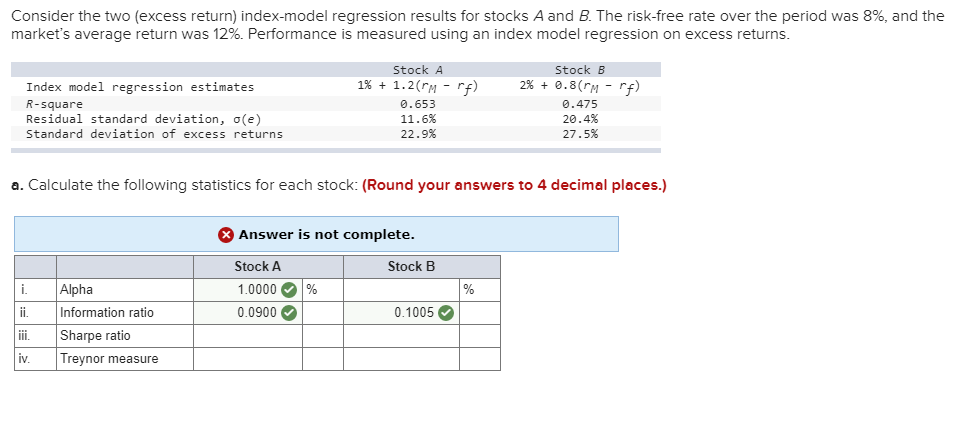
Consider the two (excess return) index-model regression results for stocks A and B. The risk-free rate over the period was 8%, and the market's average return was 12%. Performance is measured using an index model regression on excess returns. Stock A Stock B 1% + 1.2(rM - rf) 2% + 0.8(rM - rf) Index model regression estimates 0.653 11.6% 22.9% 0.475 20.4% 27.5% R-square Residual standard deviation, o(e) Standard deviation of excess returns a. Calculate the following statistics for each stock: (Round your answers to 4 decimal places.) X Answer is not complete. Stock A Stock B 1.0000 O % Alpha i. Information ratio 0.1005 O 0.0900 O i. Sharpe ratio i. iv. Treynor measure Consider the two (excess return) index-model regression results for stocks A and B. The risk-free rate over the period was 8%, and the market's average return was 12%. Performance is measured using an index model regression on excess returns. Stock A Stock B 1% + 1.2(rM - rf) 2% + 0.8(rM - rf) Index model regression estimates 0.653 11.6% 22.9% 0.475 20.4% 27.5% R-square Residual standard deviation, o(e) Standard deviation of excess returns a. Calculate the following statistics for each stock: (Round your answers to 4 decimal places.) X Answer is not complete. Stock A Stock B 1.0000 O % Alpha i. Information ratio 0.1005 O 0.0900 O i. Sharpe ratio i. iv. Treynor measure
Step by Step Solution
There are 3 Steps involved in it

Get step-by-step solutions from verified subject matter experts
 Study Help