







Question: Consider the validation results for a classification problem given below. Each class has roughly the same prevalence in the entire population. The confusion matrices match
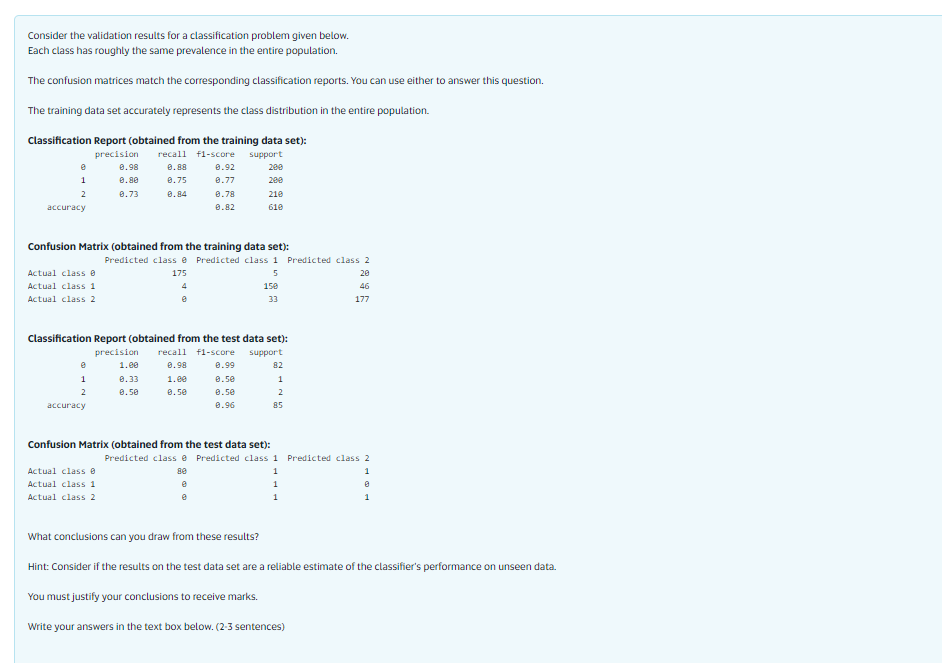
Consider the validation results for a classification problem given below. Each class has roughly the same prevalence in the entire population. The confusion matrices match the corresponding classification reports. You can use either to answer this question. The training data set accurately represents the class distribution in the entire population. Confusion Matrix (obtained from the training data set): Confusion Matrix (obtained from the test data set): What conclusions can you draw from these results? Hint: Consider if the results on the test data set are a reliable estimate of the classifier's performance on unseen data. You must justify your conclusions to receive marks. Write your answers in the text box below. ( 23 sentences) Consider the validation results for a classification problem given below. Each class has roughly the same prevalence in the entire population. The confusion matrices match the corresponding classification reports. You can use either to answer this question. The training data set accurately represents the class distribution in the entire population. Confusion Matrix (obtained from the training data set): Confusion Matrix (obtained from the test data set): What conclusions can you draw from these results? Hint: Consider if the results on the test data set are a reliable estimate of the classifier's performance on unseen data. You must justify your conclusions to receive marks. Write your answers in the text box below. ( 23 sentences)
Step by Step Solution
There are 3 Steps involved in it

Get step-by-step solutions from verified subject matter experts
 Study Help