



Question: Consider this Bayesian hierarchical model: 1% [1.03; N indep. N(1/Jj,0'32') j = 1,...,12 1% [1100an ~ iid NWOJS) j = 1,...,12 1% ~ N(0,10002) 00
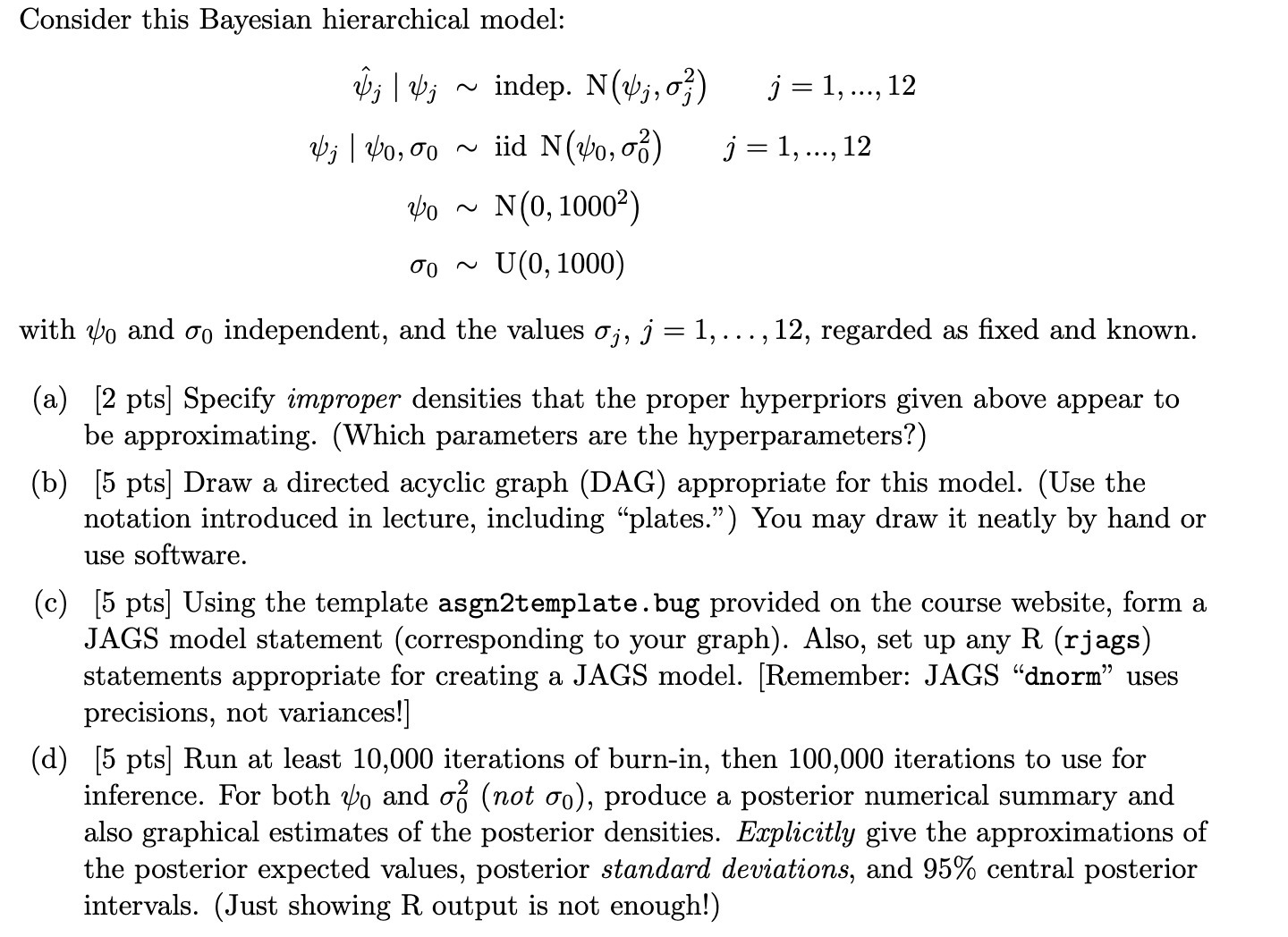
Consider this Bayesian hierarchical model: 1% [1.03; N indep. N(1/Jj,0'32') j = 1,...,12 1% [1100an ~ iid NWOJS) j = 1,...,12 1% ~ N(0,10002) 00 ~ U(0, 1000) with 1kg and 0'0 independent, and the values 03-, j = 1,. . . ,12, regarded as xed and known. (a) [2 pts] Specify improper densities that the proper hyperpriors given above appear to be approximating. (Which parameters are the hyperparameters?) (b) [5 pts] Draw a directed acyclic graph (DAG) appropriate for this model. (Use the notation introduced in lecture, including \"plates.\") You may draw it neatly by hand or use software. (0) [5 pts] Using the template asg'n2template .bug provided on the course website, form a JAGS model statement (corresponding to your graph). Also, set up any R (rj ags) statements appropriate for creating a JAGS model. [Remember JAGS \"dnorm\" uses preoisions, not variances!] (d) [5 pts] Run at least 10,000 iterations of burn-in, then 100,000 iterations to use for inference. For both 1&0 and 08 (not org), produce a posterior numerical summary and also graphical estimates of the posterior densities. Explicitly give the approximations of the posterior expected values, posterior standard deviations, and 95% central posterior intervals. (Just showing R output is not enough!)
Step by Step Solution
There are 3 Steps involved in it

Get step-by-step solutions from verified subject matter experts