







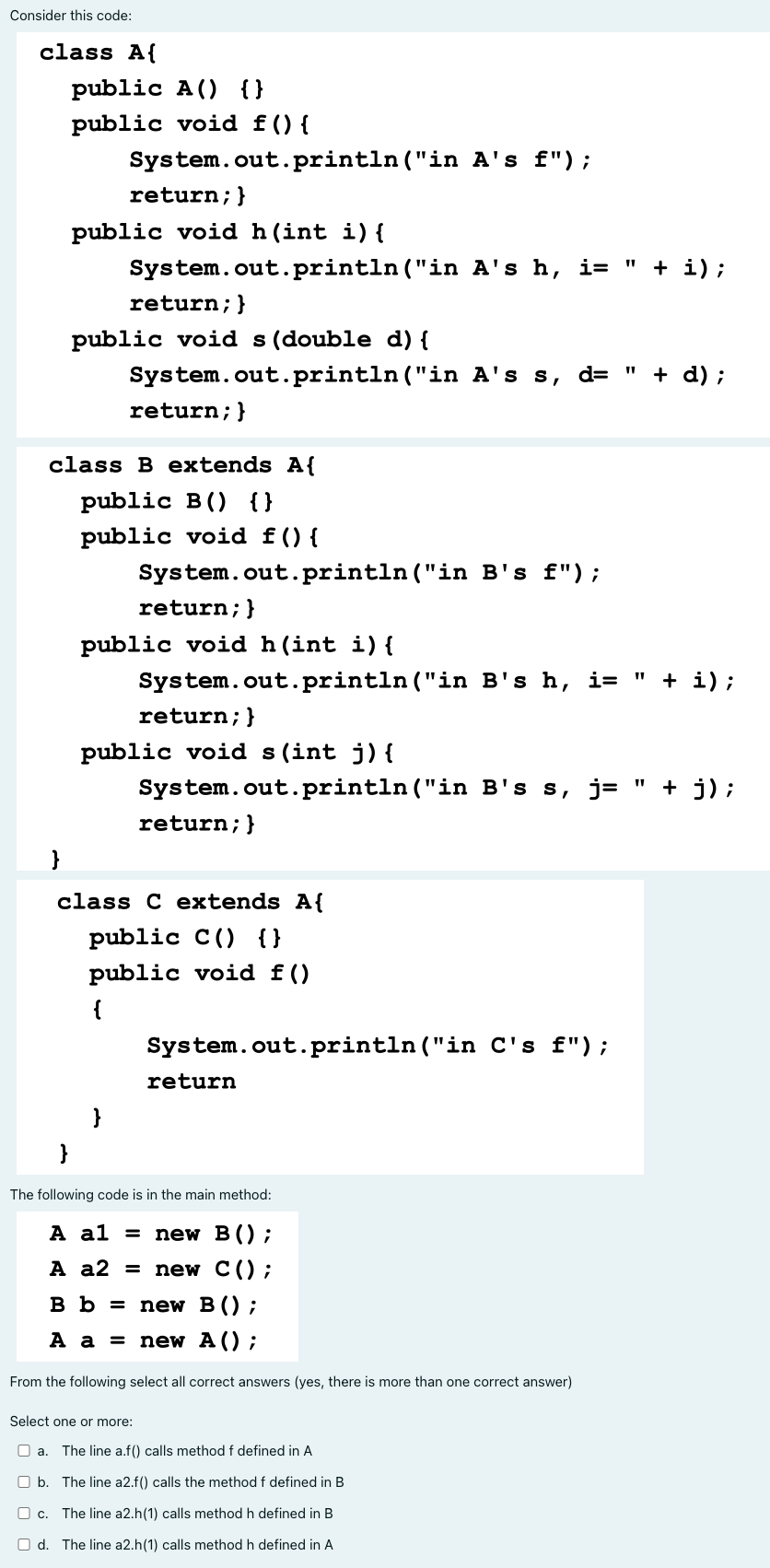
Question: Consider this code: class A { public A ( ) { } public void f ( ) { System.out.println ( in A ' s
Consider this code:
class A
public A
public void f
System.out.printlnin As f;
return;
public void hint i
System.out.printlnin As h i i;
return;
public void sdouble d
System.out.printlnin As s d d;
return;
class B extends A
public B
public void f
System.out.printlnin Bs f;
return;
public void hint i
System.out.printlnin Bs h i i;
return;
public void sint j
System.out.printlnin Bs s j j;
return;
class C extends A
public C
public void f
System.out.printlnin Cs f;
return
The following code is in the main method:
a new ;
a new ;
B b new ;
A a new ;
From the following select all correct answers yes there is more than one correct answer
Select one or more:
a The line a calls method defined in
b The line a calls the method defined in
c The line calls method defined in
d The line a calls method defined in
Step by Step Solution
There are 3 Steps involved in it
1 Expert Approved Answer
Step: 1 Unlock

Question Has Been Solved by an Expert!
Get step-by-step solutions from verified subject matter experts
Step: 2 Unlock
Step: 3 Unlock
 Study Help