







Question: Consider three processes: p1, p2, and p3, executing asynchronously the following sequence of code: P1 P2 P3 wait(y) wait(z) wait(x) wait(z) signal(y) wait(x) signal(x) signal(z)
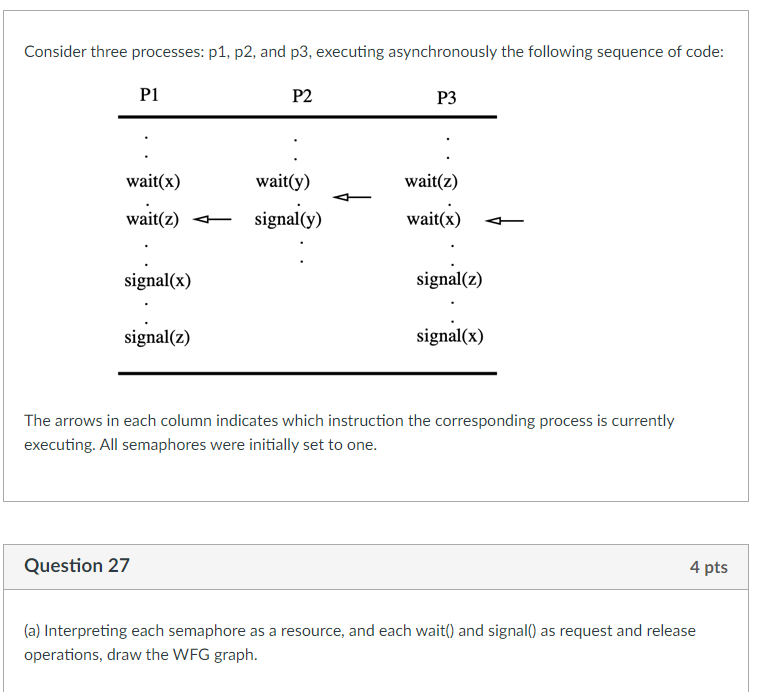

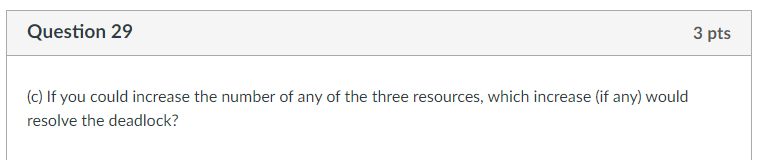
Consider three processes: p1, p2, and p3, executing asynchronously the following sequence of code: P1 P2 P3 wait(y) wait(z) wait(x) wait(z) signal(y) wait(x) signal(x) signal(z) signal(z) signal(x) The arrows in each column indicates which instruction the corresponding process is currently executing. All semaphores were initially set to one. Question 27 4 pts (a) Interpreting each semaphore as a resource, and each wait() and signal() as request and release operations, draw the WFG graph. (b) Show that there is a deadlock. Question 29 3 pts (c) If you could increase the number of any of the three resources, which increase (if any) would resolve the deadlock
Step by Step Solution
There are 3 Steps involved in it

Get step-by-step solutions from verified subject matter experts
 Study Help