







Question: Consider three real numbers a < c < b and a function f : (a, b) R such that the (n+1)-th derivative f(n+1) exists
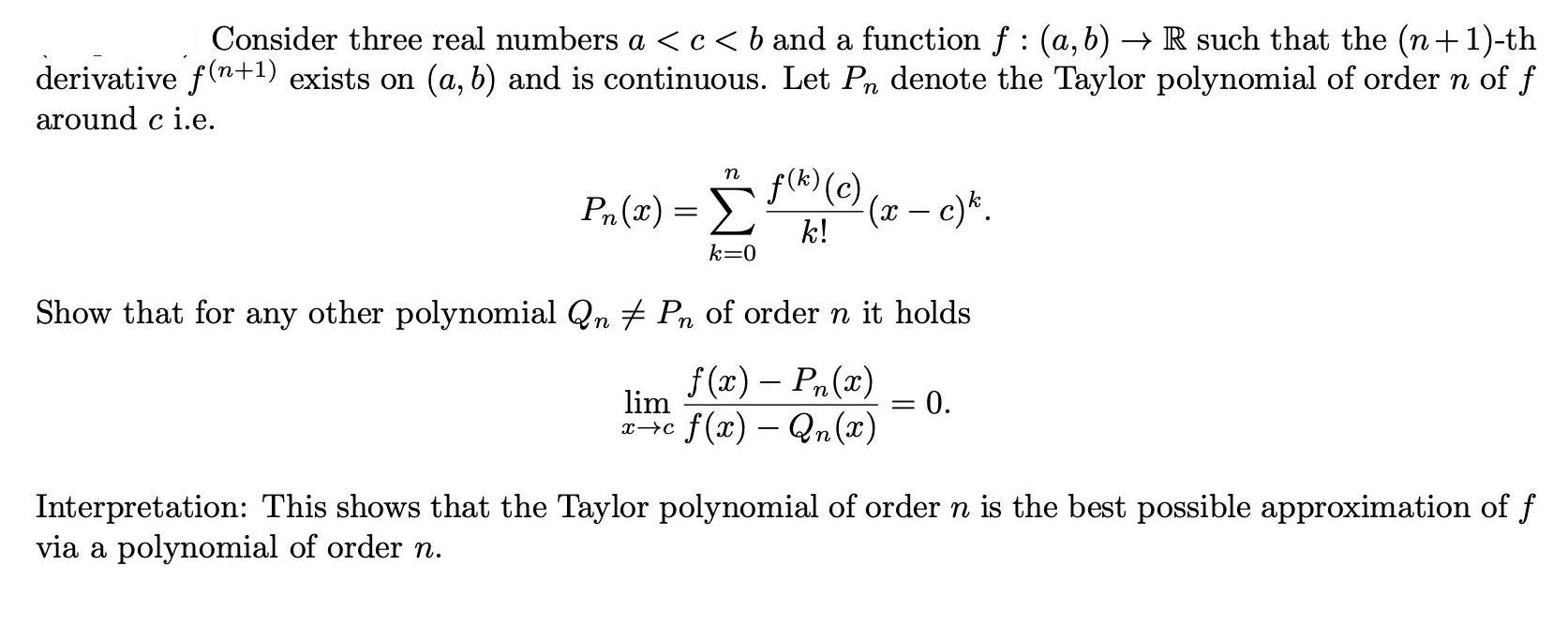
Consider three real numbers a < c < b and a function f : (a, b) R such that the (n+1)-th derivative f(n+1) exists on (a, b) and is continuous. Let P, denote the Taylor polynomial of order n of f around c i.e. n P(x) = f(k) (c) k! k=0 (x - c) k. Show that for any other polynomial Qn Pn of order n it holds f(x) - Pn(x) lim x+c f(x) - Qn (x) = = 0. Interpretation: This shows that the Taylor polynomial of order n is the best possible approximation of f via a polynomial of order n.
Step by Step Solution
3.31 Rating (151 Votes )
There are 3 Steps involved in it
To prove the given statement we need to show that lim x c fx Pxfx Qx 0 where Px is the Taylor polyno... View full answer

Get step-by-step solutions from verified subject matter experts
 Study Help