







Question: Consider three urns, one colored red, one white, and one blue. The red urn contains 1 red and 4 blue balls; the white urn
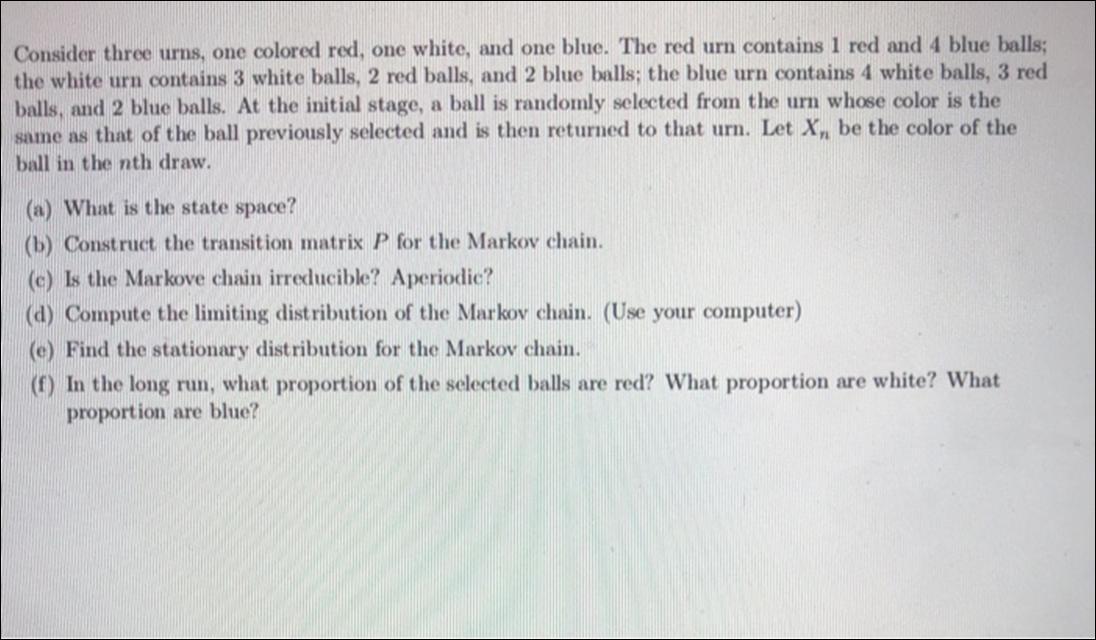
Consider three urns, one colored red, one white, and one blue. The red urn contains 1 red and 4 blue balls; the white urn contains 3 white balls, 2 red balls, and 2 blue balls; the blue urn contains 4 white balls, 3 red balls, and 2 blue balls. At the initial stage, a ball is randomly selected from the urn whose color is the same as that of the ball previously selected and is then returned to that urn. Let X, be the color of the ball in the nth draw. (a) What is the state space? (b) Construct the transition matrix P for the Markov chain. (c) Is the Markove chain irreducible? Aperiodic? (d) Compute the limiting distribution of the Markov chain. (Use your computer) (e) Find the stationary distribution for the Markov chain. (f) In the long run, what proportion of the selected balls are red? What proportion are white? What proportion are blue?
Step by Step Solution
There are 3 Steps involved in it
a The state space consists of the possible colors of the ball red white blue b The transition matrix ... View full answer

Get step-by-step solutions from verified subject matter experts
 Study Help