







Question: Consider two coils that share a common central axis, which we call the x-axis. The coils are at positions .1: = I} and .1; =
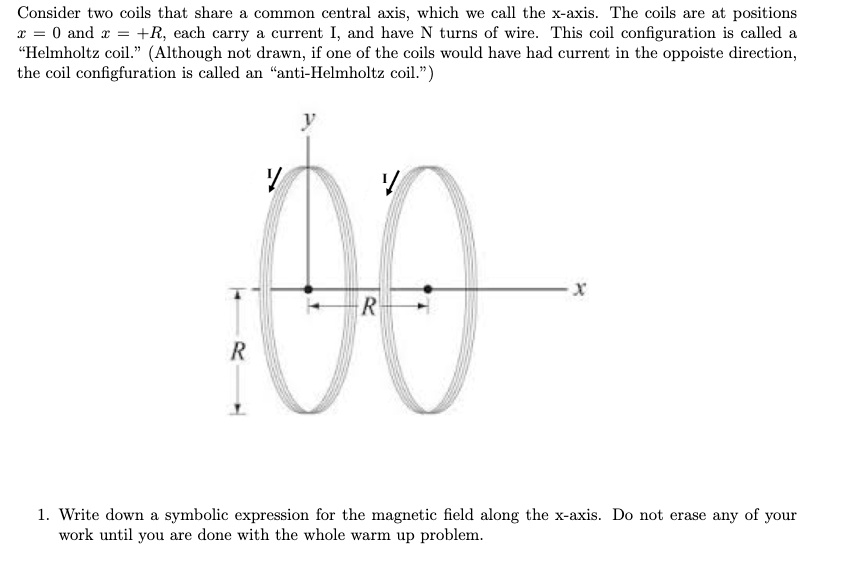
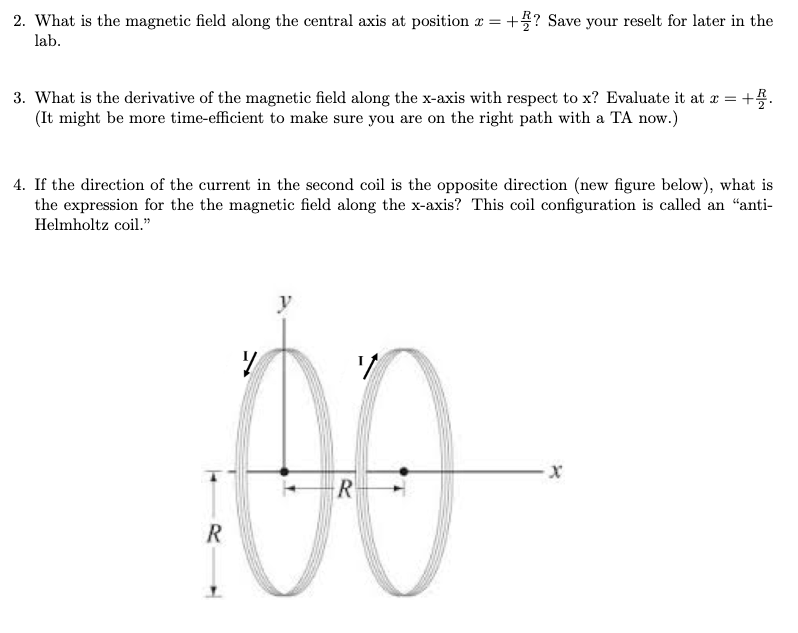
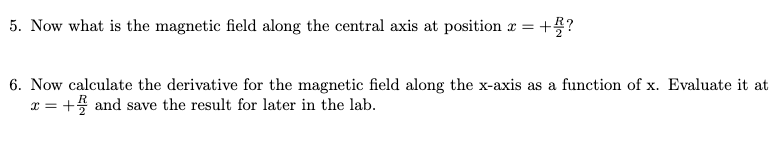
Consider two coils that share a common central axis, which we call the x-axis. The coils are at positions .1: = I} and .1; = +R, each carry a current I, and have N turns of wire. This coil conguration is called a \"Helmholtz coil.\" (Although not drawn, if one of the coils would have had current in the oppoiste direction, the coil congfuration is called an \"anti-Helmholtz coil.\") 1. Write down a symbolic expression for the magnetic eld along the xaxis. Do not erase any of your work until you are done with the whole warm up problem. 2. What is the magnetic field along the central axis at position * = + -? Save your reselt for later in the lab. 3. What is the derivative of the magnetic field along the x-axis with respect to x? Evaluate it at = = +. (It might be more time-efficient to make sure you are on the right path with a TA now.) 4. If the direction of the current in the second coil is the opposite direction (new figure below), what is the expression for the the magnetic field along the x-axis? This coil configuration is called an "anti- Helmholtz coil." X' R R5. Now what is the magnetic field along the central axis at position r = + ? 6. Now calculate the derivative for the magnetic field along the x-axis as a function of x. Evaluate it at and save the result for later in the lab
Step by Step Solution
There are 3 Steps involved in it

Get step-by-step solutions from verified subject matter experts
 Study Help