







Question: Consider two colored boxes each containing apples and oranges. Let the red box contain 2 apples and 6 oranges and the blue box contain 3
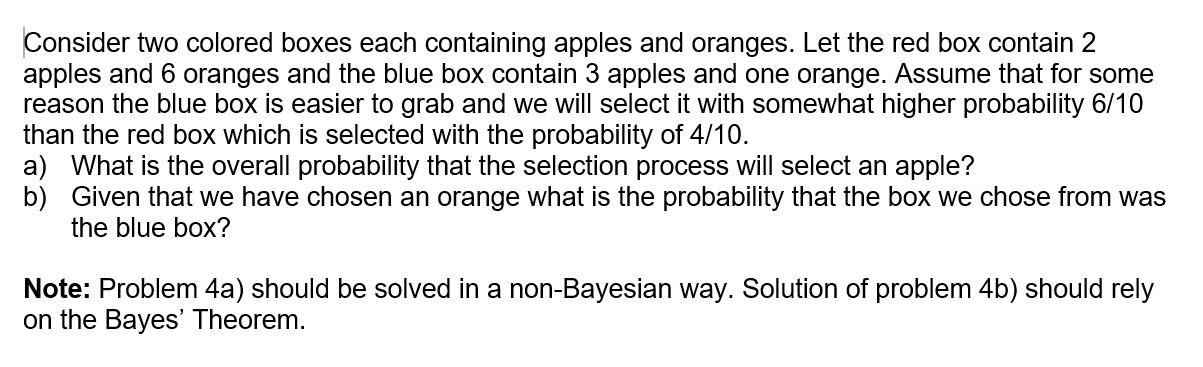
Consider two colored boxes each containing apples and oranges. Let the red box contain 2 apples and 6 oranges and the blue box contain 3 apples and one orange. Assume that for some reason the blue box is easier to grab and we will select it with somewhat higher probability 6/10 than the red box which is selected with the probability of 4/10. a) What is the overall probability that the selection process will select an apple? b) Given that we have chosen an orange what is the probability that the box we chose from was the blue box? Note: Problem 4a) should be solved in a non-Bayesian way. Solution of problem 4b) should rely on the Bayes' Theorem
Step by Step Solution
There are 3 Steps involved in it

Get step-by-step solutions from verified subject matter experts
 Study Help