







Question: Consider two different implementations, MI and M2, of the same instruction set. There are three classes of instructions (A, B, and C) in the
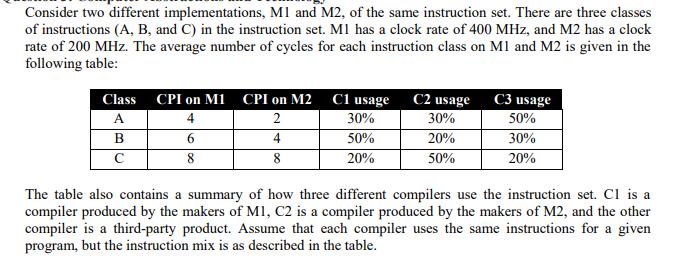

Consider two different implementations, MI and M2, of the same instruction set. There are three classes of instructions (A, B, and C) in the instruction set. MI has a clock rate of 400 MHz, and M2 has a clock rate of 200 MHz. The average number of cycles for each instruction class on M1 and M2 is given in the following table: Class CPI on M1 CPI on M2 C1 usage C2 usage C3 usage A 4 2 30% 30% 50% B 6 4 50% 20% 30% C 8 8 20% 50% 20% The table also contains a summary of how three different compilers use the instruction set. Cl is a compiler produced by the makers of MI, C2 is a compiler produced by the makers of M2, and the other compiler is a third-party product. Assume that each compiler uses the same instructions for a given program, but the instruction mix is as described in the table." a) Using Cl on both M1 and M2, how much faster can the makers of MI claim that M1 is compared with M2? b) Using C2 on both M2 and MI, how much faster can the makers of M2 claim that M2 is compared with MI? c) If you purchased the machine which compiler would you use? d) Which machine would you choose if we assumed that all other criteria are identical, including costs?
Step by Step Solution
There are 3 Steps involved in it
To determine the relative performance of M1 and M2 using different compilers we need to calculate the average execution time for each instruction class on each machine The average execution time is gi... View full answer

Get step-by-step solutions from verified subject matter experts
 Study Help