







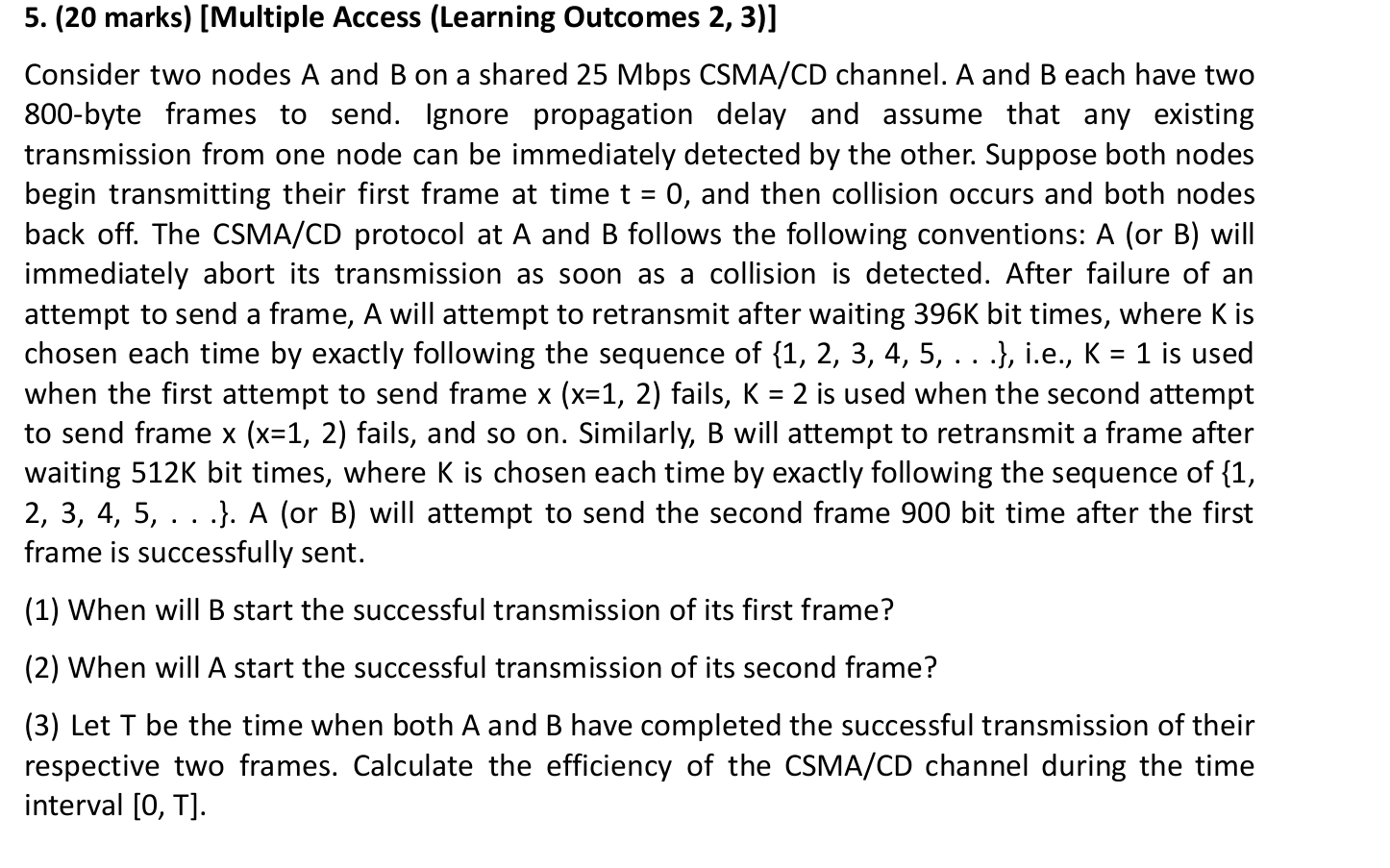
Question: Consider two nodes A and B onashared 2 5 MbpsCSMA / CDchannel . A and B each have two 8 0 0 - byte frames
Consider two nodes A and B onashared MbpsCSMACDchannel A and B each have two
byte frames to send. Ignore propagation delay and assume that any existing
transmission from one node can be immediately detected by the other. Suppose both nodes
begin transmitting their first frame at time t and then collision occurs and both nodes
back off. The CSMACD protocol at A and B follows the following conventions: A or B will
immediately abort its transmission as soon as a collision is detected. After failure of an
attempt to send a frame, A will attempt to retransmit after waiting K bit times, where K is
chosen each time by exactly following the sequence of ie K is used
when the first attempt to send frame x x fails, K is used when the second attempt
to send frame x x fails, and so on Similarly, B will attempt to retransmit a frame after
waiting K bit times, where K is chosen each time by exactly following the sequence of
A or B will attempt to send the second frame bit time after the first
frame is successfully sent.
When will B start the successful transmission of its first frame?
When will A start the successful transmission of its second frame?
Let T be the time when both A and Bhavecompleted the successful transmission of their
respective two frames. Calculate the efficiency of the CSMACD channel during the time
interval T marksMultiple Access Learning Outcomes
Consider two nodes A and on a shared CSMACD channel. A and each have two
byte frames to send. Ignore propagation delay and assume that any existing
transmission from one node can be immediately detected by the other. Suppose both nodes
begin transmitting their first frame at time and then collision occurs and both nodes
back off. The CSMACD protocol at A and B follows the following conventions: A or will
immediately abort its transmission as soon as a collision is detected. After failure of an
attempt to send a frame, A will attempt to retransmit after waiting bit times, where is
chosen each time by exactly following the sequence of ie is used
when the first attempt to send frame fails, is used when the second attempt
to send frame fails, and so on Similarly, B will attempt to retransmit a frame after
waiting bit times, where is chosen each time by exactly following the sequence of
dots. A or B will attempt to send the second frame bit time after the first
frame is successfully sent.
When will B start the successful transmission of its first frame?
When will A start the successful transmission of its second frame?
Let be the time when both A and have completed the successful transmission of their
respective two frames. Calculate the efficiency of the CSMACD channel during the time
interval
Step by Step Solution
There are 3 Steps involved in it
1 Expert Approved Answer
Step: 1 Unlock

Question Has Been Solved by an Expert!
Get step-by-step solutions from verified subject matter experts
Step: 2 Unlock
Step: 3 Unlock
 Study Help