



Question: Consider two roommates, Adam and Beethoven. Adam likes Jazz while Beethoven enjoys symphony. Both of them derive utility from the music they like but suffer
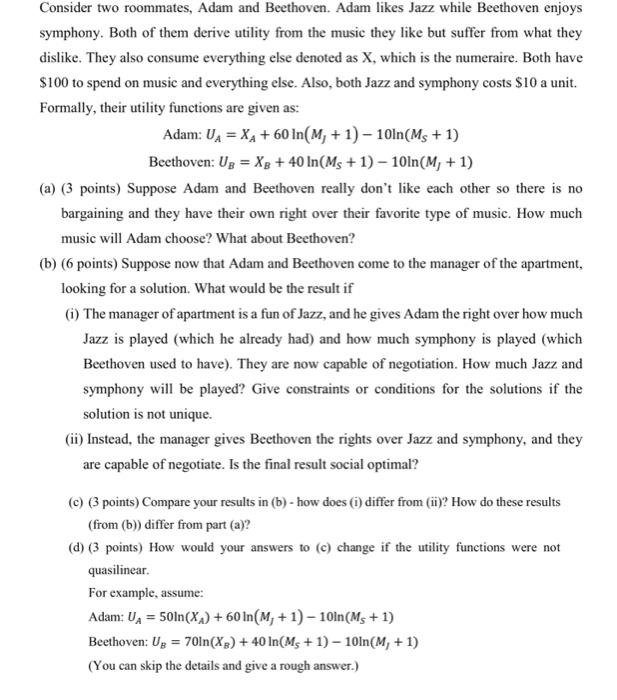
Consider two roommates, Adam and Beethoven. Adam likes Jazz while Beethoven enjoys symphony. Both of them derive utility from the music they like but suffer from what they dislike. They also consume everything else denoted as X, which is the numeraire. Both have $100 to spend on music and everything else. Also, both Jazz and symphony costs $10 a unit. Formally, their utility functions are given as: Adam:UA=XA+60ln(MJ+1)10ln(MS+1)Beethoven:UB=XB+40ln(MS+1)10ln(MJ+1) (a) (3 points) Suppose Adam and Beethoven really don't like each other so there is no bargaining and they have their own right over their favorite type of music. How much music will Adam choose? What about Beethoven? (b) (6 points) Suppose now that Adam and Beethoven come to the manager of the apartment, looking for a solution. What would be the result if (i) The manager of apartment is a fun of Jazz, and he gives Adam the right over how much Jazz is played (which he already had) and how much symphony is played (which Beethoven used to have). They are now capable of negotiation. How much Jazz and symphony will be played? Give constraints or conditions for the solutions if the solution is not unique. (ii) Instead, the manager gives Beethoven the rights over Jazz and symphony, and they are capable of negotiate. Is the final result social optimal? (c) (3 points) Compare your results in (b) - how does (i) differ from (ii)? How do these results (from (b)) differ from part (a)? (d) (3 points) How would your answers to (c) change if the utility functions were not quasilinear. For example, assume: Adam: UA=50ln(XA)+60ln(MJ+1)10ln(MS+1) Beethoven: UB=70ln(XB)+40ln(MS+1)10ln(Mf+1) (You can skip the details and give a rough answer.) Consider two roommates, Adam and Beethoven. Adam likes Jazz while Beethoven enjoys symphony. Both of them derive utility from the music they like but suffer from what they dislike. They also consume everything else denoted as X, which is the numeraire. Both have $100 to spend on music and everything else. Also, both Jazz and symphony costs $10 a unit. Formally, their utility functions are given as: Adam:UA=XA+60ln(MJ+1)10ln(MS+1)Beethoven:UB=XB+40ln(MS+1)10ln(MJ+1) (a) (3 points) Suppose Adam and Beethoven really don't like each other so there is no bargaining and they have their own right over their favorite type of music. How much music will Adam choose? What about Beethoven? (b) (6 points) Suppose now that Adam and Beethoven come to the manager of the apartment, looking for a solution. What would be the result if (i) The manager of apartment is a fun of Jazz, and he gives Adam the right over how much Jazz is played (which he already had) and how much symphony is played (which Beethoven used to have). They are now capable of negotiation. How much Jazz and symphony will be played? Give constraints or conditions for the solutions if the solution is not unique. (ii) Instead, the manager gives Beethoven the rights over Jazz and symphony, and they are capable of negotiate. Is the final result social optimal? (c) (3 points) Compare your results in (b) - how does (i) differ from (ii)? How do these results (from (b)) differ from part (a)? (d) (3 points) How would your answers to (c) change if the utility functions were not quasilinear. For example, assume: Adam: UA=50ln(XA)+60ln(MJ+1)10ln(MS+1) Beethoven: UB=70ln(XB)+40ln(MS+1)10ln(Mf+1) (You can skip the details and give a rough answer.)
Step by Step Solution
There are 3 Steps involved in it

Get step-by-step solutions from verified subject matter experts