







Question: Consider two rotating flows driven by moving boundaries. The flow is unidirectional: the flow has only one component, the (rotational) angular component: v=ve^ In Situation

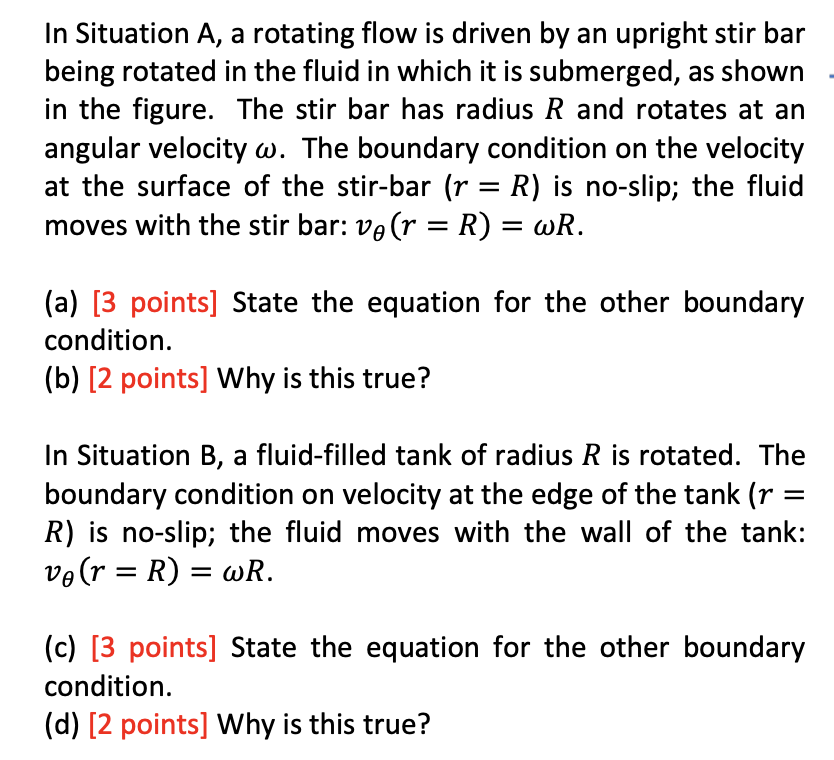
Consider two rotating flows driven by moving boundaries. The flow is unidirectional: the flow has only one component, the (rotational) angular component: v=ve^ In Situation A, a rotating flow is driven by an upright stir bar being rotated in the fluid in which it is submerged, as shown in the figure. The stir bar has radius R and rotates at an angular velocity . The boundary condition on the velocity at the surface of the stir-bar (r=R) is no-slip; the fluid moves with the stir bar: v(r=R)=R. (a) [3 points] State the equation for the other boundary condition. (b) [2 points] Why is this true? In Situation B, a fluid-filled tank of radius R is rotated. The boundary condition on velocity at the edge of the tank (r= R ) is no-slip; the fluid moves with the wall of the tank: v(r=R)=R. (c) [3 points] State the equation for the other boundary condition. (d) [2 points] Why is this true
Step by Step Solution
There are 3 Steps involved in it

Get step-by-step solutions from verified subject matter experts
 Study Help