







Question: Consider V2u = f(x), xEQC R (bounded), I Blu + B2 Vu . n = g(x), x E an, (1) with 81, B2 ER. a)
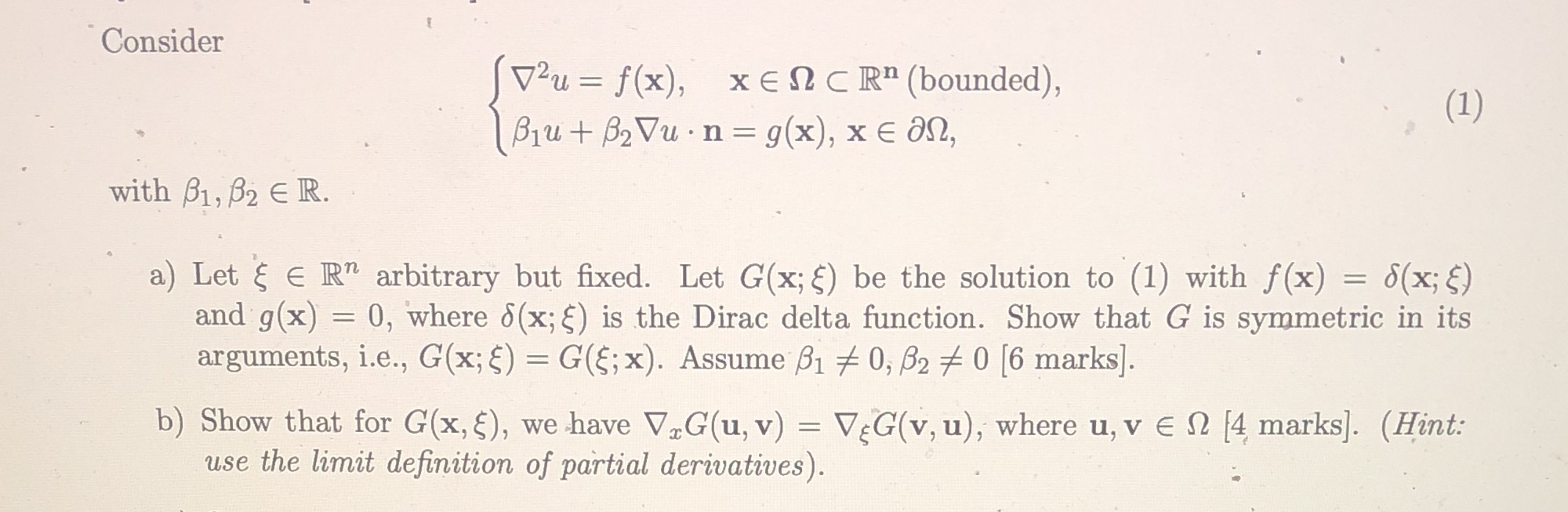
Consider V2u = f(x), xEQC R" (bounded), I Blu + B2 Vu . n = g(x), x E an, (1) with 81, B2 ER. a) Let & E Rn arbitrary but fixed. Let G(x; () be the solution to (1) with f(x) = S(x; 5) and g(x) = 0, where d(x; ) is the Dirac delta function. Show that G is symmetric in its arguments, i.e., G(x; {) = G(; x). Assume B1 / 0, B2 / 0 [6 marks]. b) Show that for G(x, {), we have VaG(u, v) = VEG(v, u), where u, v E n [4 marks]. (Hint: use the limit definition of partial derivatives)
Step by Step Solution
There are 3 Steps involved in it
1 Expert Approved Answer
Step: 1 Unlock

Question Has Been Solved by an Expert!
Get step-by-step solutions from verified subject matter experts
Step: 2 Unlock
Step: 3 Unlock
 Study Help