



Question: Constitutional Amendments The First Amendment & Business Educate yourself then teach others Background: The First Amendment: Congress shall make no law respecting an establishment of
Constitutional Amendments
The First Amendment & BusinessEducate yourself then teach others
Background:
The First Amendment: "Congress shall make no law respecting an establishment of religion, or prohibiting the free exercise thereof; or abridging the freedom of speech, or of the press; or the right of the people peaceably to assemble, and to petition the Government for a redress of grievances."
Understanding our constitutional rights and responsibilities is vitally important for all persons in the US -- including businesses. The area of First Amendment rights and freedom of speech both relate to expression and are complicated - there are many significant cases. Your focus will be limited to 1 type of First Amendment rights as they apply to businesses: commercial speech and the freedom of the press.
Speech - The U.S. Supreme Court has clarified the free speech rights of business through classification of the types of business speech. There are several types of speech that businesses commonly engage in. Businesses have the right to participate in political processes, such as creating political action committees and supporting or opposing ballot initiatives. Businesses often take positions and launch campaigns on ballot initiatives that will affect the taxes they will be required to pay.
Another important form of business speech is advertising. This is known as commercial speech. When businesses tout their products they are sometimes subject to regulations and restrictions on form, content, and placement of their marketing materials. Some of these are permitted (constitutional) and some are not (unconstitutional). The job of the courts is to balance the regulation of ads, and the right of corporations as citizens to speak.
Freedom of the Press - The Freedom of the Press is the right of news organizations and individuals to publish information and express opinions without government interference or censorship. In the United States, this freedom is protected by the First Amendment of the Constitution. This right applies to news organizations such as The New York Times, as you will learn, as well as to bloggers, indpendent journalists and even to individuals who can criticize politicians and other public figures without fear of being silenced or imprisoned.
Task:
Your focus will be on either commercial speech or the Freedom of the Press (see your "Topic Assignment" below). Students will learn when it is constitutional for the government to limit what, when or how businesses can advertize or what they can publish. You will then share what you learn with other students.
The overall issues that students will be examining are:
- When does the government have a legitimate interest in restricting advertising?
- "To accomplish this, "you will be able to explain what is meant by commercial speech;
- Learn about the signficance of the Central Hudson four-part test for determining when commercial speech can be regulated; and
- Apply it to the hypothertical case assigned to you.
OR
- When does the government have a legitimate and substantial interest in restricting the Freedom of the Press, particularly when reporting on public figures and public officials, and what legal standards must be met to justify such restrictions while balancing the public's right to know?
- you will examine who is protected by the Freedom of the Press; and
- Learn why the Pentagon Papers case is so important.
Deliverables:
Examine each of the sources I have provided below - you must incorporate them into your summary. If you wish, you can do additional research.
You will then prepare a 5-6 page written summary (single or double-space is OK), answering all of my questions. This summary will be well organized and written professionally - by you. It will touch on key points and help you prepare for class. It is not meant to be an academic paper, but rather a business summary designed for readers who need you to get to the point.
As such, you will be become familiar with the regulation of commercial speech and the broad principles of the Freedom of the Press. To make this easier for you, I put together resources that will help you complete this assignment.
- Introduce commercial speech and summarize the Central Hudson decision, focusing on the Supreme Court's development of the four-part test for commercial speech regulation.
- General understanding of the regulation of commercial speech in the US.
- Key facts of the Central Hudson case.
- Clearly explain each of the four steps in the test and how the Supreme Court applied them to the facts:
- Is the speech protected by the First Amendment? (Does it concern lawful activity and is it not misleading?)
- Is the asserted government interest substantial?
- Does the regulation directly advance the governmental interest?
- Is the regulation more extensive than necessary to serve that interest?
- What did the Supreme Court decide. Why?
- What were the conflicting interests that the Supreme Court tried to balance in this case?
- Go to Freedom Forum link (see below) -- choose 1 case where commercial speech restrictions were upheld and 1 where they were rejected. Do you agree with the Supreme Court's decisions in these cases.
Find the hypothetical that corresponds to your section and Working Group. Apply the 4-part test. So that you don't miss anything, restate each question in the 4-part test and provide an answer to each. For example:
Resources:
Commercial Speech
- Review:Commercial SpeechLinks to an external site., FreedomForum.org
- Read: Central Hudson v. Public Service Commission of N.Y. Download Central Hudson v. Public Service Commission of N.Y. 447 U.S. 557 (1980)
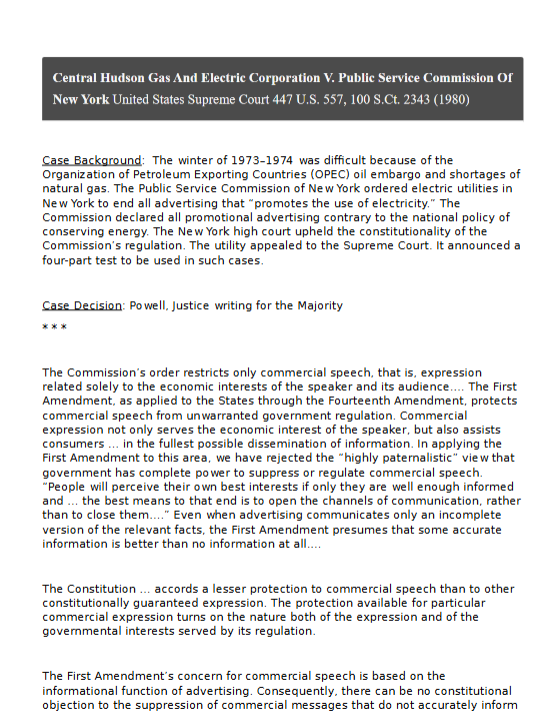
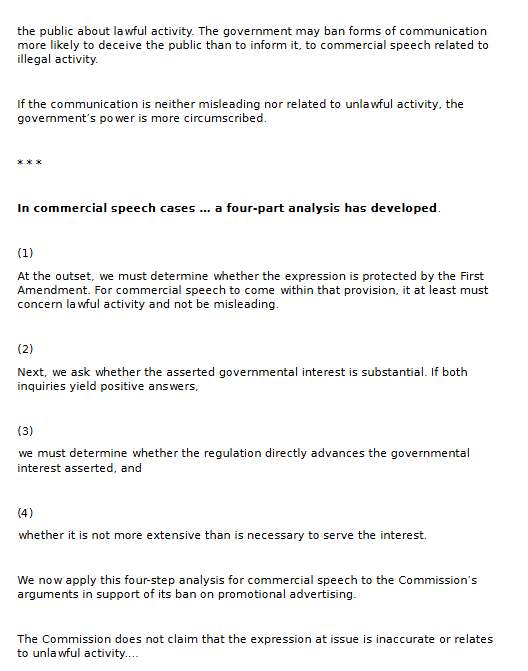
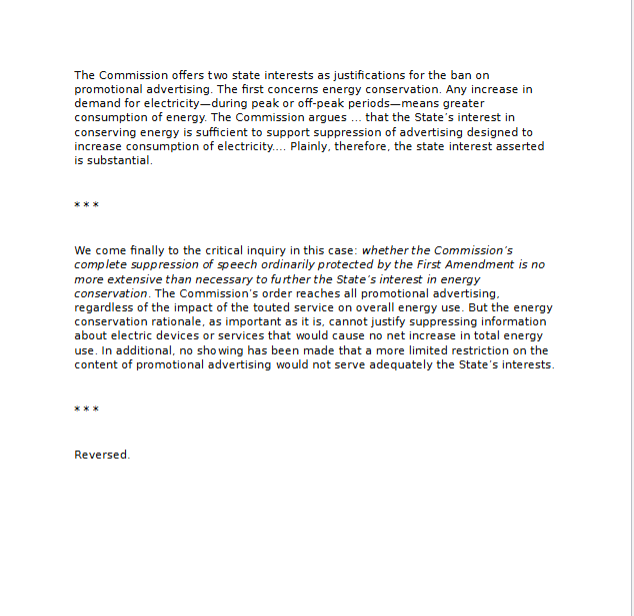
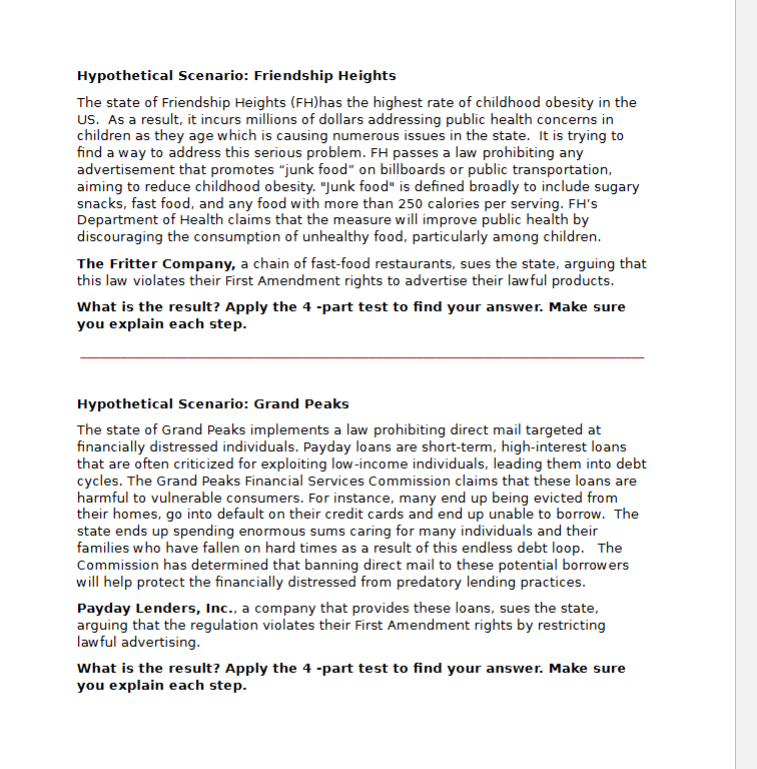
Central Hudson Gas And Electric Corporation V. Public Service Commission Of New York United States Supreme Court 447 U.S. 557, 100 8.Ct. 2343 (1980) Case Background: The winter of 1973-1974 was difficult because of the Organization of Petroleum Exporting Countries (OPEC) oil embargo and shortages of natural gas. The Public Service Commission of Mew York ordered electric utilities in Mew York to end all advertising that \"promotes the use of electricity.\" The Commission declared all promotional advertising contrary to the national policy of conserving energy. The New Yark high court upheld the constitutionality of the Commission's regulation. The utility appealed to the Supreme Court. It announced a four-part test to be used in such cases. Case Decision: Powell, Justice writing for the Majarity K The Commissien''s order restricts only commercial speech, that is, expression related solely to the economic interests of the speaker and Its audience.... The First Amendment, as applied to the States through the Fourteenth Amendment, protects commercial speech from unwarranted government regulation. Commercial expression not only serves the econemic interest of the speaker, but also assists consumers ... in the fullest possible dissemination of information. In applying the First Amendment to this area, we have rejected the \"highly paternalistic\" view that govermnment has complete power to suppress or regulate commercial speech. \"People will perceive their own best interests if only they are well enough informed and ... the best means to that end is to open the channels of communication, rather than to close them....\" Even when advertising communicates anly an incomplete version of the relevant facts, the First Amendment presumes that some accurate infarmation is better than no information at all.... The Constitution ... accords a lesser protection to commercial speech than to other constitutionally guaranteed expression. The protection available for particular commercial expression turns on the nature both of the expression and of the govemmental interests served by its regulation. The First Amendment's concern for commercial speech is based on the informational function of advertising. Conseguently. there can be no constitutional objection to the suppression of commercial messages that do not accurately inform the public about lawful activity. The government may ban forms of communication more likely to deceive the public than to inform it. to commercial speech related to illegal activity. If the communication is neither misleading nor related to unlawful activity, the government's power is more circumscribed. E In commercial speech cases ... a four-part analysis has developed. (1) At the outset, we must determine whether the expression is protected by the First Amendment. For commercial speech to come within that provision. it at least must concern lawful activity and not he misleading. (2} Mext, we ask whether the asserted governmental interest is substantial. If both inquiries yield positive answers, (3] we must determine whether the regulation directly advances the governmental interest asserted, and 4) whether it is not more extensive than is necessary to serve the interest. We now apply this four-step analysis for commercial speech to the Commission's arguments in support of its han on promotional advertising. The Commission does not claim that the expression at issue is inaccurate or relates to unlawful activity.... The Commission offers two state interests as justifications for the ban on promotional advertising. The first concerns energy conservation. Any increase in demand for electricityduring peak or off-peak periodsmeans greater consumption of energy. The Commission argues ... that the State's interest in conserving energy is sufficient to support suppression of advertising designed to increase consumption of electricity.... Plainly, therefore, the state interest asserted is substantial. N K We come finally to the critical inguiry in this case: whether the Commission's complete suppression of speech ordinarily protected by the First Amendment is no mare extensive than necessary to further the State's interest in energy conservation, The Commission's order reaches all promotional advertising, regardless of the impact of the touted service on overall energy use. But the enargy conservation rationale, as important as it is, cannot justify suppressing Information about electric devices or services that would cause no net increase in total energy use, In additienal, no showing has been made that a more limited restriction on the content of promational advertising would not serve adequately the State's interests. Reversed. Hypothetical Scenario: Friendship Heights The state of Friendship Heights (FH)has the highest rate of childhood obesity in the US. As a result, it incurs millions of dollars addressing public health concerns in children as they age which is causing numerous issues in the state. It is trying to find a way to address this serious problem. FH passes a law prohibiting any advertisement that promotes \"junk food\" on billboards or public transportation, aiming to reduce childhood obesity. "Junk food" is defined broadly to include sugary snacks, fast food, and any food with more than 250 calories per serving. FH's Department of Health claims that the measure will improve public health by discouraging the consumption of unhealthy food, particularly among children. The Fritter Company, a chain of fast-food restaurants, sues the state, arguing that this law violates their First Amendment rights to advertise their lawful products. What is the result? Apply the 4 -part test to find your answer. Make sure you explain each step. Hypothetical Scenario: Grand Peaks The state of Grand Peaks implements a law prohibiting direct mail targeted at financially distressed individuals. Payday loans are short-term, high-interest loans that are often criticized for exploiting low-income individuals, leading them into debt cycles. The Grand Peaks Financial Services Commission claims that these loans are harmful to vulnerable consumers. For instance, many end up being evicted from their homes, go into default on their credit cards and end up unable to borrow. The state ends up spending enormous sums caring for many individuals and their families who have fallen on hard times as a result of this endless debt loop. The Commission has determined that banning direct mail to these potential borrowers will help protect the financially distressed from predatory lending practices. Payday Lenders, Inc., a company that provides these loans, sues the state, arguing that the regulation violates their First Amendment rights by restricting lawful advertising. What is the result? Apply the 4 -part test to find your answer. Make sure you explain each step
Step by Step Solution
There are 3 Steps involved in it

Get step-by-step solutions from verified subject matter experts