







Question: Constrained Optimization: One Internal Binding Constraint Patz Company produces two types of machine parts: Part A and Part B, with unit contribution margins of $100
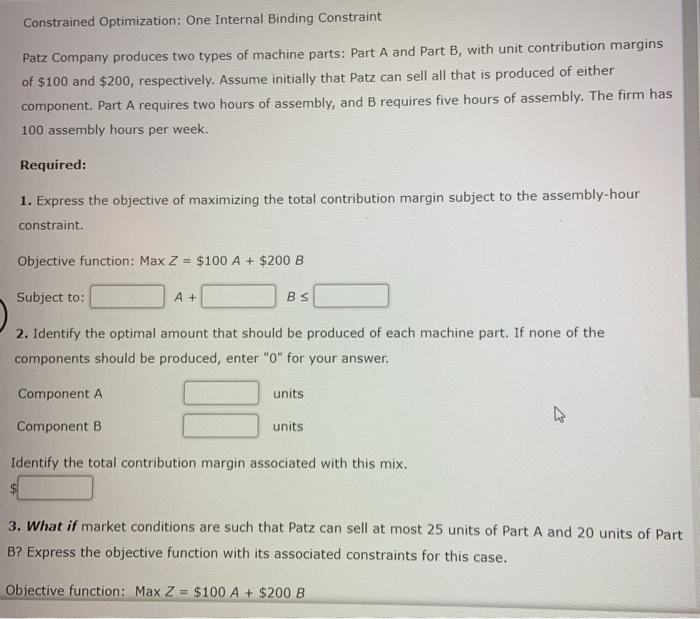
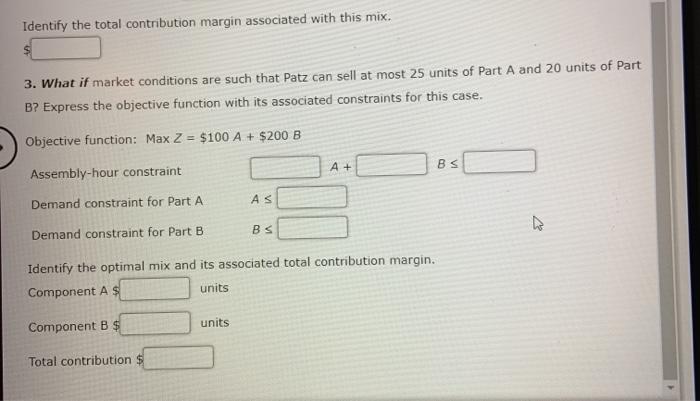
Constrained Optimization: One Internal Binding Constraint Patz Company produces two types of machine parts: Part A and Part B, with unit contribution margins of $100 and $200, respectively. Assume initially that Patz can sell all that is produced of either component. Part A requires two hours of assembly, and B requires five hours of assembly. The firm has 100 assembly hours per week. Required: 1. Express the objective of maximizing the total contribution margin subject to the assembly-hour constraint. Objective function: Max Z = $100 A + $200 B Subject to: A + BS 2. Identify the optimal amount that should be produced of each machine part. If none of the components should be produced, enter "0" for your answer. Component A units Component B units Identify the total contribution margin associated with this mix. 3. What if market conditions are such that Patz can sell at most 25 units of Part A and 20 units of Part B? Express the objective function with its associated constraints for this case. Objective function: Max Z = $100 A + $200 B Identify the total contribution margin associated with this mix. 3. What if market conditions are such that Patz can sell at most 25 units of Part A and 20 units of Part B? Express the objective function with its associated constraints for this case. Objective function: Max Z = $100 A + $200 B A+ BS Assembly-hour constraint AS Demand constraint for Part A BS Demand constraint for Part B Identify the optimal mix and its associated total contribution margin. Component AS units Component B $ units Total contribution $
Step by Step Solution
There are 3 Steps involved in it

Get step-by-step solutions from verified subject matter experts
 Study Help