







Question: Construct a pro-forma income statement, balance sheet, and cash flow statement for fiscal year 2018 for Lowe's. Note that fiscal year 2018 will end on
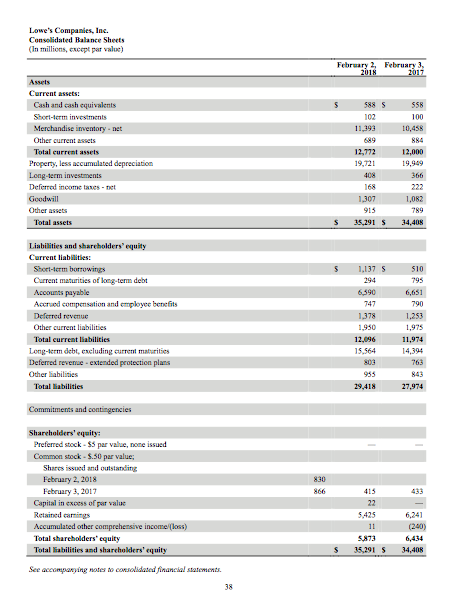
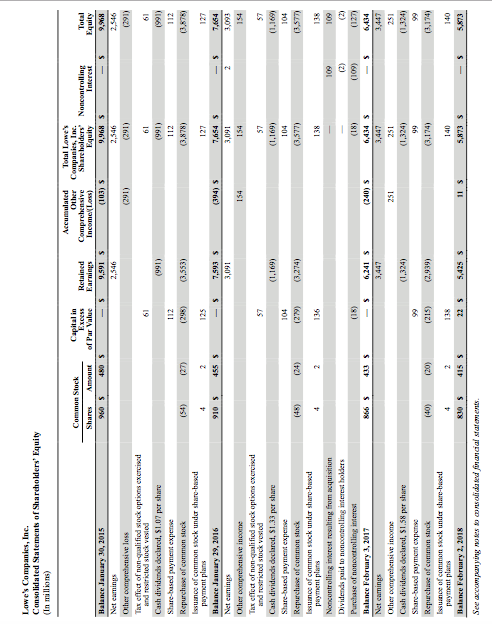
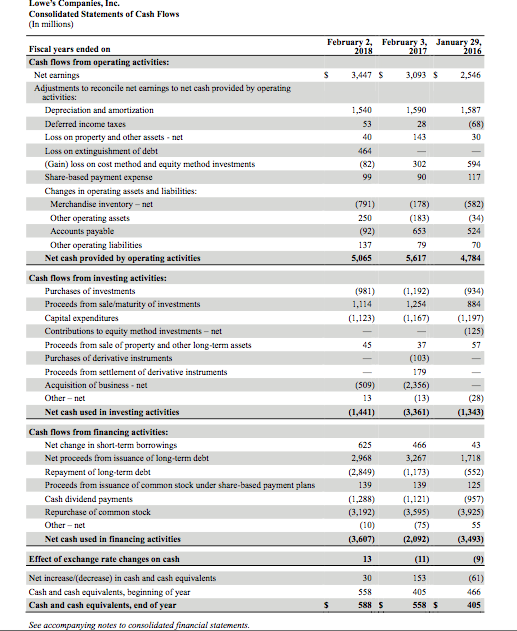
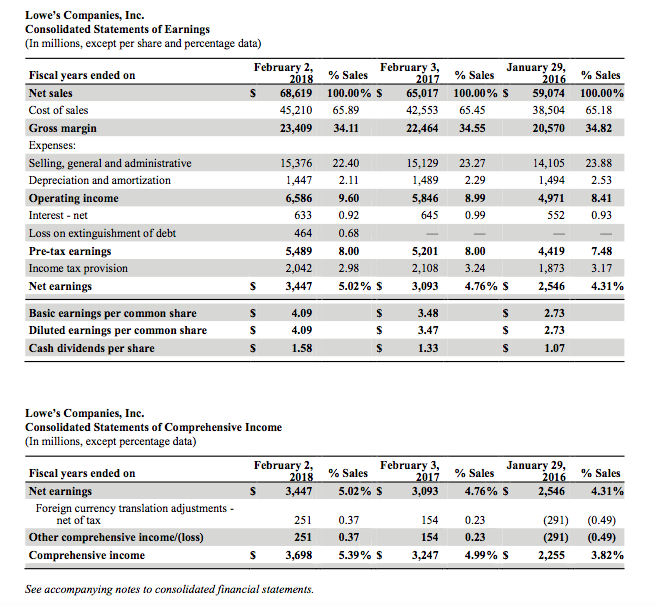
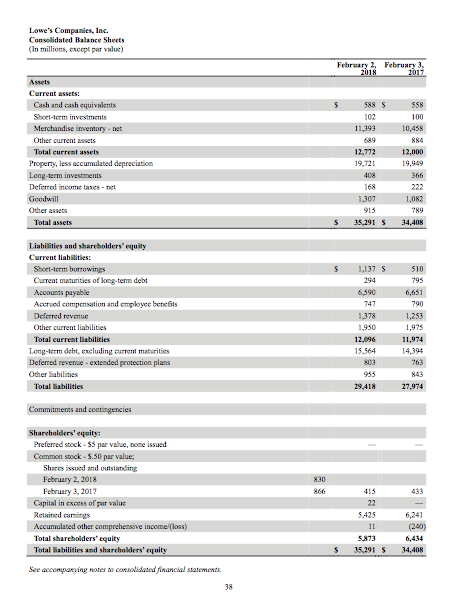
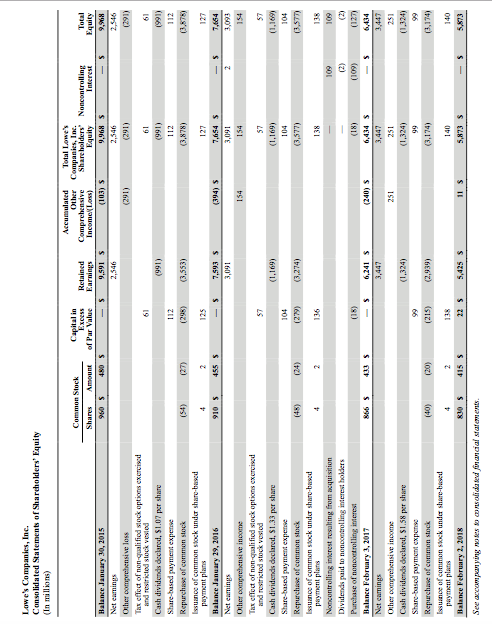
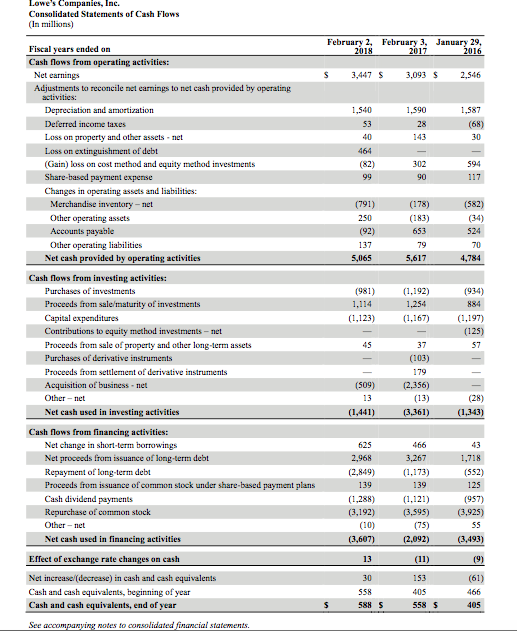
Construct a pro-forma income statement, balance sheet, and cash flow statement for fiscal year 2018 for Lowe's. Note that fiscal year 2018 will end on February 1, 2019 and last 52 weeks. Fiscal 2017 also lasted 52 years, while fiscal year 2016 lasted 53 weeks (basing accounting on weeks is common in American retail). First, a list of assumptions is provided and then an outline for the three statements is given. Your answer must follow the outline while filling in all missing numbers. Remember to write supporting calculations or references (to line items found elsewhere) to the side (this is required to receive any credit). All numbers should be rounded to the nearest $ million.
Assumptions for FY 2018 (YOY means year over year change from FY 2017)
Net sales will grow the same rate YOY as in FY 2017. Note that you must adjust the growth rate to account for difference in FY lengths.
The gross margin percentage is expected to increase by 1% from its FY 2017 level due to less intense competition (e.g., a 20% GMP in 2017 would imply a 21% GMP in 2018).
SG&A expense is expected to grow 5% YOY.
Depreciation and amortization is expected to be the same percentage of average property as in FY 2017 (use the D&A given in the income statement, not the cash flow statement).
Net interest is expected to be 4% of the average balance of debt.
There are no expected losses.
The effective tax rate in FY 2018 will be Federal (21%) plus average state tax (assumed to be the same state tax rate as in FY 2017 while other adjustments to the effective tax rate are assumed to be 0). See the footnotes for the information necessary when working this part. (page 60-61 in the Lowe's 2017 Annual Report)
Cash and equivalents will rise 2% YOY.
Short-term investments will decline 10% YOY.
Inventories will be the same percentage of cost of sales as in FY 2017.
Other current assets, long-term investments, deferred income taxes, and other assets will stay constant at FY 2017 levels. They can be combined into a single line item called other assets of $3,487 million
Capital expenditures will be $1.2 billion.
Combine all debt accounts (three of them). The capital structure will stay constant in FY 2018 (i.e. the ratio of total debt to total equity).
Accounts payable will be the same percentage of cost of sales as in FY 2017.
Deferred revenue will be the same percentage of sales as in FY 2016 adjusted for the difference in fiscal year length (the 2017 deferred revenue is historically high so we don't want to use it as a benchmark).
Deferred revenue - extended protection plans will be the same percentage of sales as in FY 2017.
All other liabilities can be combined and will stay constant at $3,652 million.
Layouts for the financial pro-formas
Income statementFY ended February 1, 2019 (in $ million)
Net sales
Cost of sales
____________________________________
Gross margin
SG&A
Depreciation and amortization
Net interest expense
Pre-tax income
Income tax expense
Net income
Balance sheetFebruary 1, 2019 (in $ million)
Cash and equivalents
Short-term investments
Inventory
Property
Other assets3,487
Total assets35,630
Accounts payable
Deferred revenue
Deferred revenue - extended plans
Other operating liabilities3,652
Debt
Total liabilities
Shareholders' equity
Total liabilities plus equity35,630
Cash flow statementFY ended February 1, 2019 (in $ million)
Net income
Depreciation and amortization
Changes in:
Inventory
Accounts payable
Deferred revenue
Deferred revenue - ext. plans
Cash from operations
Capital expenditure(1,200)
Change in short-term investments
Cash for investments
Net borrowings
Dividends
Cash used by financing
Net increase in cash
Lowe's Annual Report: http://phx.corporate-ir.net/phoenix.zhtml?c=95223&p=irol-reportsannual
Step by Step Solution
There are 3 Steps involved in it

Get step-by-step solutions from verified subject matter experts
 Study Help