







Question: Consumer a has utility function u. (21, 12) = 2712 and endowment (w., wa (2, 3). Consumer b has utility function us(21, 12) = 21
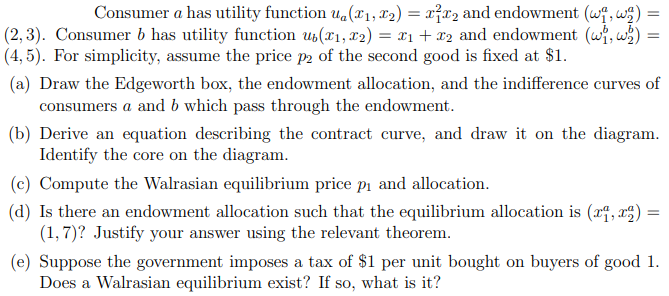
Consumer a has utility function u. (21, 12) = 2712 and endowment (w., wa (2, 3). Consumer b has utility function us(21, 12) = 21 + 12 and endowment (wj, w2) (4, 5). For simplicity, assume the price p2 of the second good is fixed at $1. (a) Draw the Edgeworth box, the endowment allocation, and the indifference curves of consumers a and o which pass through the endowment. (b) Derive an equation describing the contract curve, and draw it on the diagram. Identify the core on the diagram. (c) Compute the Walrasian equilibrium price p, and allocation. (d) Is there an endowment allocation such that the equilibrium allocation is (21, 2;) = (1, 7)? Justify your answer using the relevant theorem. (e) Suppose the government imposes a tax of $1 per unit bought on buyers of good 1. Does a Walrasian equilibrium exist? If so, what is it
Step by Step Solution
There are 3 Steps involved in it

Get step-by-step solutions from verified subject matter experts
 Study Help