







Question: Context: This is a transnational data set which contains all the transactions occurring between 01/12/2010 and 09/12/2011 for a UK-based and registered non-store online retail.
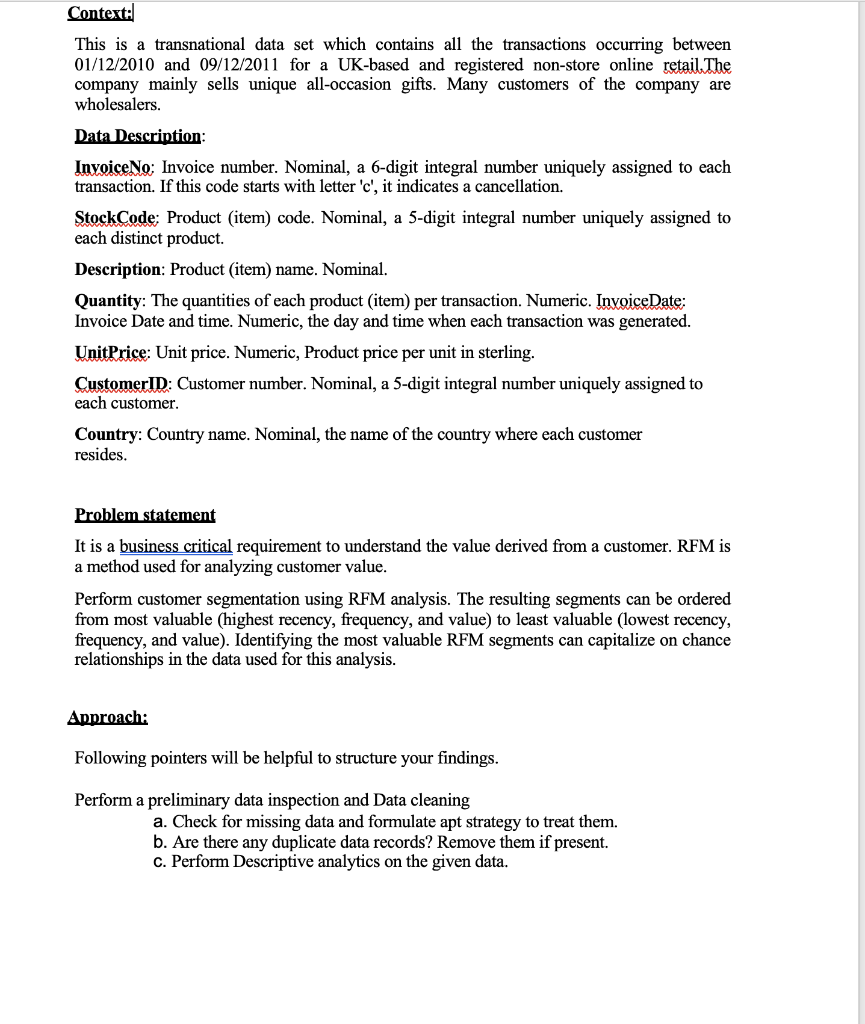
Context: This is a transnational data set which contains all the transactions occurring between 01/12/2010 and 09/12/2011 for a UK-based and registered non-store online retail. The company mainly sells unique all-occasion gifts. Many customers of the company are wholesalers. Data Description: InvoiceNo; Invoice number. Nominal, a 6-digit integral number uniquely assigned to each transaction. If this code starts with letter 'c', it indicates a cancellation. StockCode: Product (item) code. Nominal, a 5-digit integral number uniquely assigned to each distinct product. Description: Product (item) name. Nominal. Quantity: The quantities of each product (item) per transaction. Numeric. InvoiceDate: Invoice Date and time. Numeric, the day and time when each transaction was generated. UnitPrice: Unit price. Numeric, Product price per unit in sterling. CustomerID: Customer number. Nominal, a 5-digit integral number uniquely assigned to each customer Country: Country name. Nominal, the name of the country where each customer resides. Problem statement It is a business critical requirement to understand the value derived from a customer. RFM is a method used for analyzing customer value. Perform customer segmentation using RFM analysis. The resulting segments can be ordered from most valuable (highest recency, frequency, and value) to least valuable (lowest recency, frequency, and value). Identifying the most valuable RFM segments can capitalize on chance relationships in the data used for this analysis. Approach: Following pointers will be helpful to structure your findings. Perform a preliminary data inspection and Data cleaning a. Check for missing data and formulate apt strategy to treat them. b. Are there any duplicate data records? Remove them if present. c. Perform Descriptive analytics on the given data. Context: This is a transnational data set which contains all the transactions occurring between 01/12/2010 and 09/12/2011 for a UK-based and registered non-store online retail. The company mainly sells unique all-occasion gifts. Many customers of the company are wholesalers. Data Description: InvoiceNo; Invoice number. Nominal, a 6-digit integral number uniquely assigned to each transaction. If this code starts with letter 'c', it indicates a cancellation. StockCode: Product (item) code. Nominal, a 5-digit integral number uniquely assigned to each distinct product. Description: Product (item) name. Nominal. Quantity: The quantities of each product (item) per transaction. Numeric. InvoiceDate: Invoice Date and time. Numeric, the day and time when each transaction was generated. UnitPrice: Unit price. Numeric, Product price per unit in sterling. CustomerID: Customer number. Nominal, a 5-digit integral number uniquely assigned to each customer Country: Country name. Nominal, the name of the country where each customer resides. Problem statement It is a business critical requirement to understand the value derived from a customer. RFM is a method used for analyzing customer value. Perform customer segmentation using RFM analysis. The resulting segments can be ordered from most valuable (highest recency, frequency, and value) to least valuable (lowest recency, frequency, and value). Identifying the most valuable RFM segments can capitalize on chance relationships in the data used for this analysis. Approach: Following pointers will be helpful to structure your findings. Perform a preliminary data inspection and Data cleaning a. Check for missing data and formulate apt strategy to treat them. b. Are there any duplicate data records? Remove them if present. c. Perform Descriptive analytics on the given data
Step by Step Solution
There are 3 Steps involved in it

Get step-by-step solutions from verified subject matter experts
 Study Help