







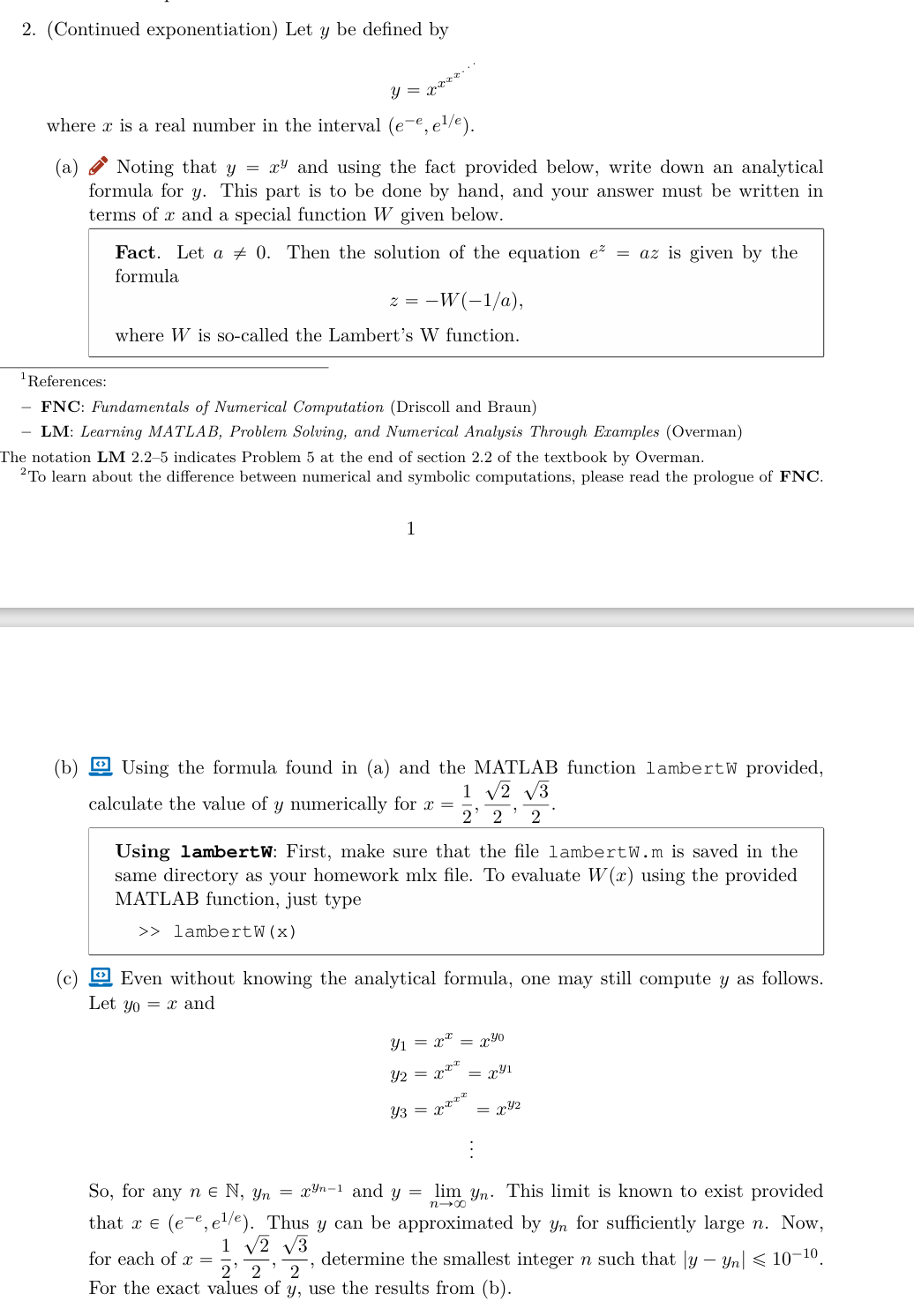
Question: ( Continued exponentiation ) Let y be defined by y = x x x x 2 where x is a real number in the interval
Continued exponentiation Let be defined by
where is a real number in the interval
a Noting that and using the fact provided below, write down an analytical
formula for This part is to be done by hand, and your answer must be written in
terms of and a special function given below.
Fact. Let Then the solution of the equation is given by the
formula
where is socalled the Lambert's function.
References:
FNC: Fundamentals of Numerical Computation Driscoll and Braun
LM: Learning MATLAB, Problem Solving, and Numerical Analysis Through Examples Overman
The notation LM indicates Problem at the end of section of the textbook by Overman.
To learn about the difference between numerical and symbolic computations, please read the prologue of FNC
b Using the formula found in a and the MATLAB function lambertW provided,
calculate the value of numerically for
Using lambertW: First, make sure that the file lambertW.m is saved in the
same directory as your homework mlx file. To evaluate using the provided
MATLAB function, just type
lambertWx
c Even without knowing the analytical formula, one may still compute as follows.
Let and
vdots
So for any ninN, and This limit is known to exist provided
that xin Thus can be approximated by for sufficiently large Now,
for each of determine the smallest integer such that
For the exact values of use the results from b
lambertW function :
y lambertWx
y zerossizex;
for i :numelx
yi fzero@y xiyexpy;
end
end
Step by Step Solution
There are 3 Steps involved in it
1 Expert Approved Answer
Step: 1 Unlock

Question Has Been Solved by an Expert!
Get step-by-step solutions from verified subject matter experts
Step: 2 Unlock
Step: 3 Unlock
 Study Help