Question: Contracts in Manufacturing/Management eClass, a software company, has entered into a contract with Total Fabricator, Inc. (TFI), a manufacturing company, to duplicate, package, and label
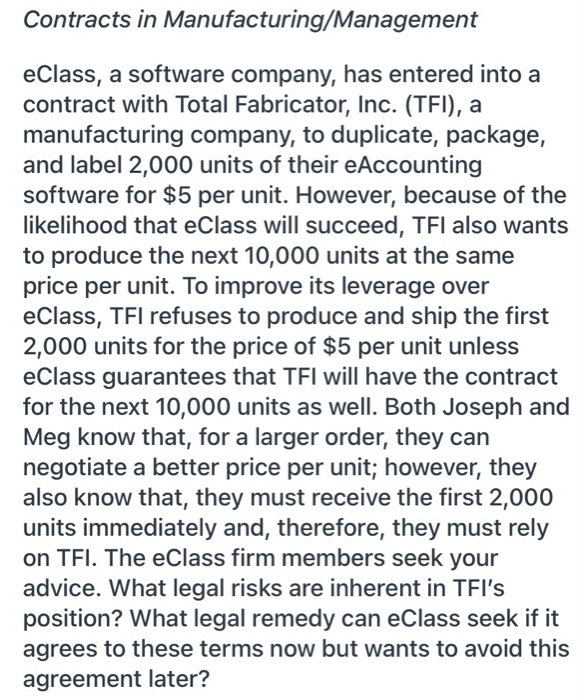
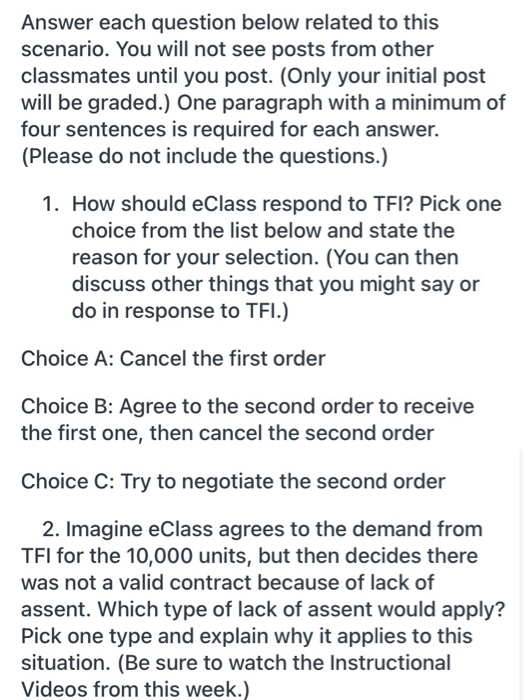
Contracts in Manufacturing/Management eClass, a software company, has entered into a contract with Total Fabricator, Inc. (TFI), a manufacturing company, to duplicate, package, and label 2,000 units of their eAccounting software for $5 per unit. However, because of the likelihood that eClass will succeed, TFI also wants to produce the next 10,000 units at the same price per unit. To improve its leverage over eClass, Til refuses to produce and ship the first 2,000 units for the price of $5 per unit unless eClass guarantees that TFI will have the contract for the next 10,000 units as well. Both Joseph and Meg know that, for a larger order, they can negotiate a better price per unit; however, they also know that, they must receive the first 2,000 units immediately and, therefore, they must rely on TFl. The eClass firm members seek your advice. What legal risks are inherent in TFI's position? What legal remedy can eClass seek if it agrees to these terms now but wants to avoid this agreement later? Answer each question below related to this scenario. You will not see posts from other classmates until you post. (Only your initial post will be graded.) One paragraph with a minimum of four sentences is required for each answer. (Please do not include the questions.) 1. How should eClass respond to TFI? Pick one choice from the list below and state the reason for your selection. (You can then discuss other things that you might say or do in response to TFI.) Choice A: Cancel the first order Choice B: Agree to the second order to receive the first one, then cancel the second order Choice C: Try to negotiate the second order 2. Imagine eClass agrees to the demand from Til for the 10,000 units, but then decides there was not a valid contract because of lack of assent. Which type of lack of assent would apply? Pick one type and explain why it applies to this situation. (Be sure to watch the Instructional Videos from this week.)