







Question: Controlling for other available factors, is there a significant difference between bike usage on working days versus non-working days? Write down the formal null and
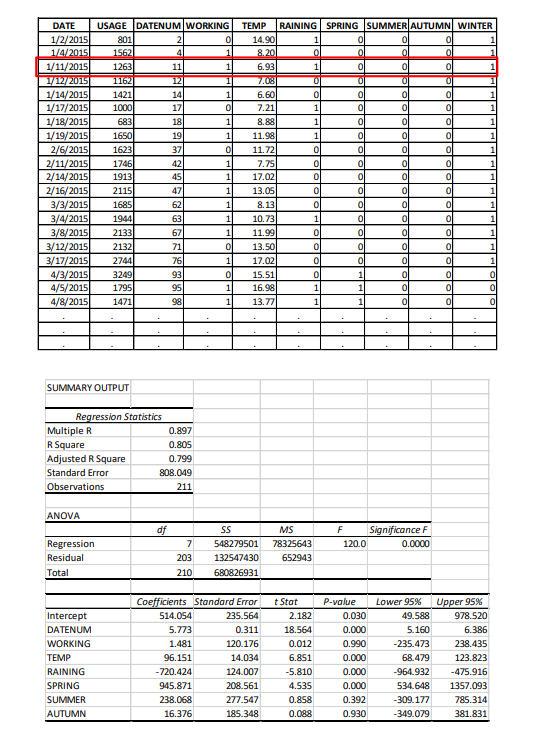
Controlling for other available factors, is there a significant difference between bike usage on working days versus non-working days? Write down the formal null and alternative hypotheses appropriate for this question, indicate the test statistic and prob-value for the test, and reach your conclusion at the 5% significance level.
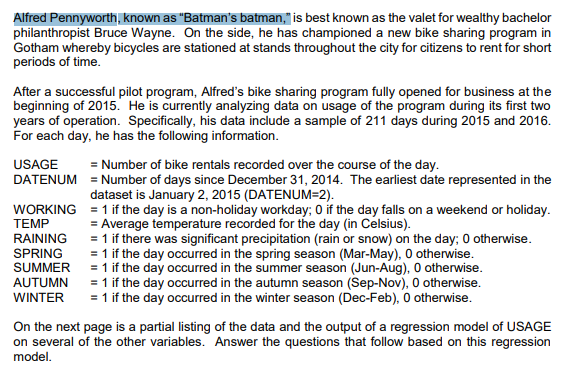
Alfred Pennyworth, known as "Batman's batman," is best known as the valet for wealthy bachelor philanthropist Bruce Wayne. On the side, he has championed a new bike sharing program in Gotham whereby bicycles are stationed at stands throughout the city for citizens to rent for short periods of time. After a successful pilot program, Alfred's bike sharing program fully opened for business at the beginning of 2015. He is currently analyzing data on usage of the program during its first two years of operation. Specifically, his data include a sample of 211 days during 2015 and 2016. For each day, he has the following information. USAGE = Number of bike rentals recorded over the course of the day. DATENUM = Number of days since December 31, 2014. The earliest date represented in the dataset is January 2, 2015 (DATENUM=2). WORKING = 1 if the day is a non-holiday workday; O if the day falls on a weekend or holiday. TEMP = Average temperature recorded for the day in Celsius). RAINING = 1 if there was significant precipitation (rain or snow) on the day; 0 otherwise. SPRING = 1 if the day occurred in the spring season (Mar-May), 0 otherwise. SUMMER = 1 if the day occurred in the summer season (Jun-Aug), 0 otherwise. AUTUMN = 1 if the day occurred in the autumn season (Sep-Nov), 0 otherwise. WINTER = 1 if the day occurred in the winter season (Dec-Feb), 0 otherwise. On the next page is a partial listing of the data and the output of a regression model of USAGE on several of the other variables. Answer the questions that follow based on this regression model. DATE 1/2/2015 1/4/2015 1/11/2015 1/12/20151 1/14/2015 1/17/2015 1/18/2015 1/19/2015 2/6/2015 2/11/2015 2/14/2015 2/16/2015 3/3/2015 3/4/2015 3/8/2015 3/12/2015 3/17/2015 4/3/2015 4/5/2015 4/8/2015 USAGE DATENUM WORKING 801 2 0 0 1562 4 11 1263 11 1 1102 12 1 1421 14 1 1000 17 0 683 18 1 1650 19 1 1623 37 0 1746 42 1 1913 45 1 2115 47 1 1685 62 1 1944 63 1 2133 67 1 2132 71 0 2744 76 1 3249 93 0 1795 95 1 1471 98 1 TEMP RAINING SPRING SUMMER AUTUMN WINTER 14.90 1 0 0 0 8.201 0 0 0 ol 6.93 1 0 0 o 1 0 0 01 0 1 6.60 0 0 0 ol 1 7.21 1 0 0 0 1 8.88 1 0 0 0 1 11.98 1 0 0 0 1 11.72 0 0 0 0 1 7.75 0 0 0 0 1 17.02 0 0 0 0 13.05 0 0 0 0 1 8.13 0 0 0 0 1 10.73 1 0 0 0 1 11.99 0 0 0 0 1 13.50 0 0 0 o 17.02 0 0 0 0 1 15.51 0 1 0 ol 0 16.981 1 1 0 0 0 13.77 1 1 0 0 0 SUMMARY OUTPUT Regression Statistics Multiple R 0.897 R Square 0.805 Adjusted R Square 0.799 Standard Error 808.049 Observations 211 ANOVA df F Significance 120.0 0.0000 7 Regression Residual Total SS 548279501 132547430 680826931 MS 78325643 652943 203 210 Intercept DATENUM WORKING TEMP RAINING SPRING SUMMER AUTUMN Coefficients Standard Error 514.054 235.564 5.773 0.311 1.481 120.176 96.151 14.034 -720.424 124.007 945.871 208.561 238.068 277.547 16.376 185.348 t Stat 2.182 18.564 0.012 6.851 -5.810 4.535 0.858 0.088 P-value 0.030 0.000 0.990 0.000 0.000 0.000 0.392 0.930 Lower 95% Upper 95% 49.588 978.520 5.160 6.386 -235.473 238.435 68.479 123.823 -964.932 -475.916 534.648 1357.093 -309.177 785.314 -349.079 381.831Step by Step Solution
There are 3 Steps involved in it
1 Expert Approved Answer
Step: 1 Unlock

Question Has Been Solved by an Expert!
Get step-by-step solutions from verified subject matter experts
Step: 2 Unlock
Step: 3 Unlock
 Study Help