







Question: Convert numbers given in one base to its equivalent numbers in a different base. Translate word statement and / or Boolean function to equivalent truth
Convert numbers given in one base to its equivalent numbers in a different base.
Translate word statement andor Boolean function to equivalent truth table.
Deriveminimize SOP or POS form of logic functions.
Realize Boolean logic given in either minterm or maxterm form using NANDonly or NORonly circuits.
Determine outputs of combinational circuits that may include one or more of the following MSI's MUX, decoder, and adders.
Assemble full adders, multibit adderssubtracters half adders, and MUX to addsubtract multibit numbers.
Redesign given multilevel logic circuit to reduce either the number of logic gates or propagation delay or both.
Interpret behavior of a given sequential circuit Mealy or Moore either in terms of state diagram or PSNS table.
Design synchronous sequential circuits including counters from given word statement.
Develop primitive flow table and, in turn, merged flow table from given word statement related to asynchronous sequential circuits.
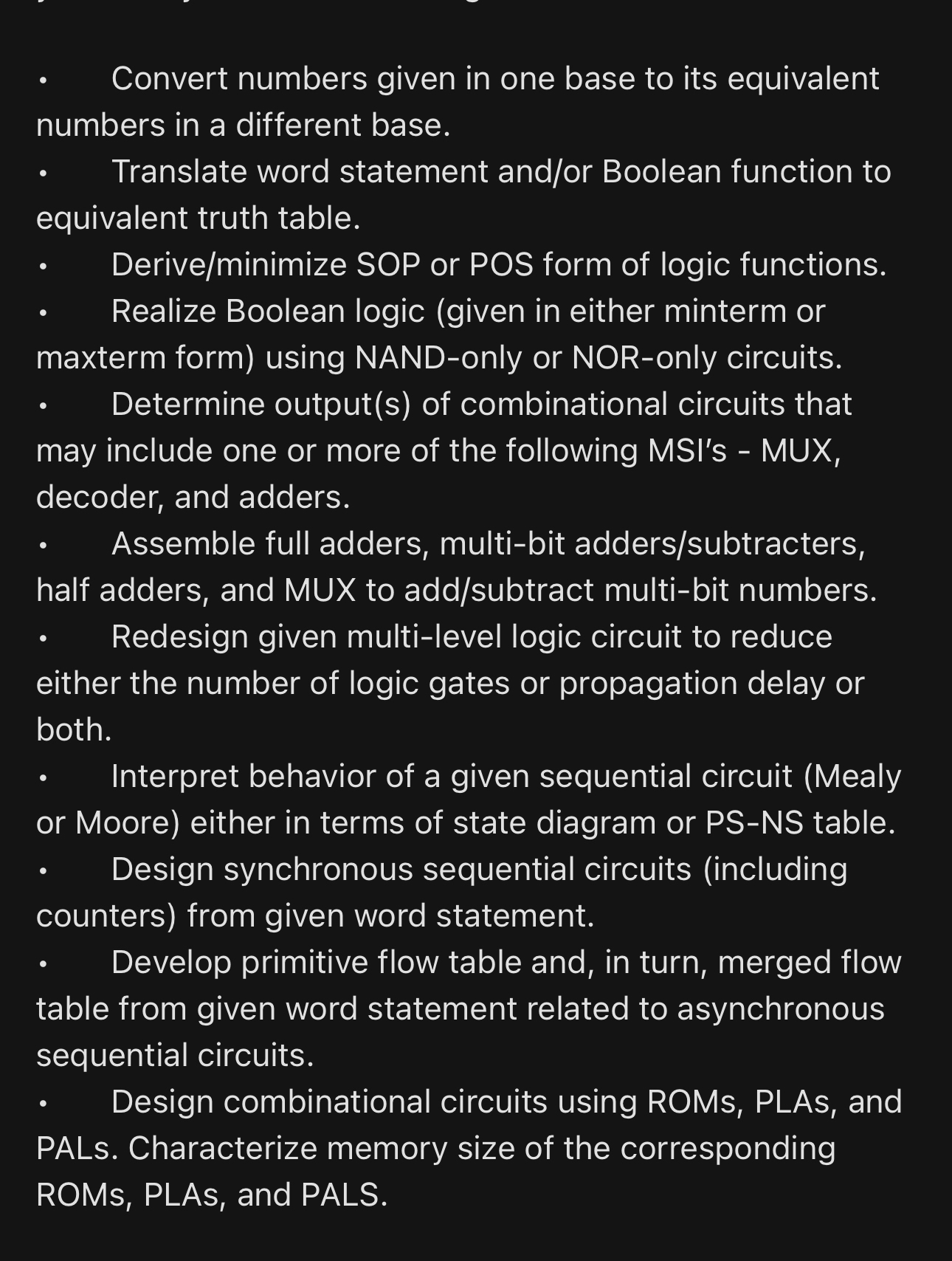
Design combinational circuits using ROMs, PLAs, and PALs. Characterize memory size of the corresponding ROMs, PLAs, and PALS.Convert numbers given in one base to its equivalent numbers in a different base.
Translate word statement andor Boolean function to equivalent truth table.
Deriveminimize SOP or POS form of logic functions.
Realize Boolean logic given in either minterm or maxterm form using NANDonly or NORonly circuits.
Determine outputs of combinational circuits that may include one or more of the following MSI's MUX, decoder, and adders.
Assemble full adders, multibit adderssubtracters half adders, and MUX to addsubtract multibit numbers.
Redesign given multilevel logic circuit to reduce either the number of logic gates or propagation delay or both.
Interpret behavior of a given sequential circuit Mealy or Moore either in terms of state diagram or PSNS table.
Design synchronous sequential circuits including counters from given word statement.
Develop primitive flow table and, in turn, merged flow table from given word statement related to asynchronous sequential circuits.
Design combinational circuits using ROMs, PLAs, and PALs. Characterize memory size of the corresponding ROMs, PLAs, and PALS.
Step by Step Solution
There are 3 Steps involved in it
1 Expert Approved Answer
Step: 1 Unlock

Question Has Been Solved by an Expert!
Get step-by-step solutions from verified subject matter experts
Step: 2 Unlock
Step: 3 Unlock
 Study Help