







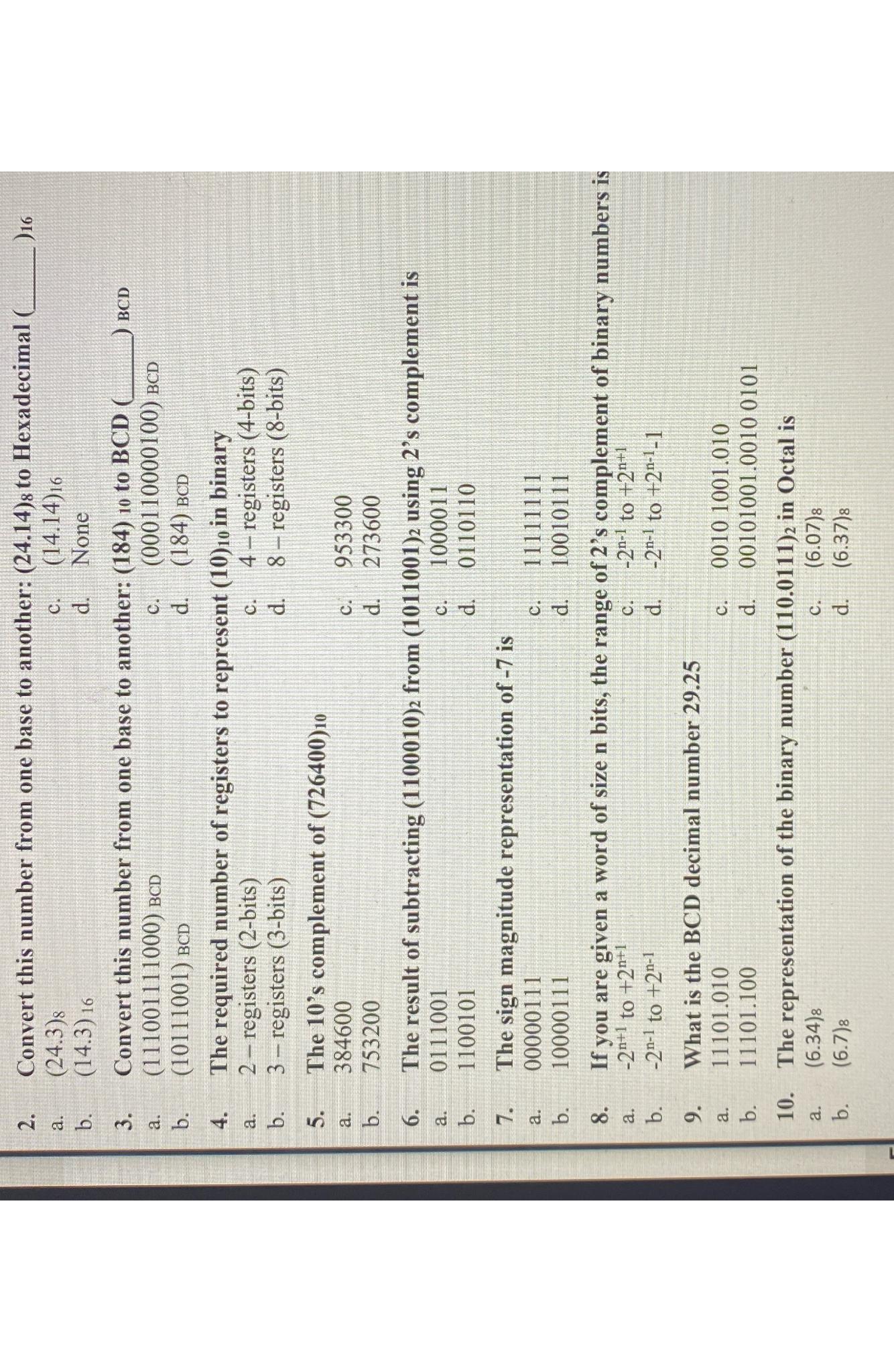
Question: Convert this number from one base to another: ( 2 4 . 1 4 ) 8 to Hexadecimal ( ) 1 6 a . (
Convert this number from one base to another: to Hexadecimal
a
c
b
d None
Convert this number from one base to another: to CD
a BCD
c
b
d
The required number of registers to represent in binary
aregisters bits
cregisters bits
bregisters bits
dregisters bits
The s complement of
a
c
b
d
The result of subtracting from using s complement is
a
c
b
d
The sign magnitude representation of is
a
c
b
d
If you are given a word of size bits, the range of s complement of binary numbers is
a to
c to
b to
d to
What is the decimal number
a
c
b
d
The representation of the binary number in Octal is
a
c
b
d
Step by Step Solution
There are 3 Steps involved in it
1 Expert Approved Answer
Step: 1 Unlock

Question Has Been Solved by an Expert!
Get step-by-step solutions from verified subject matter experts
Step: 2 Unlock
Step: 3 Unlock
 Study Help