Question: convert to me summarising the lessons I have learnt. Use paragraph. no bullet point. Fff Into=fe a-Based Design *Lesson:** Waing the Shape interface as a
convert to me summarising the lessons I have learnt. Use paragraph. no bullet point.
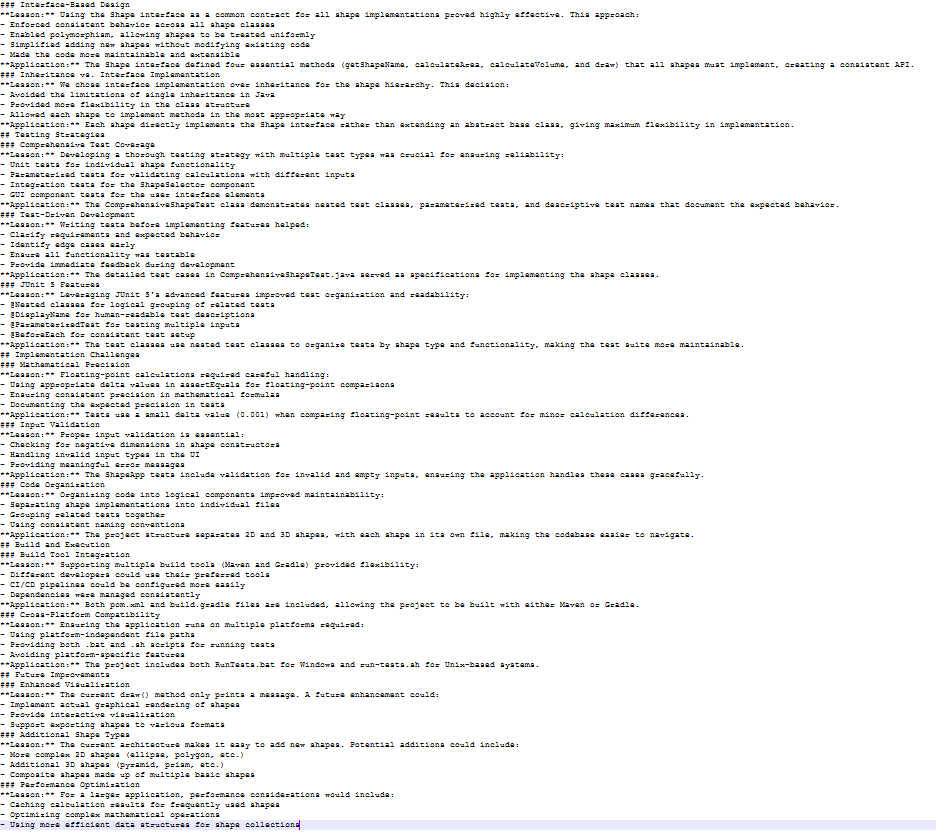
Fff Into=fe a-Based Design *Lesson:** Waing the Shape interface as a common contract for all shape implementations proved highly affective. This approach: Enforced consistent behavior across all shape classon Enabled polymorphism, allowing shapes to be treated uniforml; Simplified adding new shapes without modifying existing code Made the cade moss maintainable and extensible the face Implementation *Application: ** The Shape interface defined fous essential methods (getShapeName, calculateAses, calculateVolume, and draw) that all shapes must implement, creating a consistent API. Inhesitance va. Interface -Lesson: "* We chose interface implementation eves inheritance for the shape hierarchy. This decision: Avoided the limitations of single inheritance in Java Provided more flexibility in the class structure Allowed each shape to implement methods in the most appropriate way Application: "# Each shape disactly implements the Shape interface sathes than extending an abstract base class, giving maximum flexibility in implementation. Testing Strategies #8 Comprehensive Test Coverage "Lesson:** Developing a thorough testing strategy with multiple test types was crucial for anausing saliability: Unit tests for individual shape functionality Fazamatezized tests for validating calculations with different inputs Integration tests for the Shapesalastes component GUI component tests for the uses interface alamants *Application: "* The ComprehensiveShapeTest class demonstrates nested test classes, pasamatasized tests, and descriptive test names that document the expected behavior. ## Test-Driven Development *Longon: ** Waiting tests before implementing features helped: Clarify saquizaments and expected bahavids Identify edge canon amzly Endura functionality was testable Provide immediate feedback dusing development "Application:"* The detailed test cases in ComprehensiveShapeTest. java mazved as specifications fos implementing the shape classes. JUnit s Features "Landon:"* Leveraging JUnit S's advanced features improved test organization and seedability: awanted classes for logical grouping of solated taste DisplayMama fo= hum for human-saadable toat descriptions FazamatazizadTent for testing multiple inputs zoEach for consistent test satup Application: #* The test classes use nested test classes to organize teats by ahape type and functionality, making the teat quite mose maintainable. # Implementation Challenges ## Mathematical Precision *Lesson:* * Floating-point calculations saquized casaful handling: Waing app: values in anmostEquals for floating-point comparisons Enduring consistent precision in mathematical formulas Documenting the expected precision in tests Application: "* Tests was a small delta value (0. 001) when comparing floating-point samulta to account for mines calculation differences. ## Input Validation *Langan:" Propos input validation is assantial: Checking for negative dimensions in shape constructosa Handling invalid input types in the UI Providing meaningful azzo= messages -Application:"* The ShapeApp tests include validation for invalid and empty inputs, andusing the application handles these cases gracefully. ## Code Organization *London:"* Organizing code into logical components improved maintainability: Sopazating shape implementations inte individual files Grouping salated teats together Waing consistent naming conventions *Application:** The project structure separates 20 and 30 shapes, with each shape in its own file, making the codebase amadas to navigate. # Build and E ## Build Tool Integration Lesson: "* Supporting multiple build tools (Maven and Cradle) provided flexibility: zant developers could use theis professed tools CI/CD pipelines could be configured maza easily Dependencies wase managed consistently *Application:"* Both pam.xml and build. gradle files are included, allowing the project to be built with aithes Maven as Cradle. #8 Cross-Flatfoam Compatibility *Lennon:"* Ensuring the application suns on multiple platforms sequined: Using platform-independent file patha Providing both . bat and .ah scripts for sunning tests Avoiding platform-specific features "Application:"* The project includes both RunTests. bat for Windows and sun-testa. ah for Unix-based ayatama. # Future Improvements ## Enhanced Visualization "Lesson:"* The current draw () method only prints a massage. A future enhancement could: Implement actual graphical sendasing of shapes Provide interactive visualization Support exporting shapes to various formats ## Additional Shape Types *Lesson:** The current architecture makes it amay to add new shapes. Potential additions could include: Moze complex 20 shapes (ellipse, polygon, etc.) Additional 30 shapes (pyramid, prism, etc. ) Campas made up of multiple basic shapes ## Fazformance Optimization Lesson:"* Fos a laages application, pasformance considerations would include: Caching calculation samults for frequently wood shapon ical apasations Waing maze efficient data structures for shape collections









 Study Help