







Question: Coordinate transformations '7. Suppose you read a problem in the textbook that begins: Suppose a: = 3.92 +t y = 25 t z = st
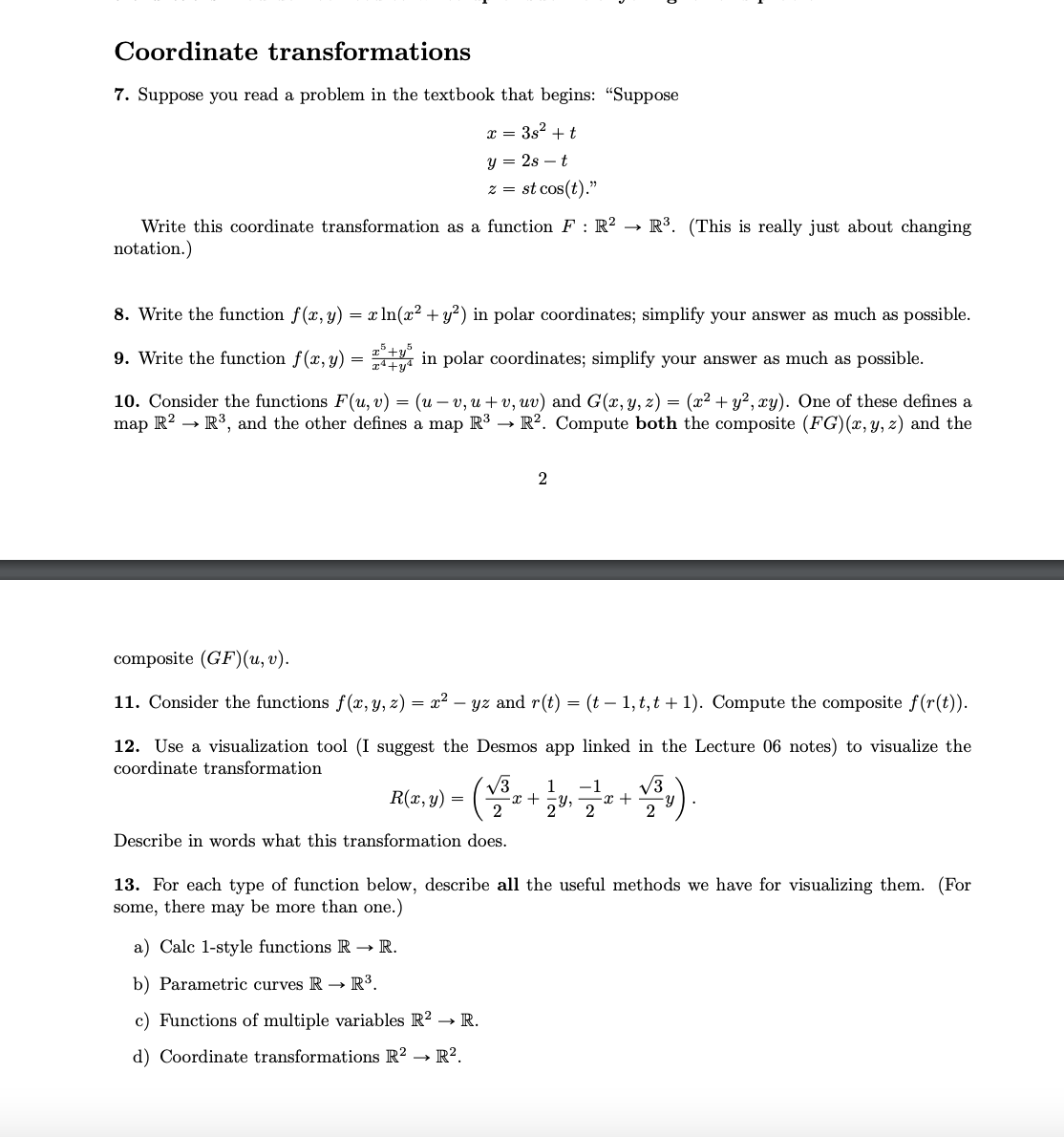
Coordinate transformations '7. Suppose you read a problem in the textbook that begins: \"Suppose a: = 3.92 +t y = 25 t z = st cos(t).\" Write this coordinate transformation as a function F : R2 r R3. (This is really just about changing notation.) 8. Write the function f (egg) 2 I ln[m2 + y\") in polar coordinates; simplify your answer as much as possible. 5 9. Write the function f[m,y) = :eifgq in polar coordinates; simplify your answer as much as possible. 10. Consider the functions F(u,v) = (u 1;, u + 1;, an) and G(I, y, z) = [1'2 + yz, my). One of these denes a map R2 ~ R3, and the other denes a map R3 ~ 13?. Compute both the composite (FG)(m,y, z) and the composite (GF)(1:., v). 11. Consider the functions f(:r,y, z) = m2 yz and Mt) = (t 1,t,t + 1). Compute the composite f(r(t)). 12. Use a visualization tool [I suggest the Desmos app linked in the Lecture 06 notes) to visualize the coordinate transformation f f 3 1 1 3 R($,y) = (?Z + iy, $3 + ?y) . Describe in words what this transformation does. 13. For each type of function below, describe all the useful methods we have for visualizing them. (For some, there may be more than one.) a Calc l-style functions R > R. b Parametric curves IR - R3. 0 d Flinctions of multiple variables 1R2 ~ 1R. ) ) ) ) Coordinate transformations R2 ~ 1R2
Step by Step Solution
There are 3 Steps involved in it

Get step-by-step solutions from verified subject matter experts
 Study Help