







Question: Corners 2. We continue with the previous problem. When you graphed solutions of the form x* = (xi(p, w), x2(p, w) - (0, w/p2), you
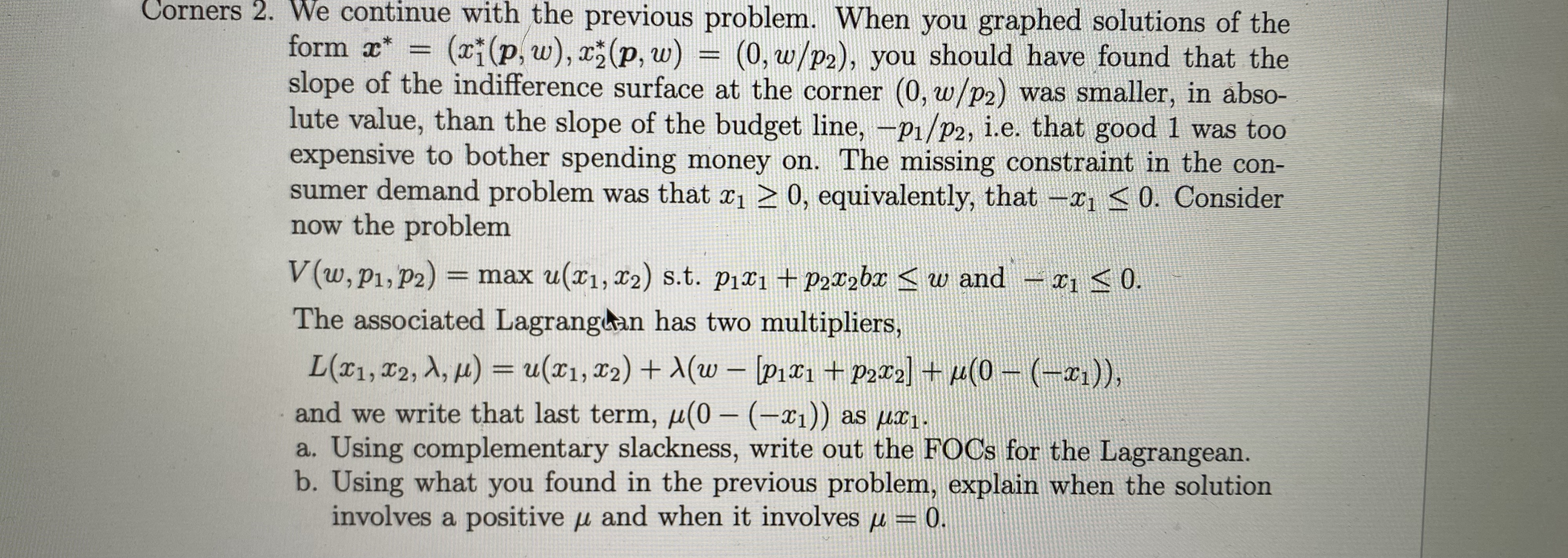
Corners 2. We continue with the previous problem. When you graphed solutions of the form x* = (xi(p, w), x2(p, w) - (0, w/p2), you should have found that the slope of the indifference surface at the corner (0, w/p2) was smaller, in abso- lute value, than the slope of the budget line, -p1/p2, i.e. that good I was too expensive to bother spending money on. The missing constraint in the con- sumer demand problem was that x1 2 0, equivalently, that -x1 0. Consider now the problem V(w, P1,P2) = max u(X1, T2) s.t. PIX1 + P2x26x _ w and - x1 0. The associated Lagrangian has two multipliers, L(21, X2, A, H) = u(X1, X2) + X(w - [P1x1 + P2x2] + A(0 - (-21)), and we write that last term, (0 - (-x1)) as ux1. a. Using complementary slackness, write out the FOCs for the Lagrangean. b. Using what you found in the previous problem, explain when the solution involves a positive / and when it involves u = 0
Step by Step Solution
There are 3 Steps involved in it

Get step-by-step solutions from verified subject matter experts
 Study Help