







Question: Corporate decision makers and analysts often use a technique called DuPont analysis to understand and assess the factors that drive a company's financial performance, as
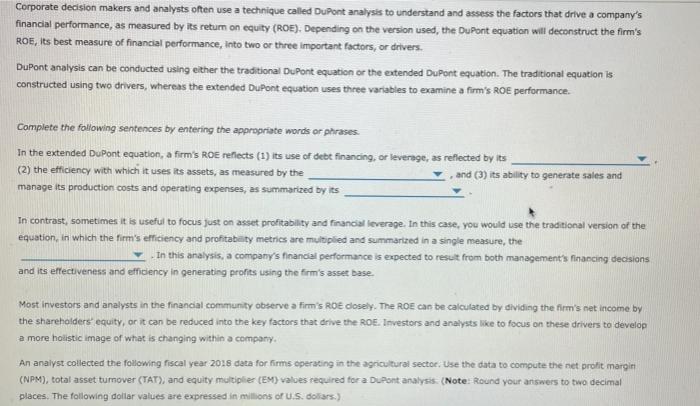
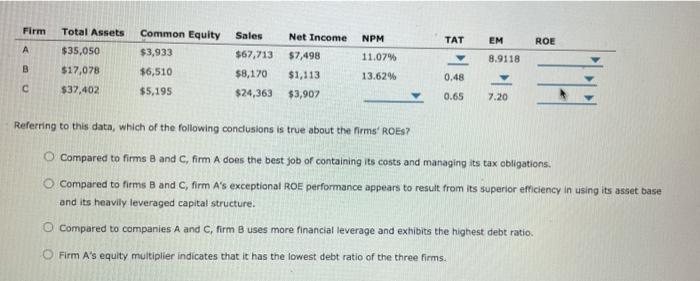
Corporate decision makers and analysts often use a technique called DuPont analysis to understand and assess the factors that drive a company's financial performance, as measured by its return on equity (ROE). Depending on the version used, the DuPont equation will deconstruct the firm's ROE, its best measure of financial performance, into two or three important factors, or drivers. DuPont analysis can be conducted using either the traditional DuPont equation or the extended DuPont equation. The traditional equation is constructed using two drivers, whereas the extended DuPont equation uses three variables to examine a firm's ROE performance. Complete the following sentences by entering the appropriate words or phrases In the extended DuPont equation, a firm's ROE reflects (1) its use of debt financing, or leverage, as reflected by its (2) the efficiency with which it uses its assets, as measured by the and (3) its ability to generate sales and manage its production costs and operating expenses, as summarized by its In contrast, sometimes it is useful to focus just on asset profitability and financial leverage. In this case, you would use the traditional version of the equation, in which the firm's efficiency and profitabity metrics are multiples and summarized in a single measure, the In this analysis, a company's financial performance is expected to result from both management's financing decisions and its effectiveness and efficiency in generating profits using the firm's asset base. Most investors and analysts in the financial community observe a firm's ROE dosely. The ROE can be calculated by dividing the firm's net income by the shareholders' equity, or it can be reduced into the key factors that drive the ROE Investors and analysts like to focus on these drivers to develop a more holistic image of what is changing within a company An analyst collected the following fiscal year 2018 data for firms operating in the agricultural sector. Use the data to compute the net profit margin (NPM), total asset turnover (TAT), and equity multiple (EM) valoes required for a DuPont analysis. (Note: Round your answers to two decimal places. The following dollar values are expressed in millions of U.S. dollars.) Firm Total Assets Sales Common Equity $3,933 Net Income NPM TAT EM ROE $67,713 11.07% 8.9118 B $35,050 $17,078 $37,402 $6,510 $5,195 $7,498 $1,113 $3,907 13.62% $8,170 $24,363 0.48 0.65 7.20 Referring to this data, which of the following conclusions is true about the firms Roes? Compared to firms and C, firm A does the best job of containing its costs and managing its tax obligations, Compared to firms and C, firm A's exceptional ROE performance appears to result from its superior efficiency in using its asset base and its heavily leveraged capital structure. Compared to companies A and C, firm Buses more financial leverage and exhibits the highest debt ratio. Firm A's equity multiplier indicates that it has the lowest debt ratio of the three firms
Step by Step Solution
There are 3 Steps involved in it

Get step-by-step solutions from verified subject matter experts
 Study Help