







Question: correct answer is -1.56. answer expressed as a percentage, (new-old)ew You are trying to purify contaminated water that is stored in a tank. You have
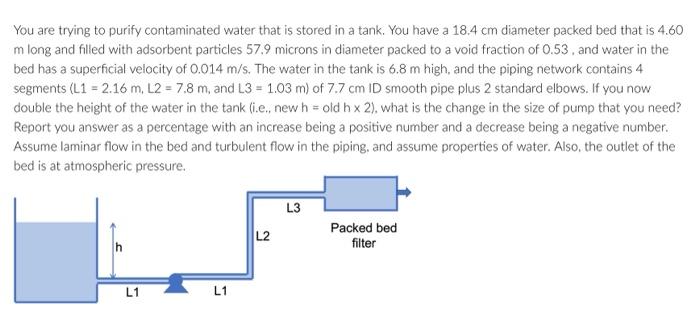
You are trying to purify contaminated water that is stored in a tank. You have a 18.4cm diameter packed bed that is 4.60 m long and filled with adsorbent particles 57.9 microns in diameter packed to a void fraction of 0.53 , and water in the bed has a superficial velocity of 0.014m/s. The water in the tank is 6.8m high, and the piping network contains 4 segments (L1=2.16m,L2=7.8m, and L3=1.03m) of 7.7cm ID smooth pipe plus 2 standard elbows. If you now double the height of the water in the tank (i.e., new h= old h2 ), what is the change in the size of pump that you need? Report you answer as a percentage with an increase being a positive number and a decrease being a negative number. Assume laminar flow in the bed and turbulent flow in the piping, and assume properties of water. Also, the outlet of the bed is at atmospheric pressure. You are trying to purify contaminated water that is stored in a tank. You have a 18.4cm diameter packed bed that is 4.60 m long and filled with adsorbent particles 57.9 microns in diameter packed to a void fraction of 0.53 , and water in the bed has a superficial velocity of 0.014m/s. The water in the tank is 6.8m high, and the piping network contains 4 segments (L1=2.16m,L2=7.8m, and L3=1.03m) of 7.7cm ID smooth pipe plus 2 standard elbows. If you now double the height of the water in the tank (i.e., new h= old h2 ), what is the change in the size of pump that you need? Report you answer as a percentage with an increase being a positive number and a decrease being a negative number. Assume laminar flow in the bed and turbulent flow in the piping, and assume properties of water. Also, the outlet of the bed is at atmospheric pressure
Step by Step Solution
There are 3 Steps involved in it

Get step-by-step solutions from verified subject matter experts
 Study Help