







Question: Correlation Study II Reaction Time in Milliseconds Age Groups Correlation Study II 1. Is the correlation between age and reaction speed positive or negative?
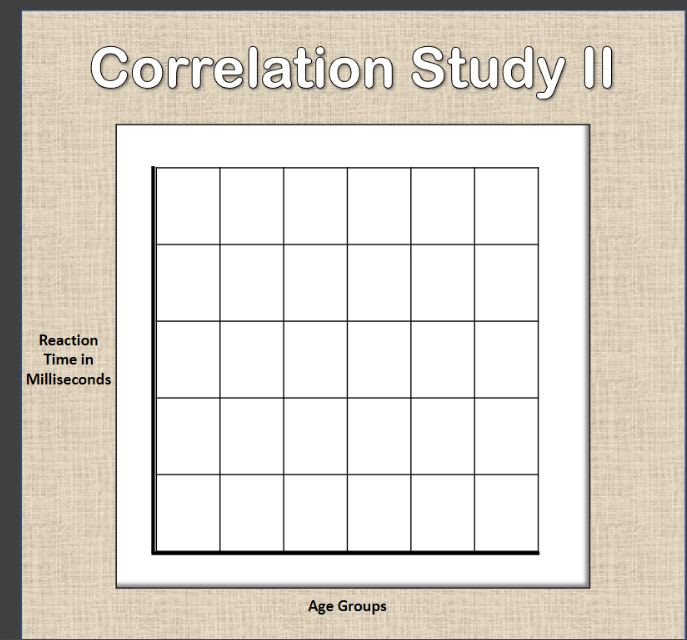
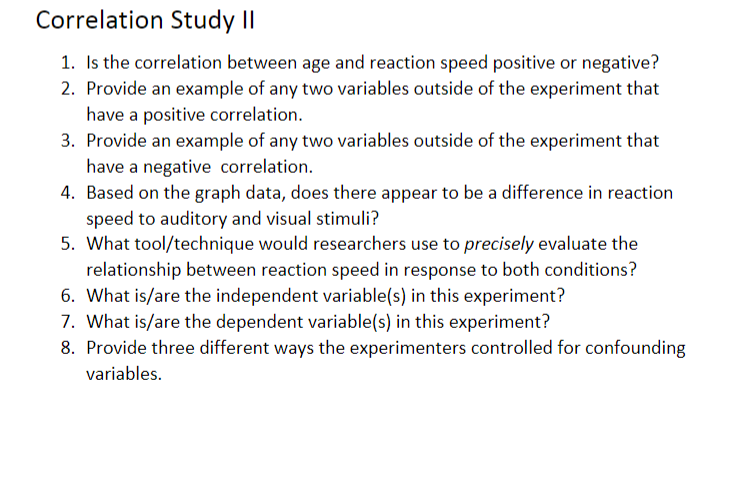
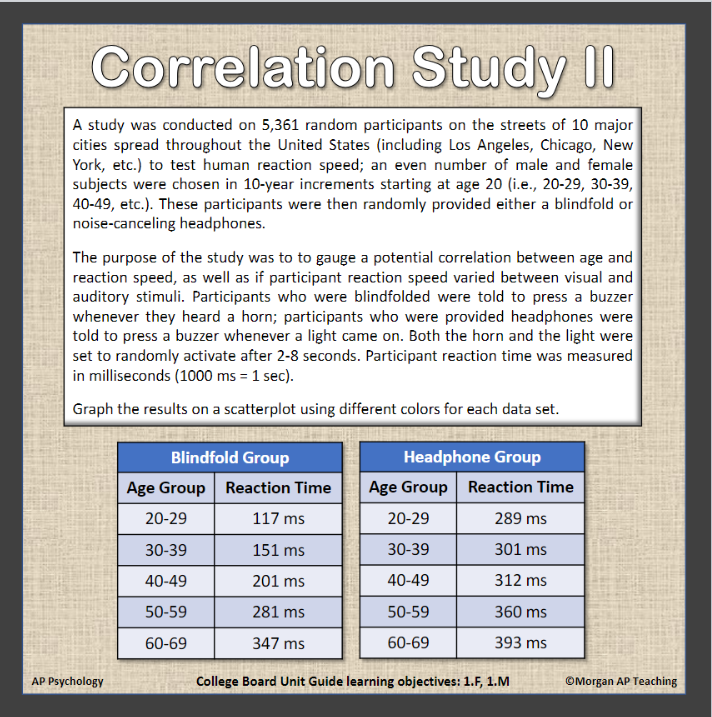
Correlation Study II Reaction Time in Milliseconds Age Groups Correlation Study II 1. Is the correlation between age and reaction speed positive or negative? 2. Provide an example of any two variables outside of the experiment that have a positive correlation. 3. Provide an example of any two variables outside of the experiment that have a negative correlation. 4. Based on the graph data, does there appear to be a difference in reaction speed to auditory and visual stimuli? 5. What tool/technique would researchers use to precisely evaluate the relationship between reaction speed in response to both conditions? 6. What is/are the independent variable(s) in this experiment? 7. What is/are the dependent variable(s) in this experiment? 8. Provide three different ways the experimenters controlled for confounding variables. Correlation Study II 00 A study was conducted on 5,361 random participants on the streets of 10 major cities spread throughout the United States (including Los Angeles, Chicago, New York, etc.) to test human reaction speed; an even number of male and female subjects were chosen in 10-year increments starting at age 20 (i.e., 20-29, 30-39, 40-49, etc.). These participants were then randomly provided either a blindfold or noise-canceling headphones. The purpose of the study was to to gauge a potential correlation between age and reaction speed, as well as if participant reaction speed varied between visual and auditory stimuli. Participants who were blindfolded were told to press a buzzer whenever they heard a horn; participants who were provided headphones were told to press a buzzer whenever a light came on. Both the horn and the light were set to randomly activate after 2-8 seconds. Participant reaction time was measured in milliseconds (1000 ms = 1 sec). Graph the results on a scatterplot using different colors for each data set. Blindfold Group Headphone Group Age Group Reaction Time Age Group Reaction Time 20-29 117 ms 20-29 289 ms 30-39 151 ms 30-39 301 ms 40-49 201 ms 40-49 312 ms 50-59 281 ms 50-59 360 ms 60-69 347 ms 60-69 393 ms AP Psychology College Board Unit Guide learning objectives: 1.F, 1.M Morgan AP Teaching
Step by Step Solution
There are 3 Steps involved in it

Get step-by-step solutions from verified subject matter experts
 Study Help