



Question: CORROSION ENGINEERING. I WILL LEAVE A GOOD RATING IMMEDIATELY IF ANSWERED CORRECTLY! Problem 4: Chapter I2: Corrosion of Structural Concrete The diffusion of chlorine into
CORROSION ENGINEERING. I WILL LEAVE A GOOD RATING IMMEDIATELY IF ANSWERED CORRECTLY!
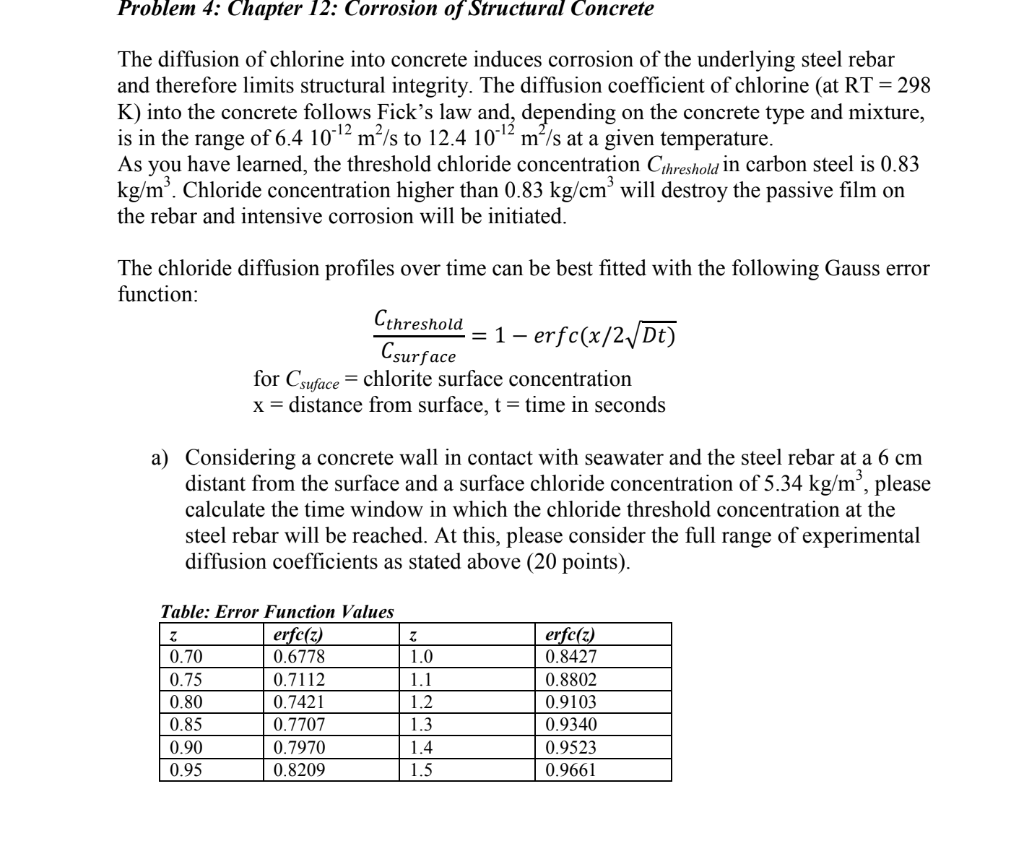
Problem 4: Chapter I2: Corrosion of Structural Concrete The diffusion of chlorine into concrete induces corrosion of the underlying steel rebar and therefore limits structural integrity. The diffusion coefficient of chlorine (at RT =298 K) into the concrete follows Fick's law and, depending on the concrete type and mixture, is in the range of 6.41012m2/s to 12.41012m2/s at a given temperature. As you have learned, the threshold chloride concentration Cthreshold in carbon steel is 0.83 kg/m3. Chloride concentration higher than 0.83kg/cm3 will destroy the passive film on the rebar and intensive corrosion will be initiated. The chloride diffusion profiles over time can be best fitted with the following Gauss error function: CsurfaceCthreshold=1erfc(x/2Dt)forCsuface=chloritesurfaceconcentrationx=distancefromsurface,t=timeinseconds a) Considering a concrete wall in contact with seawater and the steel rebar at a 6cm distant from the surface and a surface chloride concentration of 5.34kg/m3, please calculate the time window in which the chloride threshold concentration at the steel rebar will be reached. At this, please consider the full range of experimental diffusion coefficients as stated above ( 20 points). Problem 4: Chapter I2: Corrosion of Structural Concrete The diffusion of chlorine into concrete induces corrosion of the underlying steel rebar and therefore limits structural integrity. The diffusion coefficient of chlorine (at RT =298 K) into the concrete follows Fick's law and, depending on the concrete type and mixture, is in the range of 6.41012m2/s to 12.41012m2/s at a given temperature. As you have learned, the threshold chloride concentration Cthreshold in carbon steel is 0.83 kg/m3. Chloride concentration higher than 0.83kg/cm3 will destroy the passive film on the rebar and intensive corrosion will be initiated. The chloride diffusion profiles over time can be best fitted with the following Gauss error function: CsurfaceCthreshold=1erfc(x/2Dt)forCsuface=chloritesurfaceconcentrationx=distancefromsurface,t=timeinseconds a) Considering a concrete wall in contact with seawater and the steel rebar at a 6cm distant from the surface and a surface chloride concentration of 5.34kg/m3, please calculate the time window in which the chloride threshold concentration at the steel rebar will be reached. At this, please consider the full range of experimental diffusion coefficients as stated above ( 20 points)
Step by Step Solution
There are 3 Steps involved in it

Get step-by-step solutions from verified subject matter experts