







Question: COSC 2325.S01 Semester Project Problem: Create an assembly language program that will read in a set of student records. Each student record will consist of
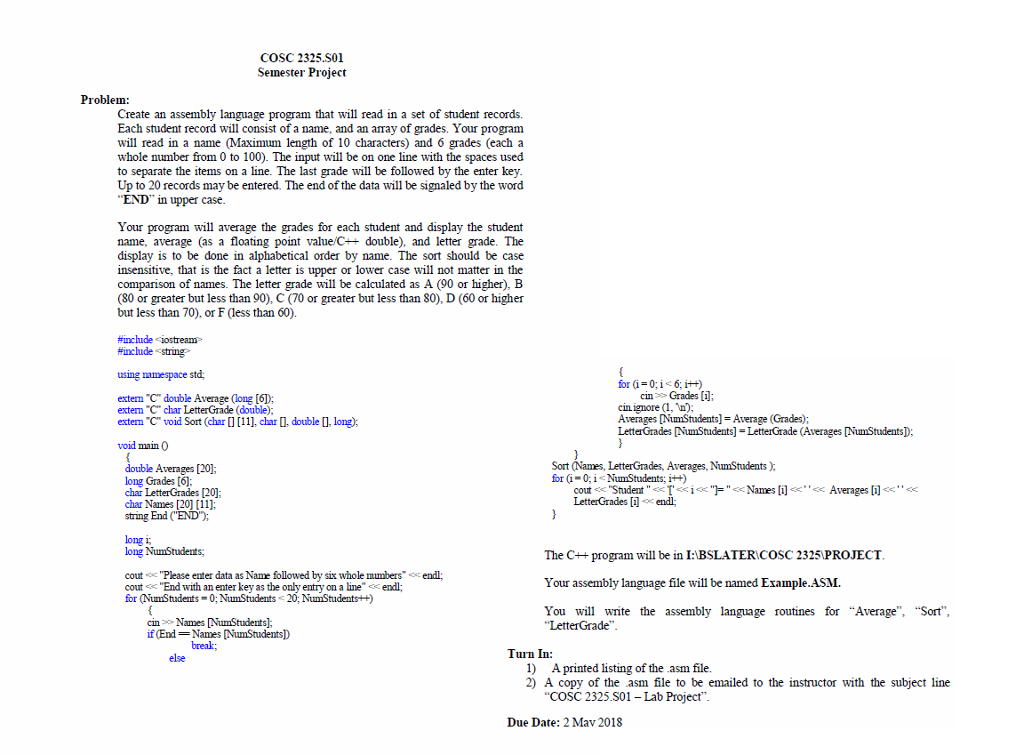
COSC 2325.S01 Semester Project Problem: Create an assembly language program that will read in a set of student records. Each student record will consist of a name, and an aay of grades. Your program will read in a name (Maximum length of 10 characters) and 6 grades (each a whole number from 0 to 100). The input will be on one line with the spaces used to separate the items on a line. The last grade will be followed by the enter key. Up to 20 records may be entered. The end of the data will be signaled by the word END" in upper case Your program will average the grades for each student and display the student name, average (as a floating point value C double), and letter grade. The display is to be done in alphabetical order by name. The sort should be case insensitive, that is the fact a letter is upper or lower case will not matter in the comparison of names. The letter grade will be calculated as A (90 or higher). B (80 or greater but less than 90), C (70 or greater but less than S0), D (60 or higher but less than 70), or F (less than 60) #include-iostream #includestring. using namespace std cinGrades il exten "C" double Average (long [6); extem "C" char LetterGrade (double); extern "C" void Sort (char [11], char , double 1. long) cin ignore (1,n); Averages NumStudents]-Average (Grades); LetterGrades NmStudents]-LetterGrade (Averages NumStudentsD: void main 0 Sort (Names, LetterGrades, Averages, NumStudents for (1-0, i-NumStudents, i++) double Averages [20]; long Grades [6]; char LetterGrades [20]; char Names [20] [11] string End END; cout "Student .. ?.?"f.'Names [i] LetterGrades [i]? endk -.. Averages [i]
Step by Step Solution
There are 3 Steps involved in it

Get step-by-step solutions from verified subject matter experts
 Study Help