



Question: Cost Accounting 51-301-01 Chapter 4: Assignment A Fall 2019 Job Costing Problem: Asiana Arts, Incorporated Asiana Arts, Inc., manufactures custom-made furniture groupings for museum, gallery,
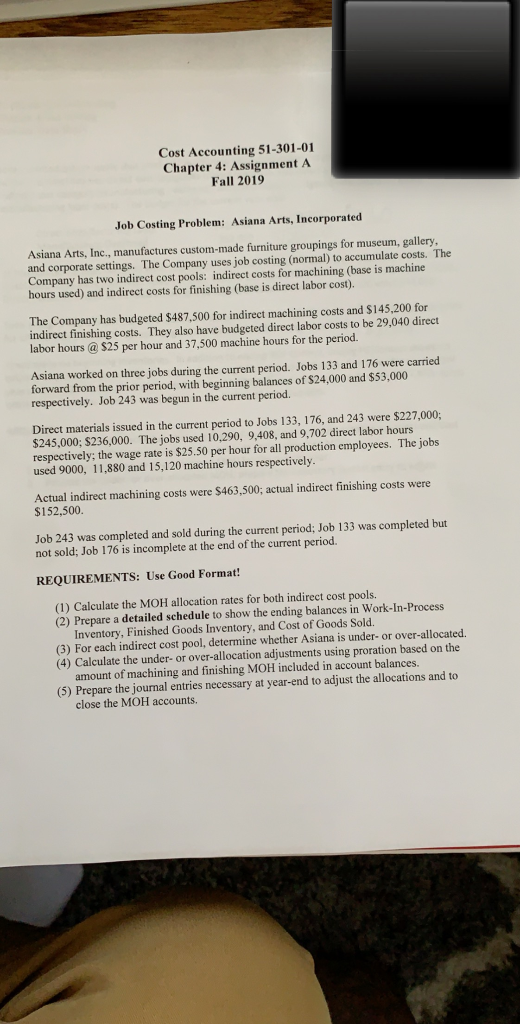
Cost Accounting 51-301-01 Chapter 4: Assignment A Fall 2019 Job Costing Problem: Asiana Arts, Incorporated Asiana Arts, Inc., manufactures custom-made furniture groupings for museum, gallery, and corporate settings. The Company uses job costing (normal) to accumulate costs. The Company has two indirect cost pools: indirect costs for machining (base is machine hours used) and indirect costs for finishing (base is direct labor cost). The Company has budgeted $487,500 for indirect machining costs and $145,200 for indirect finishing costs. They also have budgeted direct labor costs to be 29,040 direct labor hours a $25 per hour and 37.500 machine hours for the period. Asiana worked on three jobs during the current period. Jobs 133 and 176 were carried forward from the prior period, with beginning balances of $24,000 and $53,000 respectively. Job 243 was begun in the current period. Direct materials issued in the current period to Jobs 133, 176, and 243 were $227,000; $245,000: $236,000. The jobs used 10.290. 9,408, and 9,702 direct labor hours respectively, the wage rate is $25.50 per hour for all production employees. The jobs used 9000, 11,880 and 15,120 machine hours respectively. Actual indirect machining costs were $463,500; actual indirect finishing costs were $152,500 Job 243 was completed and sold during the current period; Job 133 was completed but not sold; Job 176 is incomplete at the end of the current period. REQUIREMENTS: Use Good Format! (1) Calculate the MOH allocation rates for both indirect cost pools. (2) Prepare a detailed schedule to show the ending balances in Work-In-Process Inventory, Finished Goods Inventory, and Cost of Goods Sold. (3) For each indirect cost pool, determine whether Asiana is under or over-allocated. (4) Calculate the under or over-allocation adjustments using proration based on the amount of machining and finishing MOH included in account balances. (5) Prepare the journal entries necessary at year-end to adjust the allocations and to close the MOH accounts. Cost Accounting 51-301-01 Chapter 4: Assignment A Fall 2019 Job Costing Problem: Asiana Arts, Incorporated Asiana Arts, Inc., manufactures custom-made furniture groupings for museum, gallery, and corporate settings. The Company uses job costing (normal) to accumulate costs. The Company has two indirect cost pools: indirect costs for machining (base is machine hours used) and indirect costs for finishing (base is direct labor cost). The Company has budgeted $487,500 for indirect machining costs and $145,200 for indirect finishing costs. They also have budgeted direct labor costs to be 29,040 direct labor hours a $25 per hour and 37.500 machine hours for the period. Asiana worked on three jobs during the current period. Jobs 133 and 176 were carried forward from the prior period, with beginning balances of $24,000 and $53,000 respectively. Job 243 was begun in the current period. Direct materials issued in the current period to Jobs 133, 176, and 243 were $227,000; $245,000: $236,000. The jobs used 10.290. 9,408, and 9,702 direct labor hours respectively, the wage rate is $25.50 per hour for all production employees. The jobs used 9000, 11,880 and 15,120 machine hours respectively. Actual indirect machining costs were $463,500; actual indirect finishing costs were $152,500 Job 243 was completed and sold during the current period; Job 133 was completed but not sold; Job 176 is incomplete at the end of the current period. REQUIREMENTS: Use Good Format! (1) Calculate the MOH allocation rates for both indirect cost pools. (2) Prepare a detailed schedule to show the ending balances in Work-In-Process Inventory, Finished Goods Inventory, and Cost of Goods Sold. (3) For each indirect cost pool, determine whether Asiana is under or over-allocated. (4) Calculate the under or over-allocation adjustments using proration based on the amount of machining and finishing MOH included in account balances. (5) Prepare the journal entries necessary at year-end to adjust the allocations and to close the MOH accounts
Step by Step Solution
There are 3 Steps involved in it

Get step-by-step solutions from verified subject matter experts