







Question: Cost data $10 Regular time labor cost per hour Overtime time labor cost per hour Subcontracting cost per unit (labor only $80 Back order cost
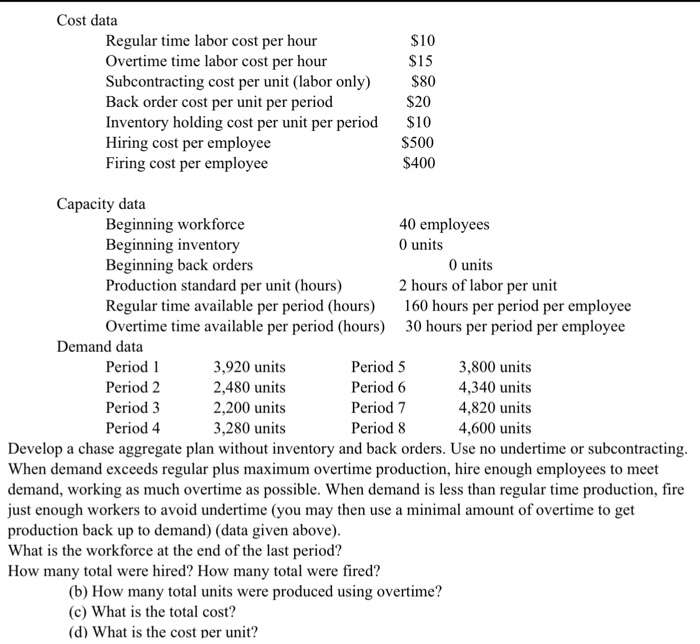
Cost data $10 Regular time labor cost per hour Overtime time labor cost per hour Subcontracting cost per unit (labor only $80 Back order cost per unit per period Inventory holding cost per unit per period $10 Hiring cost per employee Firing cost per employee $15 $20 $500 $400 Capacity data Beginning workforce Beginning inventory Beginning back orders Production standard per unit (hours) Regular time available per period (hours) Overtime time available per period (hours) 40 employees 0 units 0 units 2 hours of labor per unit 160 hours per period per employee 30 hours per period per employee Demand data Period 1 Period 2 Period 3 Period 4 3,920 units 2,480 units 2,200 units 3,280 units Period 5 Period 6 Period 7 Period 8 3,800 units 4,340 units 4,820 units 4,600 units Develop a chase aggregate plan without inventory and back orders. Use no undertime or subcontracting When demand exceeds regular plus maximum overtime production, hire enough employees to meet demand, working as much overtime as possible. When demand is less than regular time production, fire just enough workers to avoid undertime (you may then use a minimal amount of overtime to get production back up to demand) (data given above) What is the workforce at the end of the last period? How many total were hired? How many total were fired? (b) How many total units were produced using overtime? (c) What is the total cost? (d) What is the cost per unit
Step by Step Solution
There are 3 Steps involved in it

Get step-by-step solutions from verified subject matter experts
 Study Help