







Question: Cost Formulas, Single and Multiple Cost Drivers For the past five years, Velocity Manufacturing Company has had a policy of producing to meet customer demand.
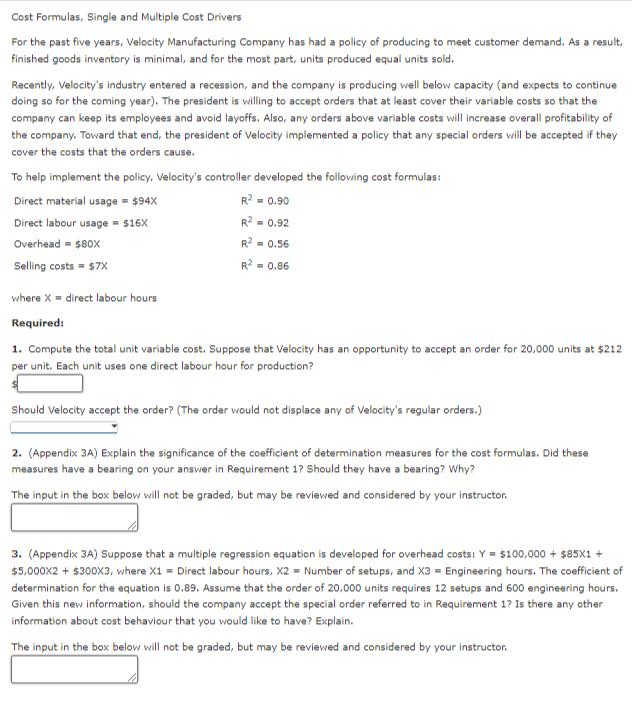
Cost Formulas, Single and Multiple Cost Drivers For the past five years, Velocity Manufacturing Company has had a policy of producing to meet customer demand. As a result, finished goods inventory is minimal, and for the most part, units produced equal units sold. Recently, Velocity's industry entered a recession, and the company is producing well below capacity (and expects to continue doing so for the coming year). The president is willing to accept orders that at least cover their variable costs so that the company can keep its employees and avoid layoffs. Also, any orders above variable costs will increase overall profitability of the company. Toward that end, the president of Velocity implemented a policy that any special orders will be accepted if they cover the costs that the orders cause. To help implement the policy, Velocity's controller developed the following cost formulas: Direct material usage =$94X R2=0.90 Direct labour usage =$16X R2=0.92 Overhead =580X R2=0.56 Selling costs =$7x R2=0.86 where X= direct labour hours Required: 1. Compute the total unit variable cost. Suppose that Velocity has an opportunity to accept an order for 20,000 units at $212 per unit. Each unit uses one direct labour hour for production? i Should Velocity accept the order? (The order would not displace any of Velocity's regular orders.) 2. (Appendix 3A) Explain the significance of the coefficient of determination measures for the cost formulas, Did these measures have a bearing on your answer in Requirement 1 ? Should they have a bearing? Why? The input in the box below will not be graded, but may be reviewed and considered by your instructor. 3. (AppendiX 3A ) Suppose that a multiple regression equation is developed for overhead costs: Y=$100,000+$851+ $5,0002+$3003, where X1= Direct labour hours, X2= Number of setups, and X3 = Engineering hours. The coefficient of determination for the equation is 0.89. Assume that the order of 20,000 units requires 12 setups and 600 engineering hours. Given this new information, should the company accept the special order referred to in Requirement 1? Is there any other information about cost behaviour that you would like to have? Explain. The input in the box below will not be graded, but may be reviewed and considered by your instructor. Cost Formulas, Single and Multiple Cost Drivers For the past five years, Velocity Manufacturing Company has had a policy of producing to meet customer demand. As a result, finished goods inventory is minimal, and for the most part, units produced equal units sold. Recently, Velocity's industry entered a recession, and the company is producing well below capacity (and expects to continue doing so for the coming year). The president is willing to accept orders that at least cover their variable costs so that the company can keep its employees and avoid layoffs. Also, any orders above variable costs will increase overall profitability of the company. Toward that end, the president of Velocity implemented a policy that any special orders will be accepted if they cover the costs that the orders cause. To help implement the policy, Velocity's controller developed the following cost formulas: Direct material usage =$94X R2=0.90 Direct labour usage =$16X R2=0.92 Overhead =580X R2=0.56 Selling costs =$7x R2=0.86 where X= direct labour hours Required: 1. Compute the total unit variable cost. Suppose that Velocity has an opportunity to accept an order for 20,000 units at $212 per unit. Each unit uses one direct labour hour for production? i Should Velocity accept the order? (The order would not displace any of Velocity's regular orders.) 2. (Appendix 3A) Explain the significance of the coefficient of determination measures for the cost formulas, Did these measures have a bearing on your answer in Requirement 1 ? Should they have a bearing? Why? The input in the box below will not be graded, but may be reviewed and considered by your instructor. 3. (AppendiX 3A ) Suppose that a multiple regression equation is developed for overhead costs: Y=$100,000+$851+ $5,0002+$3003, where X1= Direct labour hours, X2= Number of setups, and X3 = Engineering hours. The coefficient of determination for the equation is 0.89. Assume that the order of 20,000 units requires 12 setups and 600 engineering hours. Given this new information, should the company accept the special order referred to in Requirement 1? Is there any other information about cost behaviour that you would like to have? Explain. The input in the box below will not be graded, but may be reviewed and considered by your instructor
Step by Step Solution
There are 3 Steps involved in it

Get step-by-step solutions from verified subject matter experts
 Study Help