







Question: Could I get some help and explanation? 1. What decimal number does the bit pattern 0x0C000000 represent if it is a floating point number? Use
Could I get some help and explanation?
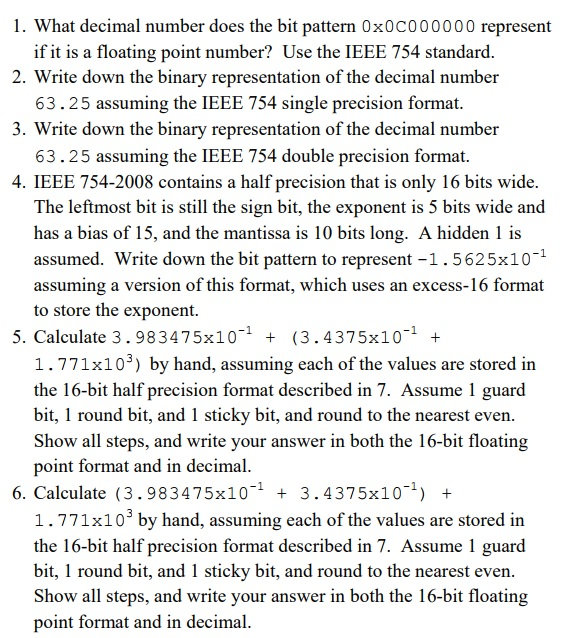

1. What decimal number does the bit pattern 0x0C000000 represent if it is a floating point number? Use the IEEE 754 standard 63.25 assuming the IEEE 754 single precision format 63.25 assuming the IEEE 754 double precision format. 2. Write down the binary representation of the decimal number 3. Write down the binary representation of the decimal number 4. IEEE 754-2008 contains a half precision that is only 16 bits wide. The leftmost bit is still the sign bit, the exponent is 5 bits wide and has a bias of 15, and the mantissa is 10 bits long. A hidden 1 is assumed. Write down the bit pattern to represent-1, 562 5x10⁻¹ assuming a version of this format, which uses an excess-16 format to store the exponent 5. Calculate 3.983475x101 +(3.4375x10⁻¹ + 1771x103) by hand, assuming each of the values are stored in the 16-bit half precision format described in 7. Assume 1 guard bit, 1 round bit, and 1 sticky bit, and round to the nearest even Show all steps, and write your answer in both the 16-bit floating point format and in decimal 6. Calculate (3.983475x103.4375x101) + 1771x10 by hand, assuming each of the values are stored in the 16-bit half precision format described in 7. Assume 1 guard bit, 1 round bit, and 1 sticky bit, and round to the nearest even Show all steps, and write your answer in both the 16-bit floating point format and in decimal 1. What decimal number does the bit pattern 0x0C000000 represent if it is a floating point number? Use the IEEE 754 standard 63.25 assuming the IEEE 754 single precision format 63.25 assuming the IEEE 754 double precision format. 2. Write down the binary representation of the decimal number 3. Write down the binary representation of the decimal number 4. IEEE 754-2008 contains a half precision that is only 16 bits wide. The leftmost bit is still the sign bit, the exponent is 5 bits wide and has a bias of 15, and the mantissa is 10 bits long. A hidden 1 is assumed. Write down the bit pattern to represent-1, 562 5x10⁻¹ assuming a version of this format, which uses an excess-16 format to store the exponent 5. Calculate 3.983475x101 +(3.4375x10⁻¹ + 1771x103) by hand, assuming each of the values are stored in the 16-bit half precision format described in 7. Assume 1 guard bit, 1 round bit, and 1 sticky bit, and round to the nearest even Show all steps, and write your answer in both the 16-bit floating point format and in decimal 6. Calculate (3.983475x103.4375x101) + 1771x10 by hand, assuming each of the values are stored in the 16-bit half precision format described in 7. Assume 1 guard bit, 1 round bit, and 1 sticky bit, and round to the nearest even Show all steps, and write your answer in both the 16-bit floating point format and in decimal
Step by Step Solution
There are 3 Steps involved in it

Get step-by-step solutions from verified subject matter experts
 Study Help