







Question: could I please get the answers for these problems? From the majority opinion of the Court, delivered by Justice Henry Billings Brown: The constitutionality of
could I please get the answers for these problems?
From the majority opinion of the Court, delivered by Justice Henry Billings Brown: The constitutionality of this act is attacked upon the ground that it conflicts both with the thirteenth amendment of the constitution, abolishing slavery, and the fourteenth amendment, which prohibits certain restrictive legislation on the part of the states. 1. That it does not conflict with the thirteenth amendment, which abolished slavery and involuntary servitude, except as a punishment for crime, is too clear for argument. Slavery implies involuntary servitude,a state of bondage; the ownership of mankind as a chattel, or, at least, the control of the labor and services of one man for the benefit of another, and the absence of a legal right to the disposal of his own person, property, and services. This amendment was said in the Slaughter-House Cases to have been intended primarily to abolish slavery, as it had been previously known in this country and that it equally forbade Mexican peonage or the Chinese coolie trade, when they amounted to slavery or involuntary servitude, and that the use of the word "servitude" was intended to prohibit the use of all forms of involuntary slavery, of whatever class or name. It was intimated, however, in that case, that this amendment was regarded by the statesmen of that day as insufficient to protect the colored race from certain laws which had been enacted in the Southern states, imposing upon the colored race onerous disabilities and burdens, and curtailing their rights in the pursuit of life, liberty, and property to such an extent that their freedom was of little value; and that the fourteenth amendment was devised to meet this exigency. ... 2. By the fourteenth amendment, all persons born or naturalized in the United States, and subject to the jurisdiction thereof, are made citizens of the United States and of the state wherein they reside; and the states are forbidden from making or enforcing any law which shall abridge the privileges or immunities of citizens of the United States, or shall deprive any person of life, liberty, or property without due process of law, or deny to any person within their jurisdiction the equal protection of the laws. ... The object of the amendment was undoubtedly to enforce the absolute equality of the two races before the law, but, in the nature of things, it could not have been intended to abolish distinctions based upon color, or to enforce social, as distinguished from political, equality, or a commingling of the two races upon terms unsatisfactory to either. Laws permitting, and even requiring, their separation, in places where they are liable to be brought into contact, do not necessarily imply the inferiority of either race to the other, and have been generally, if not universally, recognized as within the competency of the state legislatures in the exercise of their police power. The most common instance of this is connected with the establishment of separate schools for white and colored children, which have been held to be a valid exercise of the legislative power even by courts of states where the political rights of the colored race have been longest and most earnestly enforced. ... We consider the underlying fallacy of the plaintiff's argument to consist in the assumption that the enforced separation of the two races stamps the colored race with a badge of inferiority. If this be so, it is not by reason of anything found in the act, but solely because the colored race chooses to put that construction upon it. The argument necessarily assumes that if, as has been more than once the case, and is not unlikely to be so again, the colored race should become the dominant power in the state legislature, and should enact a law in precisely similar terms, it would thereby relegate the white race to an inferior position. We imagine that the white race, at least, would not acquiesce in this assumption. The argument also assumes that social prejudices may be overcome by legislation, and that equal rights cannot be secured to the negro except by an enforced commingling of the two races. We cannot accept this proposition. If the two races are to meet upon terms of social equality, it must be the result of natural affinities, a mutual appreciation of each other's merits, and a voluntary consent of individuals. As was said by the court of appeals of New York in People v. Gallagher: 'This end can neither be accomplished nor promoted by laws which conflict with the general sentiment of the community upon whom they are designed to operate. When the government, therefore, has secured to each of its citizens equal rights before the law, and equal opportunities for improvement and progress, it has accomplished the end for which it was organized, and performed all of the functions respecting social advantages with which it is endowed.' Legislation is powerless to eradicate racial instincts, or to abolish distinctions based upon physical differences, and the attempt to do so can only result in accentuating the difficulties of the present situation. If the civil and political rights of both races be equal, one cannot be inferior to the other civilly or politically. If one race be inferior to the other socially, the constitution of the United States cannot put them upon the same plane. It is true that the question of the proportion of colored blood necessary to constitute a colored person, as distinguished from a white person, is one upon which there is a difference of opinion in the different states; some holding that any visible admixture of black blood stamps the person as belonging to the colored race; others, that it depends upon the preponderance of blood; and still others, that the predominance of white blood must only be in the proportion of three-fourths. But these are questions to be determined under the laws of each state, and are not properly put in issue in this case. Under the allegations of his petition, it may undoubtedly become a question of importance whether, under the laws of Louisiana, the petitioner belongs to the white or colored race. The judgment of the court below is therefore affirmed. From Justice John Marshall Harlan's dissenting opinion: The thirteenth amendment does not permit the withholding or the deprivation of any right necessarily inhering in freedom. It not only struck down the institution of slavery as previously existing in the United States, but it prevents the imposition of any burdens or disabilities that constitute badges of slavery or servitude. It decreed universal civil freedom in this country. This court has so adjudged. But, that amendment having been found inadequate to the protection of the rights of those who had been in slavery, it was followed by the fourteenth amendment, which added greatly to the dignity and glory of American citizenship, and to the security of personal liberty, by declaring that 'all persons born or naturalized in the United States, and subject to the jurisdiction thereof, are citizens of the United States and of the state wherein they reside,' and that 'no state shall make or enforce any law which shall abridge the privileges or immunities of citizens of the United States; nor shall any state deprive any person of life, liberty or property without due process of law, nor deny to any person within its jurisdiction the equal protection of the laws.' These two amendments, if enforced according to their true intent and meaning, will protect all the civil rights that pertain to freedom and citizenship. Finally, and to the end that no citizen should be denied, on account of his race, the privilege of participating in the political control of his country, it was declared by the fifteenth amendment that 'the right of citizens of the United States to vote shall not be denied or abridged by the United States or by any state on account of race, color or previous condition of servitude.' These notable additions to the fundamental law were welcomed by the friends of liberty throughout the world. They removed the race line from our governmental systems. They had, as this court has said, a common purpose, namely, to secure 'to a race recently emancipated, a race that through many generations have been held in slavery, all the civil rights that the superior race enjoy.' They declared, in legal effect, this court has further said, 'that the law in the states shall be the same for the black as for the white; that all persons, whether colored or white, shall stand equal before the laws of the states; and in regard to the colored race, for whose protection the amendment was primarily designed, that no discrimination shall be made against them by law because of their color.' We also said: 'The words of the amendment, it is true, are prohibitory, but they contain a necessary implication of a positive immunity or right, most valuable to the colored race,the right to exemption from unfriendly legislation against them distinctively as colored; exemption from legal discriminations, implying inferiority in civil society, lessening the security of their enjoyment of the rights which others enjoy; and discriminations which are steps towards reducing them to the condition of a subject race.' It was, consequently, adjudged that a state law that excluded citizens of the colored race from juries, because of their race, however well qualified in other respects to discharge the duties of jurymen, was repugnant to the fourteenth amendment. At the present term, referring to the previous adjudications, this court declared that 'underlying all of those decisions is the principle that the constitution of the United States, in its present form, forbids, so far as civil and political rights are concerned, discrimination by the general government or the states against any citizen because of his race. All citizens are equal before the law.' The decisions referred to show the scope of the recent amendments of the constitution. They also show that it is not within the power of a state to prohibit colored citizens, because of their race, from participating as jurors in the administration of justice. It was said in argument that the statute of Louisiana does not discriminate against either race, but prescribes a rule applicable alike to white and colored citizens. But this argument does not meet the difficulty. Everyone knows that the statute in question had its origin in the purpose, not so much to exclude white persons from railroad cars occupied by blacks, as to exclude colored people from coaches occupied by or assigned to white persons. Railroad corporations of Louisiana did not make discrimination among whites in the matter of commodation for travelers. The thing to accomplish was, under the guise of giving equal accommodation for whites and blacks, to compel the latter to keep to themselves while traveling in railroad passenger coaches. No one would be so wanting in candor as to assert the contrary. The fundamental objection, therefore, to the statute, is that it interferes with the personal freedom of citizens. 'Personal liberty,' it has been well said, 'consists in the power of locomotion, of changing situation, or removing one's person to whatsoever places one's own inclination may direct, without imprisonment or restraint, unless by due course of law.' If a white man and a black man choose to occupy the same public conveyance on a public highway, it is their right to do so; and no government, proceeding alone on grounds of race, can prevent it without infringing the personal liberty of each. ... The sure guaranty of the peace and security of each race is the clear, distinct, unconditional recognition by our governments, national and state, of every right that inheres in civil freedom, and of the equality before the law of all citizens of the United States, without regard to race. State enactments regulating the enjoyment of civil rights upon the basis of race, and cunningly devised to defeat legitimate results of the war, under the pretense of recognizing equality of rights, can have no other result than to render permanent peace impossible, and to keep alive a conflict of races, the continuance of which must do harm to all concerned.
From the majority opinion of the Court, delivered by Justice Henry Billings Brown: The constitutionality of this act is attacked upon the ground that it conflicts both with the thirteenth amendment of the constitution, abolishing slavery, and the fourteenth amendment, which prohibits certain restrictive legislation on the part of the states. 1. That it does not conflict with the thirteenth amendment, which abolished slavery and involuntary servitude, except as a punishment for crime, is too clear for argument. Slavery implies involuntary servitude,a state of bondage; the ownership of mankind as a chattel, or, at least, the control of the labor and services of one man for the benefit of another, and the absence of a legal right to the disposal of his own person, property, and services. This amendment was said in the Slaughter-House Cases to have been intended primarily to abolish slavery, as it had been previously known in this country and that it equally forbade Mexican peonage or the Chinese coolie trade, when they amounted to slavery or involuntary servitude, and that the use of the word "servitude" was intended to prohibit the use of all forms of involuntary slavery, of whatever class or name. It was intimated, however, in that case, that this amendment was regarded by the statesmen of that day as insufficient to protect the colored race from certain laws which had been enacted in the Southern states, imposing upon the colored race onerous disabilities and burdens, and curtailing their rights in the pursuit of life, liberty, and property to such an extent that their freedom was of little value; and that the fourteenth amendment was devised to meet this exigency. ... 2. By the fourteenth amendment, all persons born or naturalized in the United States, and subject to the jurisdiction thereof, are made citizens of the United States and of the state wherein they reside; and the states are forbidden from making or enforcing any law which shall abridge the privileges or immunities of citizens of the United States, or shall deprive any person of life, liberty, or property without due process of law, or deny to any person within their jurisdiction the equal protection of the laws. ... The object of the amendment was undoubtedly to enforce the absolute equality of the two races before the law, but, in the nature of things, it could not have been intended to abolish distinctions based upon color, or to enforce social, as distinguished from political, equality, or a commingling of the two races upon terms unsatisfactory to either. Laws permitting, and even requiring, their separation, in places where they are liable to be brought into contact, do not necessarily imply the inferiority of either race to the other, and have been generally, if not universally, recognized as within the competency of the state legislatures in the exercise of their police power. The most common instance of this is connected with the establishment of separate schools for white and colored children, which have been held to be a valid exercise of the legislative power even by courts of states where the political rights of the colored race have been longest and most earnestly enforced. ... We consider the underlying fallacy of the plaintiff's argument to consist in the assumption that the enforced separation of the two races stamps the colored race with a badge of inferiority. If this be so, it is not by reason of anything found in the act, but solely because the colored race chooses to put that construction upon it. The argument necessarily assumes that if, as has been more than once the case, and is not unlikely to be so again, the colored race should become the dominant power in the state legislature, and should enact a law in precisely similar terms, it would thereby relegate the white race to an inferior position. We imagine that the white race, at least, would not acquiesce in this assumption. The argument also assumes that social prejudices may be overcome by legislation, and that equal rights cannot be secured to the negro except by an enforced commingling of the two races. We cannot accept this proposition. If the two races are to meet upon terms of social equality, it must be the result of natural affinities, a mutual appreciation of each other's merits, and a voluntary consent of individuals. As was said by the court of appeals of New York in People v. Gallagher: 'This end can neither be accomplished nor promoted by laws which conflict with the general sentiment of the community upon whom they are designed to operate. When the government, therefore, has secured to each of its citizens equal rights before the law, and equal opportunities for improvement and progress, it has accomplished the end for which it was organized, and performed all of the functions respecting social advantages with which it is endowed.' Legislation is powerless to eradicate racial instincts, or to abolish distinctions based upon physical differences, and the attempt to do so can only result in accentuating the difficulties of the present situation. If the civil and political rights of both races be equal, one cannot be inferior to the other civilly or politically. If one race be inferior to the other socially, the constitution of the United States cannot put them upon the same plane. It is true that the question of the proportion of colored blood necessary to constitute a colored person, as distinguished from a white person, is one upon which there is a difference of opinion in the different states; some holding that any visible admixture of black blood stamps the person as belonging to the colored race; others, that it depends upon the preponderance of blood; and still others, that the predominance of white blood must only be in the proportion of three-fourths. But these are questions to be determined under the laws of each state, and are not properly put in issue in this case. Under the allegations of his petition, it may undoubtedly become a question of importance whether, under the laws of Louisiana, the petitioner belongs to the white or colored race. The judgment of the court below is therefore affirmed. From Justice John Marshall Harlan's dissenting opinion: The thirteenth amendment does not permit the withholding or the deprivation of any right necessarily inhering in freedom. It not only struck down the institution of slavery as previously existing in the United States, but it prevents the imposition of any burdens or disabilities that constitute badges of slavery or servitude. It decreed universal civil freedom in this country. This court has so adjudged. But, that amendment having been found inadequate to the protection of the rights of those who had been in slavery, it was followed by the fourteenth amendment, which added greatly to the dignity and glory of American citizenship, and to the security of personal liberty, by declaring that 'all persons born or naturalized in the United States, and subject to the jurisdiction thereof, are citizens of the United States and of the state wherein they reside,' and that 'no state shall make or enforce any law which shall abridge the privileges or immunities of citizens of the United States; nor shall any state deprive any person of life, liberty or property without due process of law, nor deny to any person within its jurisdiction the equal protection of the laws.' These two amendments, if enforced according to their true intent and meaning, will protect all the civil rights that pertain to freedom and citizenship. Finally, and to the end that no citizen should be denied, on account of his race, the privilege of participating in the political control of his country, it was declared by the fifteenth amendment that 'the right of citizens of the United States to vote shall not be denied or abridged by the United States or by any state on account of race, color or previous condition of servitude.' These notable additions to the fundamental law were welcomed by the friends of liberty throughout the world. They removed the race line from our governmental systems. They had, as this court has said, a common purpose, namely, to secure 'to a race recently emancipated, a race that through many generations have been held in slavery, all the civil rights that the superior race enjoy.' They declared, in legal effect, this court has further said, 'that the law in the states shall be the same for the black as for the white; that all persons, whether colored or white, shall stand equal before the laws of the states; and in regard to the colored race, for whose protection the amendment was primarily designed, that no discrimination shall be made against them by law because of their color.' We also said: 'The words of the amendment, it is true, are prohibitory, but they contain a necessary implication of a positive immunity or right, most valuable to the colored race,the right to exemption from unfriendly legislation against them distinctively as colored; exemption from legal discriminations, implying inferiority in civil society, lessening the security of their enjoyment of the rights which others enjoy; and discriminations which are steps towards reducing them to the condition of a subject race.' It was, consequently, adjudged that a state law that excluded citizens of the colored race from juries, because of their race, however well qualified in other respects to discharge the duties of jurymen, was repugnant to the fourteenth amendment. At the present term, referring to the previous adjudications, this court declared that 'underlying all of those decisions is the principle that the constitution of the United States, in its present form, forbids, so far as civil and political rights are concerned, discrimination by the general government or the states against any citizen because of his race. All citizens are equal before the law.' The decisions referred to show the scope of the recent amendments of the constitution. They also show that it is not within the power of a state to prohibit colored citizens, because of their race, from participating as jurors in the administration of justice. It was said in argument that the statute of Louisiana does not discriminate against either race, but prescribes a rule applicable alike to white and colored citizens. But this argument does not meet the difficulty. Everyone knows that the statute in question had its origin in the purpose, not so much to exclude white persons from railroad cars occupied by blacks, as to exclude colored people from coaches occupied by or assigned to white persons. Railroad corporations of Louisiana did not make discrimination among whites in the matter of commodation for travelers. The thing to accomplish was, under the guise of giving equal accommodation for whites and blacks, to compel the latter to keep to themselves while traveling in railroad passenger coaches. No one would be so wanting in candor as to assert the contrary. The fundamental objection, therefore, to the statute, is that it interferes with the personal freedom of citizens. 'Personal liberty,' it has been well said, 'consists in the power of locomotion, of changing situation, or removing one's person to whatsoever places one's own inclination may direct, without imprisonment or restraint, unless by due course of law.' If a white man and a black man choose to occupy the same public conveyance on a public highway, it is their right to do so; and no government, proceeding alone on grounds of race, can prevent it without infringing the personal liberty of each. ... The sure guaranty of the peace and security of each race is the clear, distinct, unconditional recognition by our governments, national and state, of every right that inheres in civil freedom, and of the equality before the law of all citizens of the United States, without regard to race. State enactments regulating the enjoyment of civil rights upon the basis of race, and cunningly devised to defeat legitimate results of the war, under the pretense of recognizing equality of rights, can have no other result than to render permanent peace impossible, and to keep alive a conflict of races, the continuance of which must do harm to all concerned.
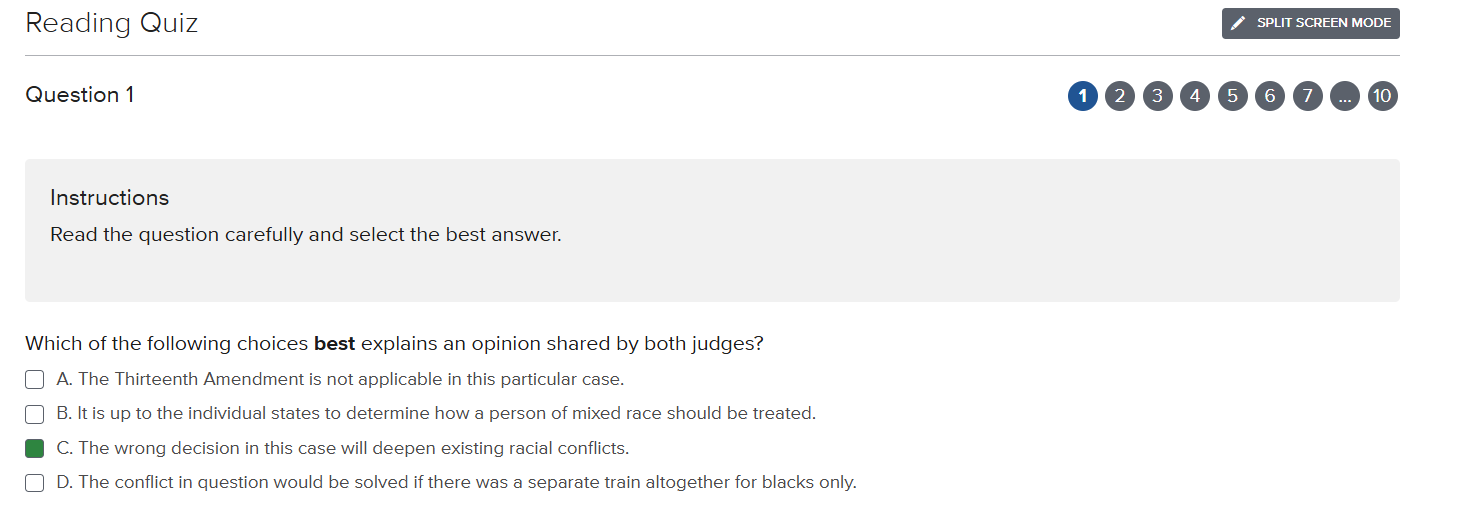
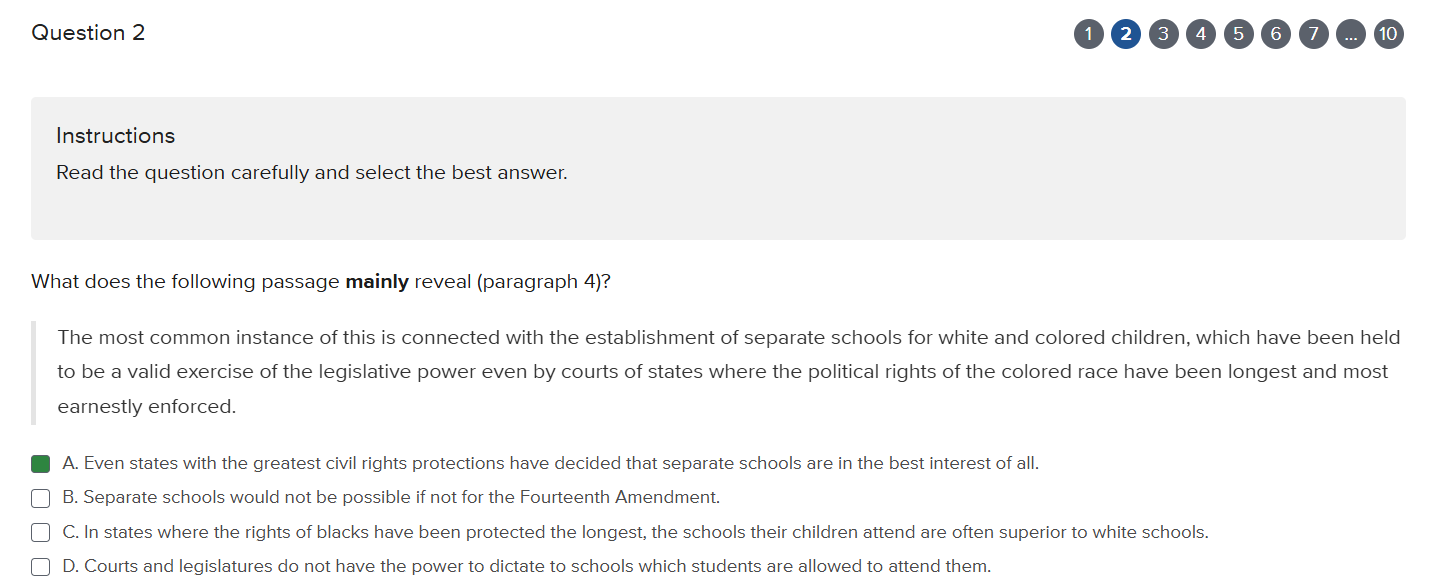
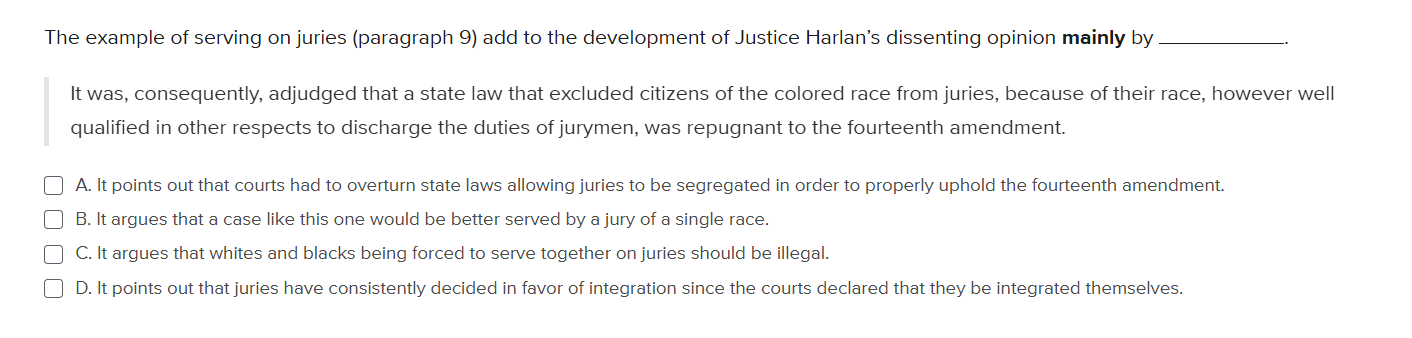

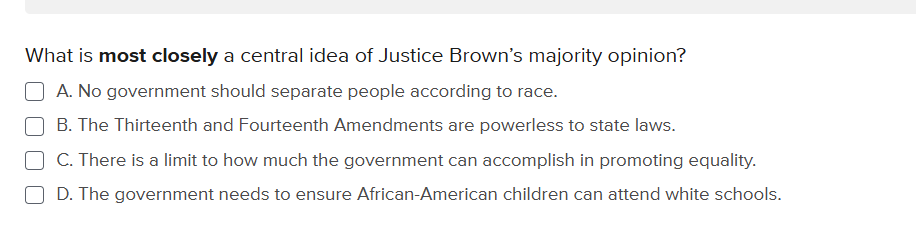
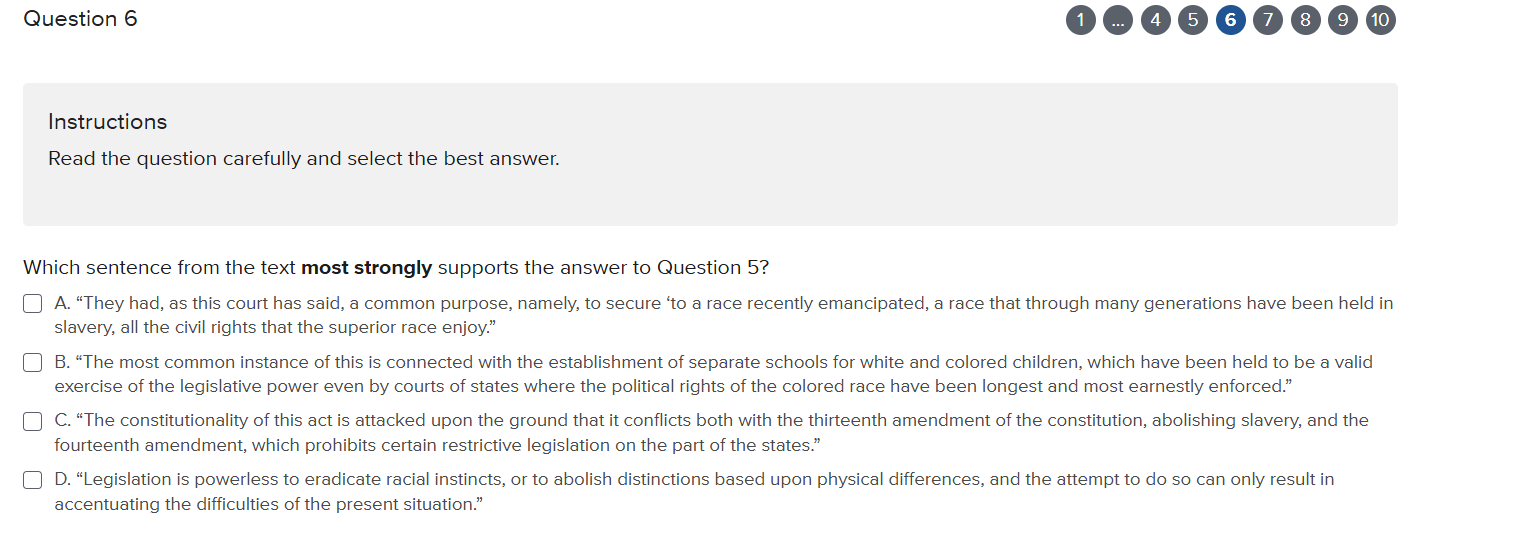
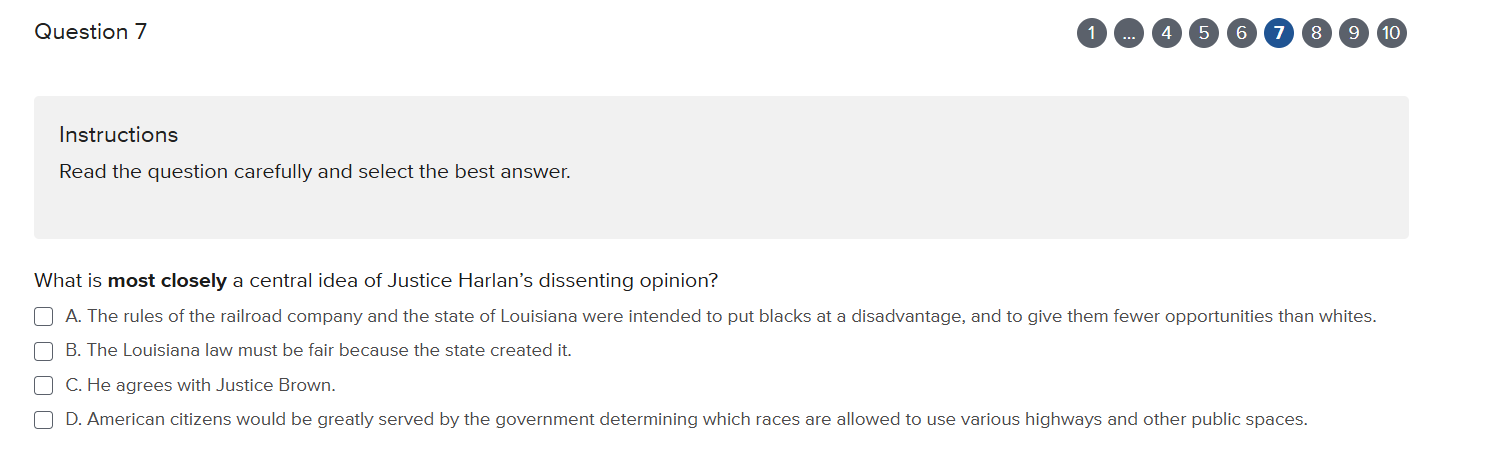
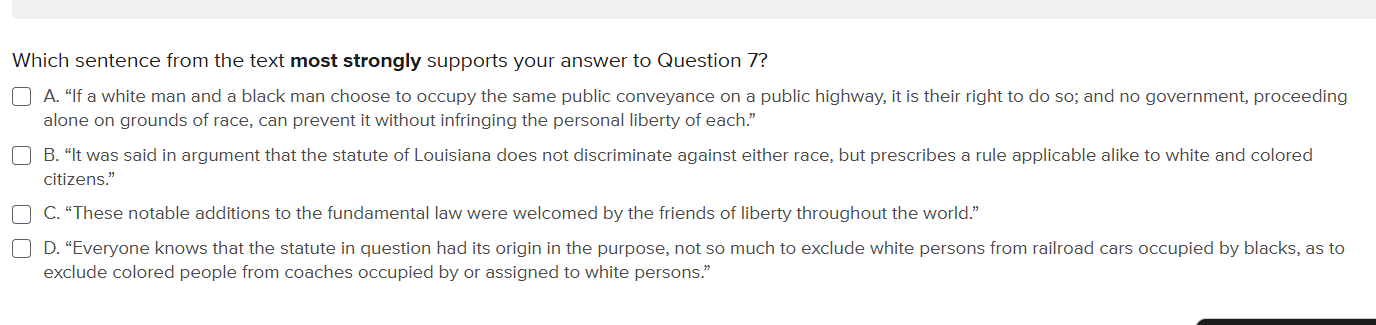
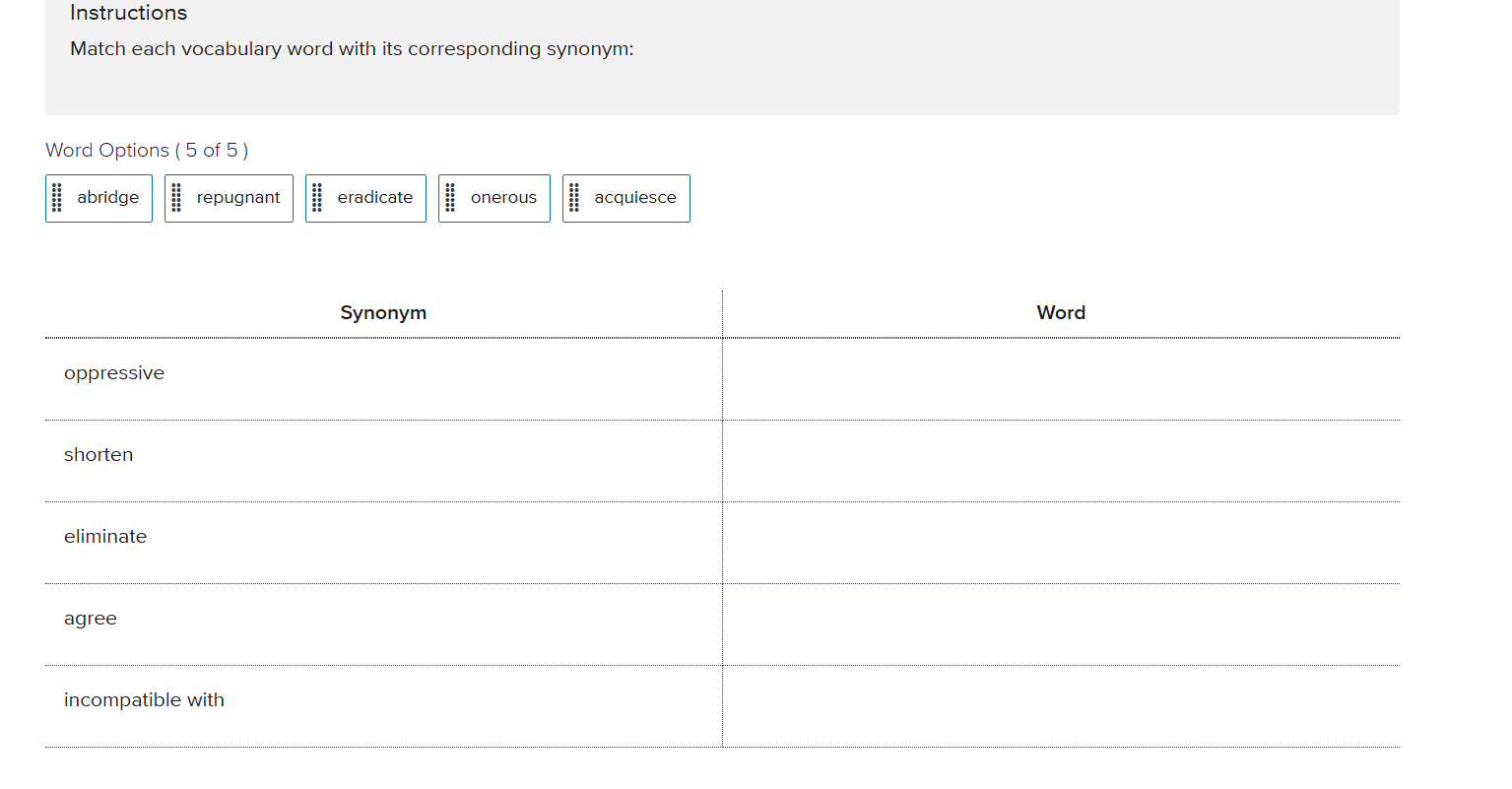
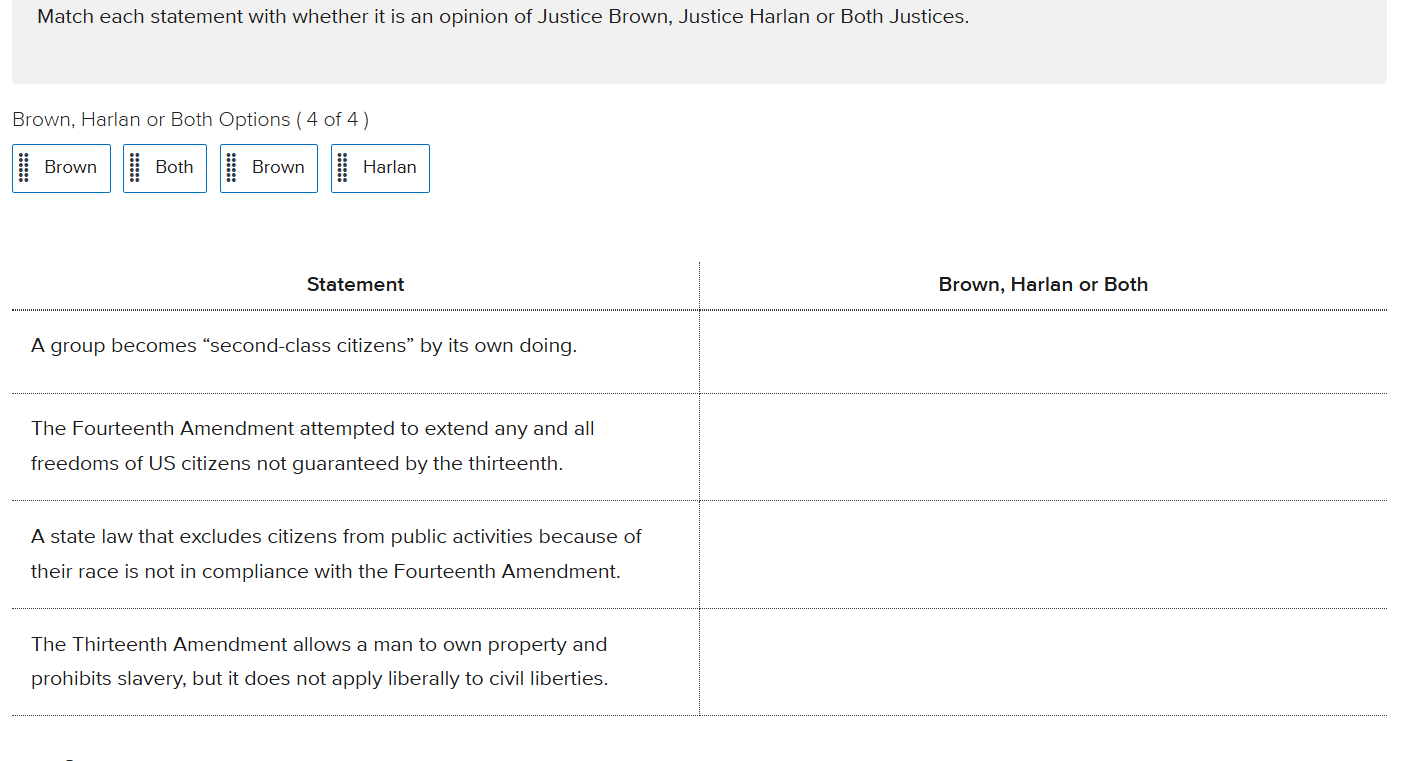 Reading Quiz Question 1 oeeoee Instructions Read the question carefully and select the best answer. Which of the following choices best explains an opinion shared by both judges? (] A. The Thirteenth Amendment is not applicable in this particular case. (] B.ltis up to the individual states to determine how a person of mixed race should be treated. B C. The wrong decision in this case will deepen existing racial conflicts. D. The conflict in question would be solved if there was a separate train altogether for blacks only. Question 2 00906600@ Instructions Read the question carefully and select the best answer. What does the following passage mainly reveal (paragraph 4)? The most common instance of this is connected with the establishment of separate schools for white and colored children, which have been held to be a valid exercise of the legislative power even by courts of states where the political rights of the colored race have been longest and most earnestly enforced. B A Even states with the greatest civil rights protections have decided that separate schools are in the best interest of all. B. Separate schools would not be possible if not for the Fourteenth Amendment. () C.In states where the rights of blacks have been protected the longest, the schools their children attend are often superior to white schools. D. Courts and legislatures do not have the power to dictate to schools which students are allowed to attend them. The example of serving on juries (paragraph 9) add to the development of Justice Harlan's dissenting opinion mainly by It was, consequently, adjudged that a state law that excluded citizens of the colored race from juries, because of their race, however well qualified in other respects to discharge the duties of jurymen, was repugnant to the fourteenth amendment. A.lt points out that courts had to overturn state laws allowing juries to be segregated in order to properly uphold the fourteenth amendment. [J B.lItargues that a case like this one would be better served by a jury of a single race. (] C. It argues that whites and blacks being forced to serve together on juries should be illegal. [J D. It points out that juries have consistently decided in favor of integration since the courts declared that they be integrated themselves. Which of the following statements best explains how Justice Brown would defend the railroad company's rule separating people by race? [ ] A. He would argue racism is so common it should be acceptable. [J B.He would say the rule should be just be ignored. (] C.He would say it is the responsibility of the two races themselves to find reasons to appreciate one another and abolish these differences. [J D.He would argue that the railroad company should apologize to their workers. What is most closely a central idea of Justice Brown's majority opinion? (] A. No government should separate people according to race. (] B. The Thirteenth and Fourteenth Amendments are powerless to state laws. (] C.There is a limit to how much the government can accomplish in promoting equality. [ ) D. The government needs to ensure African-American children can attend white schools. Question 6 00099099@ Instructions Read the question carefully and select the best answer. Which sentence from the text most strongly supports the answer to Question 57 [ A.\"They had, as this court has said, a common purpose, namely, to secure 'to a race recently emancipated, a race that through many generations have been held in slavery, all the civil rights that the superior race enjoy.\" [ B. \"The most common instance of this is connected with the establishment of separate schools for white and colored children, which have been held to be a valid exercise of the legislative power even by courts of states where the political rights of the colored race have been longest and most earnestly enforced.\" [ C.\"The constitutionality of this act is attacked upon the ground that it conflicts both with the thirteenth amendment of the constitution, abolishing slavery, and the fourteenth amendment, which prohibits certain restrictive legislation on the part of the states\" () D.*\"Legislation is powerless to eradicate racial instincts, or to abolish distinctions based upon physical differences, and the attempt to do so can only result in accentuating the difficulties of the present situation.\" Question 7 0009@0@9@ Instructions Read the question carefully and select the best answer. What is most closely a central idea of Justice Harlan's dissenting opinion? [ A. The rules of the railroad company and the state of Louisiana were intended to put blacks at a disadvantage, and to give them fewer opportunities than whites. B. The Louisiana law must be fair because the state created it. C.He agrees with Justice Brown. [ D. American citizens would be greatly served by the government determining which races are allowed to use various highways and other public spaces. Which sentence from the text most strongly supports your answer to Question 77 [) A.\"If a white man and a black man choose to occupy the same public conveyance on a public highway. it is their right to do so; and no government, proceeding alone on grounds of race, can prevent it without infringing the personal liberty of each.\" [J B.*It was said in argument that the statute of Louisiana does not discriminate against either race, but prescribes a rule applicable alike to white and colored citizens.\" C.\"These notable additions to the fundamental law were welcomed by the friends of liberty throughout the world.\" (7] D.\"Everyone knows that the statute in question had its origin in the purpose, not so much to exclude white persons from railroad cars occupied by blacks, as to exclude colored people from coaches occupied by or assigned to white persons.\" Instructions Match each vocabulary word with its corresponding synonym: Word Options (5 of 5) eradicate abridge acquiesce ' repugnant ' onerous ' Synonym Word oppressive incompatible with Match each statement with whether it is an opinion of Justice Brown, Justice Harlan or Both Justices. Brown, Harlan or Both Options (4 of 4) P Brown Brown Harlan ! Both ' aan Statement Brown, Harlan or Both A group becomes \"second-class citizens\" by its own doing. The Fourteenth Amendment attempted to extend any and all freedoms of US citizens not guaranteed by the thirteenth. A state law that excludes citizens from public activities because of their race is not in compliance with the Fourteenth Amendment. The Thirteenth Amendment allows a man to own property and prohibits slavery, but it does not apply liberally to civil liberties
Step by Step Solution
There are 3 Steps involved in it

Get step-by-step solutions from verified subject matter experts
 Study Help