







Question: Could I please have the worked solution for the following question: Illustrating your answer with sketches, explain how the mapping: s=T2tanh(2T) employed in the bi-linear
Could I please have the worked solution for the following question:


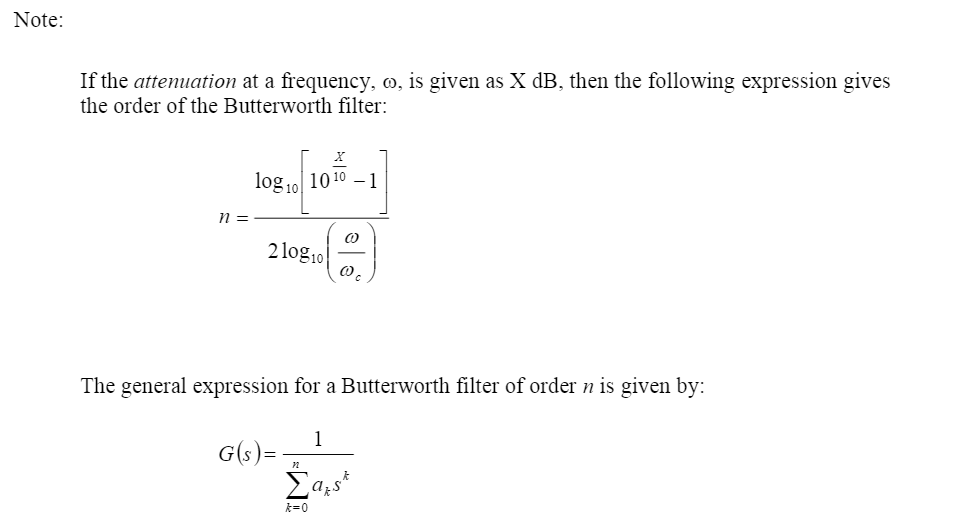
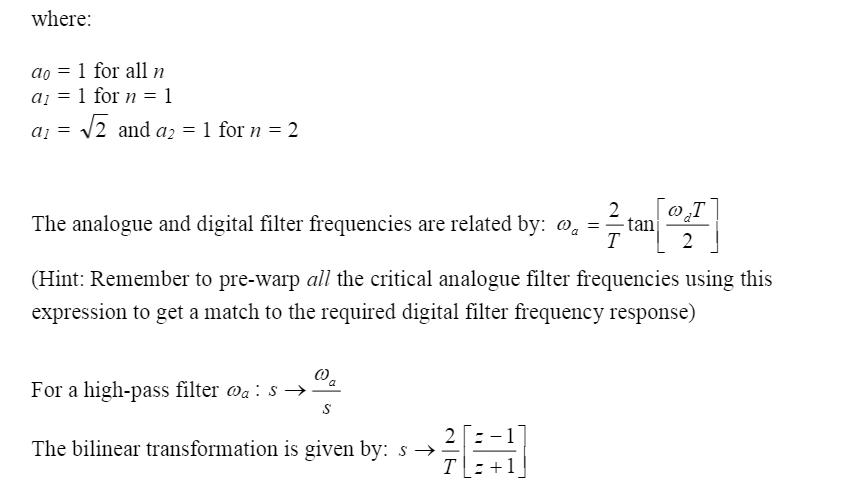
Illustrating your answer with sketches, explain how the mapping: s=T2tanh(2T) employed in the bi-linear transform method of converting an analogue filter into an equivalent digital filter avoids the problem of aliasing encountered with other methods. Using the bi-linear transform method, determine the pulse transfer function, G(z), of a high-pass digital filter having a 3dB cut-off frequency of fc=1200Hz and an attenuation of 15dB at 600Hz. The sampling period is T=0.25 milliseconds. The filter should be based on a Butterworth prototype filter of appropriate order. If the attenuation at a frequency, , is given as XdB, then the following expression gives the order of the Butterworth filter: n=2log10(c)log10[1010X1] The general expression for a Butterworth filter of order n is given by: G(s)=k=0naksk1 where: a0=1forallna1=1forn=1a1=2anda2=1forn=2 The analogue and digital filter frequencies are related by: a=T2tan[2dT] (Hint: Remember to pre-warp all the critical analogue filter frequencies using this expression to get a match to the required digital filter frequency response) For a high-pass filter a:ssa The bilinear transformation is given by: sT2[z+1z1]
Step by Step Solution
There are 3 Steps involved in it

Get step-by-step solutions from verified subject matter experts
 Study Help