



Question: could someone explain in details? What theorem it applys? If f(n)=(g(n)) and g(n)=(h(n)), then f(n)=(h(n)) True False If f (n) (g and g (n) =
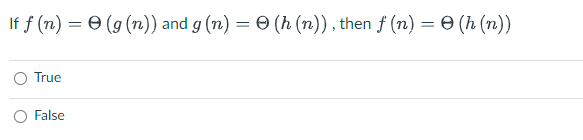
could someone explain in details? What theorem it applys?
If f(n)=(g(n)) and g(n)=(h(n)), then f(n)=(h(n)) True False
If f (n) (g and g (n) = C) True C) False (h (n)) , then f (n) = (h (n))
Step by Step Solution
There are 3 Steps involved in it
1 Expert Approved Answer
Step: 1 Unlock

Question Has Been Solved by an Expert!
Get step-by-step solutions from verified subject matter experts
Step: 2 Unlock
Step: 3 Unlock