





Question: Could someone explain what I should do in this C function? (a) Delete the #include statement. (b) Rewrite the C function TerminalPrint() so that the
 Could someone explain what I should do in this C function?(a) Delete the #include statement. (b) Rewrite the C function TerminalPrint() so

Could someone explain what I should do in this C function?

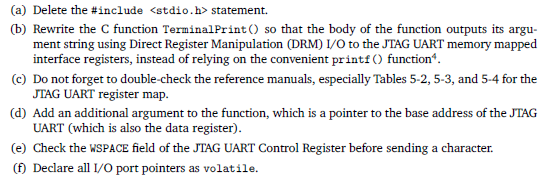
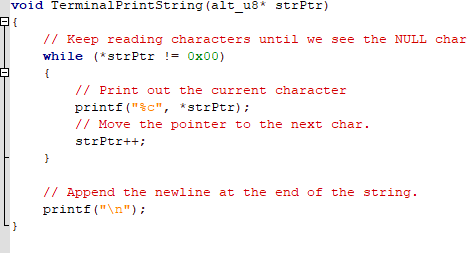
(a) Delete the #include statement. (b) Rewrite the C function TerminalPrint() so that the body of the function outputs its argu- ulation (DRM) I/O to the JTAG UART memory mapped erface registers, instead of relying on the convenient printf() function. (c) Do not forget to double-check the reference manuals, especially Tables 5-2,5-3, and 5-4 for the JTAG UART register map. (d) Add an additional argument to the function, which is a pointer to the base address of the JTAG UART (which is also the data register). (e) Check the WSPACE field of the JTAG UART Control Register before sending a character. (f) Declare all I/O port pointers as volatile. void TerminalPrintString(altu8* strptr) // Keep reading characters until we see the NULL char while (strPtr != 0x00) // Print out the current character printf("%c", *stretr); // Move the pointer to the next char. strPtr++; // Append the newline at the end of the string. printf(" "); (a) Delete the #include statement. (b) Rewrite the C function TerminalPrint() so that the body of the function outputs its argu- ulation (DRM) I/O to the JTAG UART memory mapped erface registers, instead of relying on the convenient printf() function. (c) Do not forget to double-check the reference manuals, especially Tables 5-2,5-3, and 5-4 for the JTAG UART register map. (d) Add an additional argument to the function, which is a pointer to the base address of the JTAG UART (which is also the data register). (e) Check the WSPACE field of the JTAG UART Control Register before sending a character. (f) Declare all I/O port pointers as volatile. void TerminalPrintString(altu8* strptr) // Keep reading characters until we see the NULL char while (strPtr != 0x00) // Print out the current character printf("%c", *stretr); // Move the pointer to the next char. strPtr++; // Append the newline at the end of the string. printf(" ")

Step by Step Solution

There are 3 Steps involved in it

1 Expert Approved Answer
Step: 1 Unlock blur-text-image
Question Has Been Solved by an Expert!

Get step-by-step solutions from verified subject matter experts

Step: 2 Unlock
Step: 3 Unlock

Students Have Also Explored These Related Databases Questions!