







Question: could someone help please As consumers, we often experience quantity discounts like buy three, get one free. Businesses also are offered quantity discounts. For example,
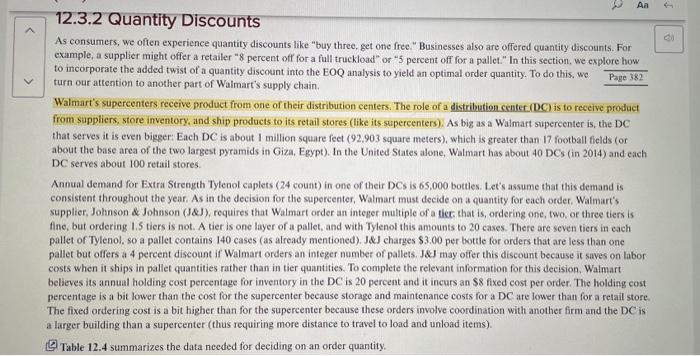
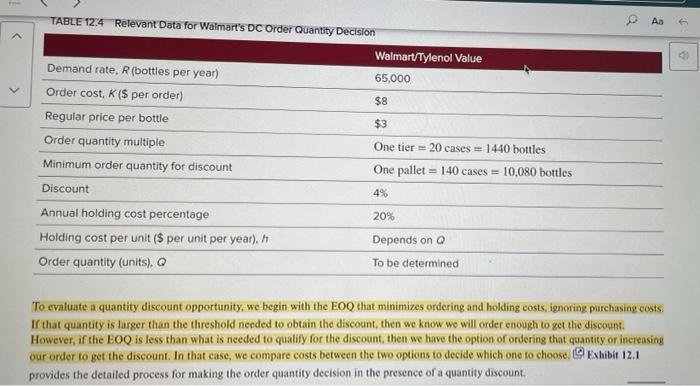
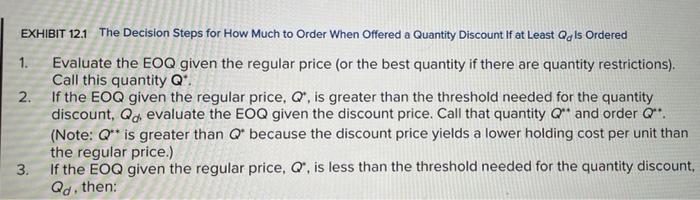
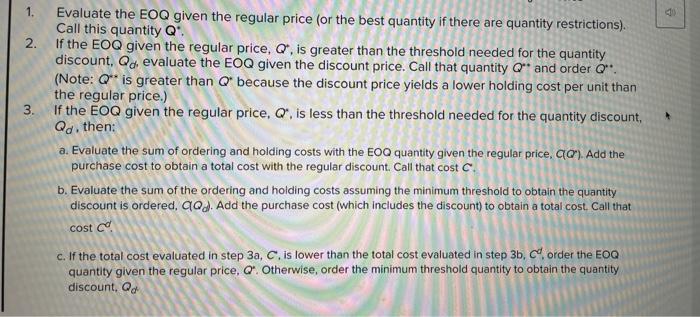
As consumers, we often experience quantity discounts like "buy three, get one free." Businesses also are offered quantity discounts. For example, a supplier might offer a retailer "8 percent off for a full truckload" or "5 percent off for a pallet." In this section, we explore how to incorporate the added twist of a quantity discount into the EOQ analysis to yield an optimal order quantity. To do this, we Page 382 turn our attention to another part of Walmart's supply chain. Walmart's supercenters receive product from one of their distribution centers. The role of a distribution center (DC) is to receive product from suppliers, store inventory, and ship products to its retail stores (like its supercenters). As big as a Waimart supercenter is, the DC that serves it is even bigger: Each DC is about I million square feet (92,903 square meters), which is greater than 17 football fields (or about the base area of the two largest pyramids in Giza, Egypt). In the United States alone, Walmart has about 40DCs (in 2014) and each DC serves about 100 retail stores. Annual demand for Extra Strength Tylenol caplets (24 count) in one of their DCs is 65,000 bottles. Let's assume that this demand is consistent throughout the year. As in the decision for the supercenter, Walmart must decide on a quantity for each order. Walmart's supplier, Johnson \& Johnson (J\&J), requires that Walmart order an integer multiple of a tice that is, ordering one, two, or three tiers is fine, but ordering 1.5 tiers is not. A tier is one layer of a pallet, and with Tylenol this amounts to 20 cases. There are seven tiers in each pallet of Tylenol, so a pallet contains 140 cases (as already mentioned). J\&J charges $3.00 per bottle for orders that are less than one pallet but offers a 4 percent discount if Walmart orders an integer number of pallets. J\&J may offer this discount because it saves on labor costs when it ships in pallet quantities rather than in tier quantities. To complete the relevant information for this decision, Walmart believes its annual holding cost percentage for inventory in the DC is 20 percent and it incurs an $8 fixed cost per order. The holding cost percentage is a bit lower than the cost for the supercenter because storage and maintenance costs for a DC are lower than for a retail store. The fixed ordering cost is a bit higher than for the supercenter because these orders involve coordination with another firm and the DC is a larger building than a supereenter (thus requiring more distance to travel to load and unload items). (9) Table 12.4 summarizes the data needed for deciding on an order quantity. To evaluate a quantity discount opportunity, we begin with the EOQ that minimizes ordering and holding costs, ignoring purchasing costs. If that quantity is larger than the threshold needed to obtain the discount, then we know we will order enough to get the discount. However, if the EOQ is less than what is needed to qualify for the discount, then we have the option of ordering that quantity or increasing our order to get the discount. In that case, we compare costs between the two options to decide which one to choose. [9 Exhibit 12.1 provides the detailed process for making the order quantity decision in the presence of a quantity discount. EXHIBIT 12.1 The Decision Steps for How Much to Order When Offered a Quantity Discount if at Least Qd Is Ordered 1. Evaluate the EOQ given the regular price (or the best quantity if there are quantity restrictions). Call this quantity Q. 2. If the EOQ given the regular price, Q, is greater than the threshold needed for the quantity discount, Qd. evaluate the EOQ given the discount price. Call that quantity Q and order Q. (Note: Q is greater than Q because the discount price yields a lower holding cost per unit than the regular price.) 3. If the EOQ given the regular price, Q, is less than the threshold needed for the quantity discount, Qd, then: 1. Evaluate the EOQ given the regular price (or the best quantity if there are quantity restrictions). Call this quantity Q : 2. If the EOQ given the regular price, Q, is greater than the threshold needed for the quantity discount, Qd, evaluate the EOQ given the discount price. Call that quantity Q and order Q. (Note: Q is greater than Q because the discount price yields a lower holding cost per unit than the regular price.) 3. If the EOQ given the regular price, Q :, is less than the threshold needed for the quantity discount, Qd, then: a. Evaluate the sum of ordering and holding costs with the EOQ quantity given the regular price, ((Q) ). Add the purchase cost to obtain a total cost with the regular discount. Call that cost C. b. Evaluate the sum of the ordering and holding costs assuming the minimum threshold to obtain the quantity discount is ordered, cQd. Add the purchase cost (which includes the discount) to obtain a total cost. Call that costCd c. If the total cost evaluated in step 3a,C, is lower than the total cost evaluated in step 3b,Cd, order the EOQ quantity given the regular price, Q *. Otherwise, order the minimum threshold quantity to obtain the quantity discount, Q As consumers, we often experience quantity discounts like "buy three, get one free." Businesses also are offered quantity discounts. For example, a supplier might offer a retailer "8 percent off for a full truckload" or "5 percent off for a pallet." In this section, we explore how to incorporate the added twist of a quantity discount into the EOQ analysis to yield an optimal order quantity. To do this, we Page 382 turn our attention to another part of Walmart's supply chain. Walmart's supercenters receive product from one of their distribution centers. The role of a distribution center (DC) is to receive product from suppliers, store inventory, and ship products to its retail stores (like its supercenters). As big as a Waimart supercenter is, the DC that serves it is even bigger: Each DC is about I million square feet (92,903 square meters), which is greater than 17 football fields (or about the base area of the two largest pyramids in Giza, Egypt). In the United States alone, Walmart has about 40DCs (in 2014) and each DC serves about 100 retail stores. Annual demand for Extra Strength Tylenol caplets (24 count) in one of their DCs is 65,000 bottles. Let's assume that this demand is consistent throughout the year. As in the decision for the supercenter, Walmart must decide on a quantity for each order. Walmart's supplier, Johnson \& Johnson (J\&J), requires that Walmart order an integer multiple of a tice that is, ordering one, two, or three tiers is fine, but ordering 1.5 tiers is not. A tier is one layer of a pallet, and with Tylenol this amounts to 20 cases. There are seven tiers in each pallet of Tylenol, so a pallet contains 140 cases (as already mentioned). J\&J charges $3.00 per bottle for orders that are less than one pallet but offers a 4 percent discount if Walmart orders an integer number of pallets. J\&J may offer this discount because it saves on labor costs when it ships in pallet quantities rather than in tier quantities. To complete the relevant information for this decision, Walmart believes its annual holding cost percentage for inventory in the DC is 20 percent and it incurs an $8 fixed cost per order. The holding cost percentage is a bit lower than the cost for the supercenter because storage and maintenance costs for a DC are lower than for a retail store. The fixed ordering cost is a bit higher than for the supercenter because these orders involve coordination with another firm and the DC is a larger building than a supereenter (thus requiring more distance to travel to load and unload items). (9) Table 12.4 summarizes the data needed for deciding on an order quantity. To evaluate a quantity discount opportunity, we begin with the EOQ that minimizes ordering and holding costs, ignoring purchasing costs. If that quantity is larger than the threshold needed to obtain the discount, then we know we will order enough to get the discount. However, if the EOQ is less than what is needed to qualify for the discount, then we have the option of ordering that quantity or increasing our order to get the discount. In that case, we compare costs between the two options to decide which one to choose. [9 Exhibit 12.1 provides the detailed process for making the order quantity decision in the presence of a quantity discount. EXHIBIT 12.1 The Decision Steps for How Much to Order When Offered a Quantity Discount if at Least Qd Is Ordered 1. Evaluate the EOQ given the regular price (or the best quantity if there are quantity restrictions). Call this quantity Q. 2. If the EOQ given the regular price, Q, is greater than the threshold needed for the quantity discount, Qd. evaluate the EOQ given the discount price. Call that quantity Q and order Q. (Note: Q is greater than Q because the discount price yields a lower holding cost per unit than the regular price.) 3. If the EOQ given the regular price, Q, is less than the threshold needed for the quantity discount, Qd, then: 1. Evaluate the EOQ given the regular price (or the best quantity if there are quantity restrictions). Call this quantity Q : 2. If the EOQ given the regular price, Q, is greater than the threshold needed for the quantity discount, Qd, evaluate the EOQ given the discount price. Call that quantity Q and order Q. (Note: Q is greater than Q because the discount price yields a lower holding cost per unit than the regular price.) 3. If the EOQ given the regular price, Q :, is less than the threshold needed for the quantity discount, Qd, then: a. Evaluate the sum of ordering and holding costs with the EOQ quantity given the regular price, ((Q) ). Add the purchase cost to obtain a total cost with the regular discount. Call that cost C. b. Evaluate the sum of the ordering and holding costs assuming the minimum threshold to obtain the quantity discount is ordered, cQd. Add the purchase cost (which includes the discount) to obtain a total cost. Call that costCd c. If the total cost evaluated in step 3a,C, is lower than the total cost evaluated in step 3b,Cd, order the EOQ quantity given the regular price, Q *. Otherwise, order the minimum threshold quantity to obtain the quantity discount
Step by Step Solution
There are 3 Steps involved in it

Get step-by-step solutions from verified subject matter experts
 Study Help