







Question: Could someone only do Part B: physics representation and the 2 questions below As a concerned citizen, you have volunteered to serve on a committee
Could someone only do Part B: physics representation and the 2 questions below
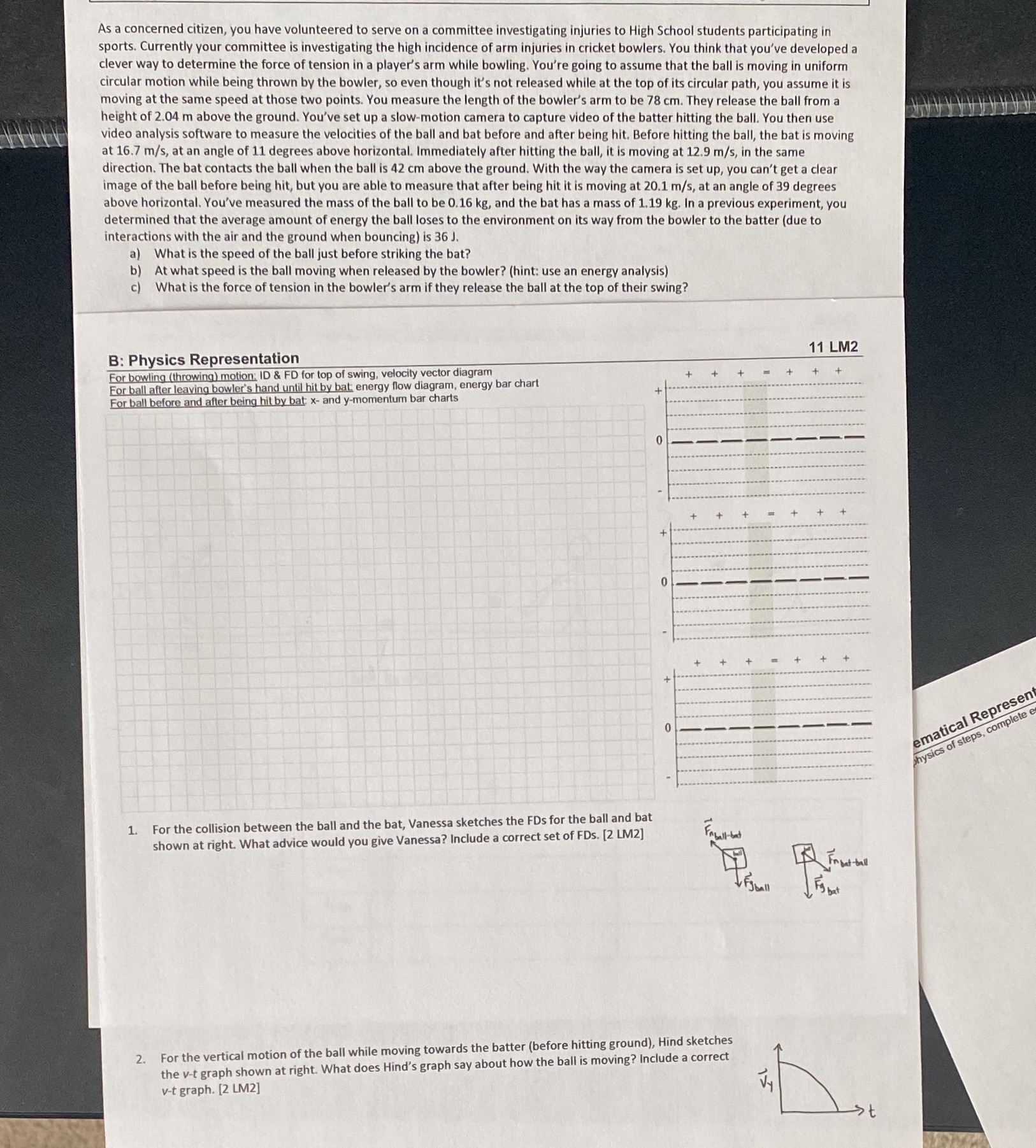
As a concerned citizen, you have volunteered to serve on a committee investigating injuries to High School students participating in sports. Currently your committee is investigating the high incidence of arm injuries in cricket bowlers. You think that you've developed a clever way to determine the force of tension in a player's arm while bowling. You're going to assume that the ball is moving in uniform circular motion while being thrown by the bowler, so even though it's not released while at the top of its circular path, you assume it is moving at the same speed at those two points. You measure the length of the bowler's arm to be 78 cm. They release the ball from a height of 2.04 m above the ground. You've set up a slow-motion camera to capture video of the batter hitting the ball. You then use video analysis software to measure the velocities of the ball and bat before and after being hit. Before hitting the ball, the bat is moving at 16.7 m/s, at an angle of 11 degrees above horizontal. Immediately after hitting the ball, it is moving at 12.9 m/s, in the same direction. The bat contacts the ball when the ball is 42 cm above the ground. With the way the camera is set up, you can't get a clear image of the ball before being hit, but you are able to measure that after being hit it is moving at 20.1 m/s, at an angle of 39 degrees above horizontal. You've measured the mass of the ball to be 0.16 kg, and the bat has a mass of 1.19 kg. In a previous experiment, you determined that the average amount of energy the ball loses to the environment on its way from the bowler to the batter (due to nteractions with the air and the ground when bouncing) is 36 J. a) What is the speed of the ball just before striking the bat? b) At what speed is the ball moving when released by the bowler? (hint: use an energy analysis) c) What is the force of tension in the bowler's arm if they release the ball at the top of their swing? 11 LM2 B: Physics Representation For bowling (throwing) motion: ID & FD for top of swing, velocity vector diagram For ball after leaving bowler's hand until hit by bat: energy flow diagram, energy bar chart For ball before and after being hit by bat x- and y-momentum bar charts ematical Represen hysics of steps, complete . For the collision between the ball and the bat, Vanessa sketches the FDs for the ball and bat shown at right. What advice would you give Vanessa? Include a correct set of FDs. [2 LM2] For the vertical motion of the ball while moving towards the batter (before hitting ground), Hind sketches the v-t graph shown at right. What does Hind's graph say about how the ball is moving? Include a correct v-t graph. [2 LM2] st
Step by Step Solution
There are 3 Steps involved in it

Get step-by-step solutions from verified subject matter experts
 Study Help