



Question: Could someone please check my work and let me know if I correctly used all of the included theorems that are referenced in the proof
Could someone please check my work and let me know if I correctly used all of the included theorems that are referenced in the proof
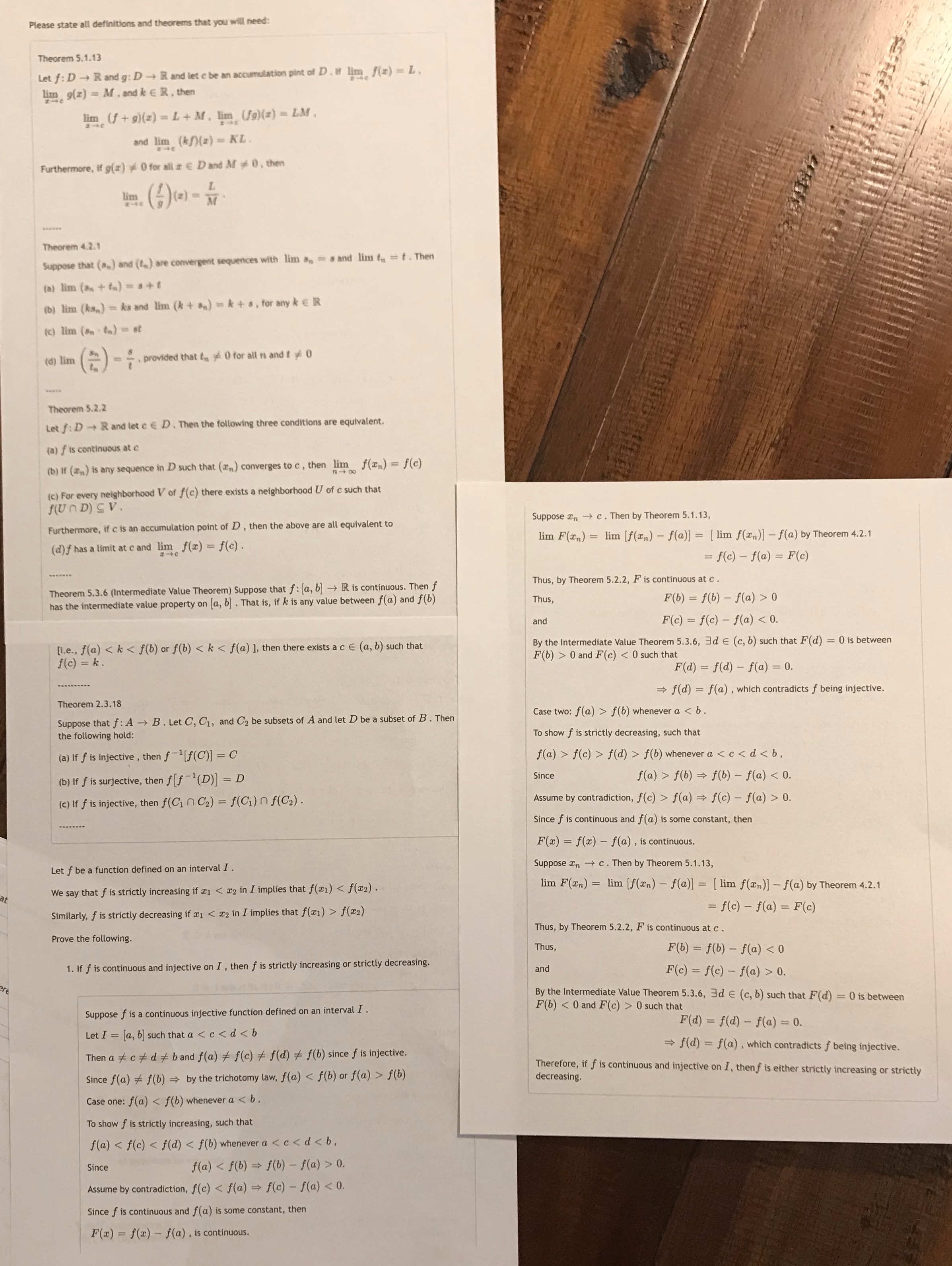
Please state all definitions and theorems that you will need: Theorem 5.1.13 Let f: D -> R and g: D -+ R and let c be an accumulation pint of D . If lim, f(x) = L. lim, 9(z) = M . and k E R. then lim (f + 9)(z) = L + M, lim (f9)(=) = LM. and lim (*))(z) - KL Furthermore, if g(x) * 0 for all a E D and M * 0. then Theorem 4.2.1 Suppose that (a.) and (to) are convergent sequences with lim an = s and lim to = t . Then (a) lim (an + to) = s + t (b) lim (ks.) = ks and lim (k + an) = k + 8 , for any k E R (c) lim (an . to) = at (0) lim ( ) = , provided that in * 0 for all n and t * 0 Theorem 5.2.2 Let f: D - R and let c E D. Then the following three conditions are equivalent. (a) f is continuous at c (b) If (n) is any sequence in D such that (In.) converges to c, then lim f(In) = f(c) (c) For every neighborhood V of f(c) there exists a neighborhood U of c such that f(UnD) CV. Furthermore, if c is an accumulation point of D , then the above are all equivalent to Suppose In -+ C. Then by Theorem 5.1. 13, (d) f has a limit at c and lim f(z) = f(c) . lim F(In) = lim [f(In) - f(a)] = [ lim f(In)] - f(a) by Theorem 4.2.1 = f(c) - f(a) = F(c) Theorem 5.3.6 (Intermediate Value Theorem) Suppose that f: [a, b] - R is continuous. Then Thus, by Theorem 5.2.2, F is continuous at c . has the intermediate value property on [a, b] . That is, if k is any value between f(a) and f(b) Thus , F (b) = f (b) - f (a) > o and F(c) = f(c) - f(a) 0 and F(c) f(b) whenever a f ( c ) > f ( d) > f (b ) whenever a f ( b ) = f ( b ) - f ( a ) f(a) = f(c) - f(a) > 0. since f is continuous and f (a) is some constant, then F(x) = f(x) - f(a) , is continuous. Let f be a function defined on an interval I . Suppose In - C. Then by Theorem 5.1.13, We say that f is strictly increasing if 21 f(2:2) = f(c) - f(a) = F(c) Prove the following Thus, by Theorem 5.2.2, F is continuous at c . Thus, F(b) = f(b) - f(a) 0. By the Intermediate Value Theorem 5.3.6, 3d E (c, b) such that F(d) = 0 is between Suppose f is a continuous injective function defined on an interval I . F(b) 0 such that Let I = [a, b] such that a f(b) decreasing Therefore, if f is continuous and injective on I, then f is either strictly increasing or strictly Case one: f(a) 0 . Assume by contradiction, f(c)
Step by Step Solution
There are 3 Steps involved in it

Get step-by-step solutions from verified subject matter experts