







Question: Could someone please design a verilog code for the following? Really need help with this for a final project or I may fail, thanks will
Could someone please design a verilog code for the following? Really need help with this for a final project or I may fail, thanks will rate thumbs up.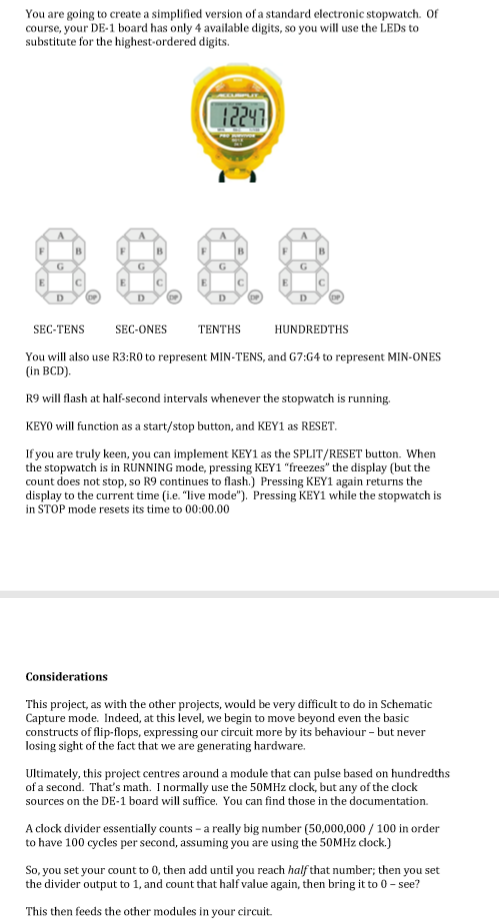
You are going to create a simplified version of a standard electronic stopwatch. Of course, your DE-1 board has only 4 available digits, so you will use the LEDs to substitute for the highest-ordered digits. 122 SEC-TENS SEC-ONES TENTHS HUNDREDTHS You will also use R3:RO to represent MIN-TENS, and G7:G4 to represent MIN-ONES (in BCD) R9 will flash at half-second intervals whenever the stopwatch is running KEYOl function as a start/stop button, and KEY1 as RESET If you are truly keen, you can implement KEY1 as the SPLIT/RESET button. When the stopwatch is in RUNNING mode, pressing KEY1 "freezes" the display (but the count does not stop, so R9 continues to flash.) Pressing KEY1 again returns the display to the current time (i.e. "live mode". Pressing KEY1 while the stopwatch is in STOP mode resets its time to 00:00,00 Considerations This project, as with the other projects, would be very difficult to do in Schematic Capture mode. Indeed, at this level, we begin to move beyond even the basic constructs of flip-flops, expressing our circuit more by its behaviour-but never losing sight of the fact that we are generating hardware. Ultimately, this project centres around a module that can pulse based on hundredths of a second. That's math. I normally use the 50MHz clock, but any of the clock sources on the DE-1 board will suffice, You can find those in the documentation. A clock divider essentially counts- a really big number (50,000,000 100 in order to have 100 cycles per second, assuming you are using the 50MHz clock.) So, you set your count to 0, then add until you reach half that number; then you set the divider output to 1, and count that half value again, then bring it to 0- see? This then feeds the other modules in your circuit. You are going to create a simplified version of a standard electronic stopwatch. Of course, your DE-1 board has only 4 available digits, so you will use the LEDs to substitute for the highest-ordered digits. 122 SEC-TENS SEC-ONES TENTHS HUNDREDTHS You will also use R3:RO to represent MIN-TENS, and G7:G4 to represent MIN-ONES (in BCD) R9 will flash at half-second intervals whenever the stopwatch is running KEYOl function as a start/stop button, and KEY1 as RESET If you are truly keen, you can implement KEY1 as the SPLIT/RESET button. When the stopwatch is in RUNNING mode, pressing KEY1 "freezes" the display (but the count does not stop, so R9 continues to flash.) Pressing KEY1 again returns the display to the current time (i.e. "live mode". Pressing KEY1 while the stopwatch is in STOP mode resets its time to 00:00,00 Considerations This project, as with the other projects, would be very difficult to do in Schematic Capture mode. Indeed, at this level, we begin to move beyond even the basic constructs of flip-flops, expressing our circuit more by its behaviour-but never losing sight of the fact that we are generating hardware. Ultimately, this project centres around a module that can pulse based on hundredths of a second. That's math. I normally use the 50MHz clock, but any of the clock sources on the DE-1 board will suffice, You can find those in the documentation. A clock divider essentially counts- a really big number (50,000,000 100 in order to have 100 cycles per second, assuming you are using the 50MHz clock.) So, you set your count to 0, then add until you reach half that number; then you set the divider output to 1, and count that half value again, then bring it to 0- see? This then feeds the other modules in your circuit
Step by Step Solution
There are 3 Steps involved in it

Get step-by-step solutions from verified subject matter experts
 Study Help