







Question: Could someone please help me write this code? Including the user input and assertion errors. If you could please notate your functions and let me
Could someone please help me write this code? Including the user input and assertion errors. If you could please notate your functions and let me know what they are doing, that would be very helpful.
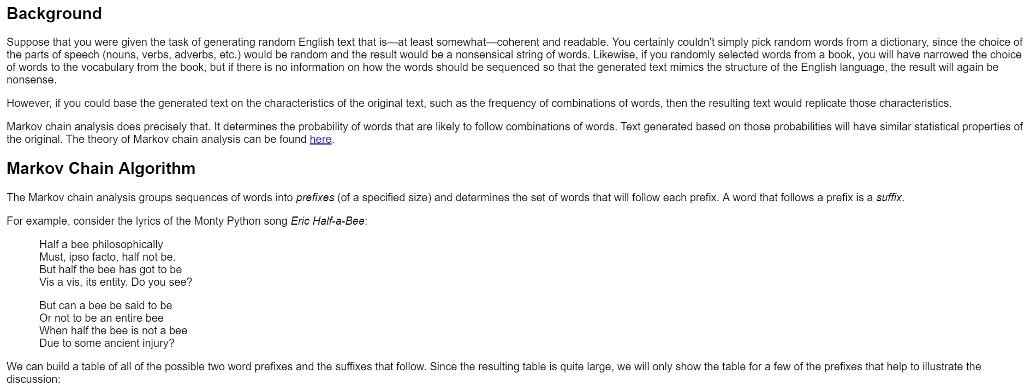
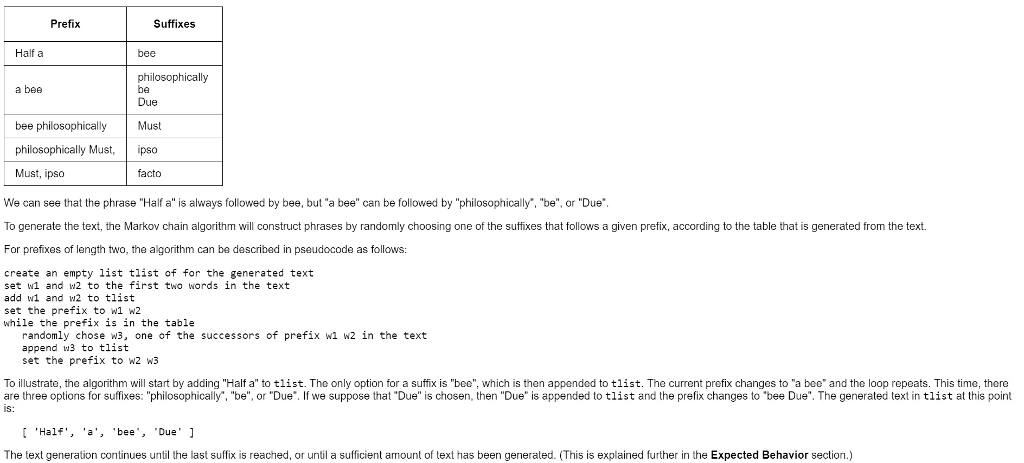
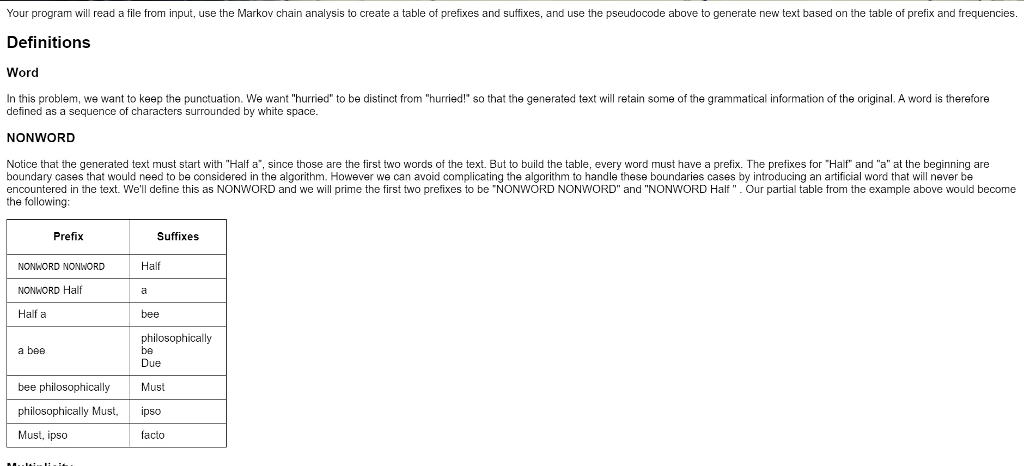
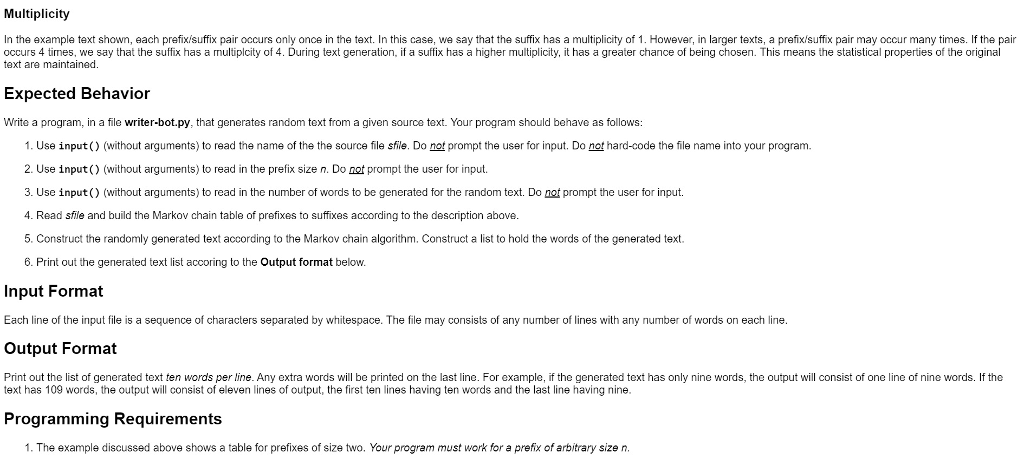
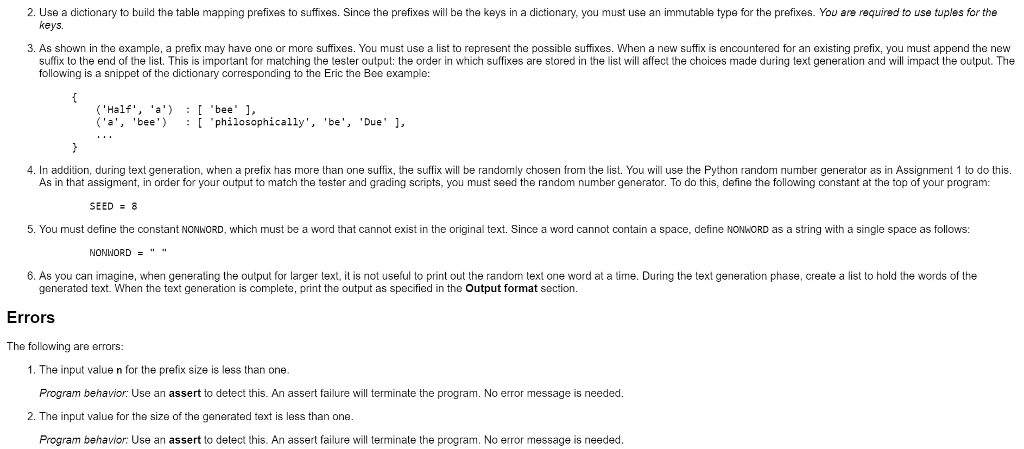
Background Suppose that you were given the task of generating random English text that is-at least somewhat-coherent and readable. You certainly couldn't simply pick random words from a dictionary, since the choice of the parts of speech (nouns, verbs, adverbs, etc.) would be random and the result would be a nansensical string of words. Likewise, if you randomly selected words from a book, you will have narrowed the choice of words to the vocabulary from the book, but if there is no information on how the words should be sequenced so that the generated text mimics the structure of the English language, the result will again be nonsense. However, if you could base the generated text on the characteristics of the original text, such as the frequency of combinations of words, then the resulting text would replicate those characteristics. Markov chain analysis does precisely that. It determines the probability of words that are likely to follow combinations of words. Text ganerated based on those probabilities will have similar statistical properties of the original. The theory of Markov chain analysis can be found here. Markov Chain Algorithm The Markov chain analysis groups sequences of words into prefixes (of a specified size) and determines the set of words that will follow each prefix. A word that follows a prefix is a suffix. For example, consider the lyrics of the Monty Python song Eric Half-a-Bee Half a bee philosophically Must, ipso facto, half not be. But half the bee has got to be Vis a vis, its entity. Do you see? But can a bee be said to be Or not to be an entire bee When half the bee is not a bee Due to some ancient injury? We can build a table of all of the possible two word prefixes and the suffixes that follow. Sincethe resulting table is quite large, we will only show the table for a few of the prefixes that help to illustrate the discussion: Prefix Suffixes Half a bee philosophically be Due a bee bee philosophically Must philosophically Must, ipso Must, ipsc We can see that the phrase "Half a" is always followed by bee, but "a bee" can be followed by "philosophically", "be", or "Due To generate the text, the Markov chain algorithm will construct phrases by randomly choosing one of the suffixes that follows a given prefix, according to the table that is generated from the text. For prefixes of length two, the algorithm can be described in pseudocode as follows facto create an empty 1ist tlist of for the generated text set wi and w2 to the first two words in the text add wi and w2 to tlist set the prefix to wi w2 while the prefix is in the table randomly chose w3, one of the successors of prefix wi w2 in the text append w3 to tlist set the prefix to w2 w3 To illustrate, the algorithm will start by adding "Half a" to tlist. The only option for a suffix is "beo", which is then appended to tlist. The current prefix changes to "a bee and the loop repeats. This time, there are three options for suffixes: "philosophically", "be", or "Due If we suppose that "Due" is chosen, then "Due" is appended to tlist and the prefix changes to "bee Due". The generated text in tlist at this point IS: ['Half', 'a', 'be Due The text generation continues until the last suffix is reached, or until a sufficient amount of text has been generated. (This is explained further in the Expected Behavior section.) Your program will read a file from input, use the Markov chain analysis to create a table of prefixes and suffixes, and use the pseudocode above to generate new text based on the table of prefix and frequencies Definitions Word In this problem, we want to keep the punctuation. We want "hurried" to be distinct from "hurried!" so that the generated text will retain some of the grammatical information of the original. A word is therefore defined as a sequence of characters surrounded by white space. NONWORD Notice that the generated text must start with "Half a, since those are the first two words of the text. But to build the table, every word must have a prefix. The prefixes for Half" and "a" at the beginning are boundary cases that would need to be considered in the algorithm. However we can avoid complicating the algorithm to handle these boundaries cases by introducing an artificial word that will never be encountered in the text. We'll define this as NONWORD and we will prime the first two prefixes to be "NONWORD NONWORD" and "NONWORD Half ". Our partial table from the example above would become the following: Prefix Suffixes Half NONWORD NONWORD NONWORD Half Half a bee philosophically a bee be Due bee philosophically Must philosophically Must,ipo Must, ipso facto Multiplicity In the example text shown, each prefixisuffix pair occurs only ance in the text. In this case, we say that the suffix has a multiplicity of 1. However, in larger texts, a prefix/suffix pair may occur many times. If the pair occurs 4 times, we say that the suffix has a multiplcity of 4. During text generation, if a suffix has a higher multiplicity, it has a greater chance of being chosen. This means the statistical properties of the original text are maintained Expected Behavior Write a program, in a file writer-bot.py, that generates random text from a given source text. Your program should behave as follows: 1. Use input) (without arguments) to read the name of the the source file sfile. Do not prompt the user for input. Do not hard-code the file name into your program. 2. Use input () (without arguments) to read in the prefix size n. Do not prompt the user for input. 3. Use input) (without arguments) to read in the number of words to be generated for the random text. Do not prompt the user for input. 4. Read sfile and build the Markov chain table of prefixes to suffixes according to the description above. 5. Construct the randomly generated text according to the Markov chain algorithm. Construct a list to hold the words of the generated text. 6. Print out the generated text list accoring to the Output format below. Input Format Each line of the input file is a sequence of characters separated by whitespace. The file may consists of any number of lines with any number of words on each line. Output Format Print out the list of generated text ten words per line. Any extra words will be printed on the last line. For example, if the generated text has only nine words, the output will consist of one line of nine words. If the text has 109 words, the output will consist of eleven lines of output, the first ten lines having ten words and the last line having nine. Programming Requirement:s 1. The example discussed above shows a table for prefixes of size two. Your program must work for a prefix of arbitrary size n 2. Use a dictionary to build the table mapping prefixes to suffixes. Since the prefixes wl be he keys in a dictionary, you must use an immutable type for the prefixes. You are required to use tuples for the keys. 3. As shown in the example, a prefix may have one or more suffixes. You must use a list to represent the possible suffixes. When a new suffix is encountered for an existing prefix, you must append the new suffix to the end of the list. This is important for matching the tester output: the order in which suffixes are stored in the list will affect the choices made during text generation and will impact the output. The following is a snippet of the dictionary corresponding to the Eric the Bee example: ('a', 'beephilosophically', 'be', Due' 4. In addition, during text generation, when a prefix has more than one suffix, the suffix will be randomly chosen from the list. You will use the Python random number generator as in Assignment 1 to do this. As in that assigment, in order for your output to match the tester and grading scripts, you must seed the random number generator. To do this, define the following constant at the top of your program: SEED 8 5. You must define the constant NONWORD, which must be a word that cannot exist in the original text. Since a word cannot contain a space, define NONWORD as a string with a single space as follows: NONWORD" 6. As you can imagine, when generating the output for larger text, is not useful to print out the random text one word at a time. During the text generation phase, create a list to hold the words of the Errors The following are errors generated text. When the text generation is complete, print the output as specified in the Output format section 1. The input value n for the prefix size is less than one Program behavior: Use an assert to detect this. An assert failure will terminate the program. No error message is needed. 2. The input value for the size of the generated text is less than one. Program behavior: Use an assert to detect this. An assert failure will terminate the program. No error message is needecd Background Suppose that you were given the task of generating random English text that is-at least somewhat-coherent and readable. You certainly couldn't simply pick random words from a dictionary, since the choice of the parts of speech (nouns, verbs, adverbs, etc.) would be random and the result would be a nansensical string of words. Likewise, if you randomly selected words from a book, you will have narrowed the choice of words to the vocabulary from the book, but if there is no information on how the words should be sequenced so that the generated text mimics the structure of the English language, the result will again be nonsense. However, if you could base the generated text on the characteristics of the original text, such as the frequency of combinations of words, then the resulting text would replicate those characteristics. Markov chain analysis does precisely that. It determines the probability of words that are likely to follow combinations of words. Text ganerated based on those probabilities will have similar statistical properties of the original. The theory of Markov chain analysis can be found here. Markov Chain Algorithm The Markov chain analysis groups sequences of words into prefixes (of a specified size) and determines the set of words that will follow each prefix. A word that follows a prefix is a suffix. For example, consider the lyrics of the Monty Python song Eric Half-a-Bee Half a bee philosophically Must, ipso facto, half not be. But half the bee has got to be Vis a vis, its entity. Do you see? But can a bee be said to be Or not to be an entire bee When half the bee is not a bee Due to some ancient injury? We can build a table of all of the possible two word prefixes and the suffixes that follow. Sincethe resulting table is quite large, we will only show the table for a few of the prefixes that help to illustrate the discussion: Prefix Suffixes Half a bee philosophically be Due a bee bee philosophically Must philosophically Must, ipso Must, ipsc We can see that the phrase "Half a" is always followed by bee, but "a bee" can be followed by "philosophically", "be", or "Due To generate the text, the Markov chain algorithm will construct phrases by randomly choosing one of the suffixes that follows a given prefix, according to the table that is generated from the text. For prefixes of length two, the algorithm can be described in pseudocode as follows facto create an empty 1ist tlist of for the generated text set wi and w2 to the first two words in the text add wi and w2 to tlist set the prefix to wi w2 while the prefix is in the table randomly chose w3, one of the successors of prefix wi w2 in the text append w3 to tlist set the prefix to w2 w3 To illustrate, the algorithm will start by adding "Half a" to tlist. The only option for a suffix is "beo", which is then appended to tlist. The current prefix changes to "a bee and the loop repeats. This time, there are three options for suffixes: "philosophically", "be", or "Due If we suppose that "Due" is chosen, then "Due" is appended to tlist and the prefix changes to "bee Due". The generated text in tlist at this point IS: ['Half', 'a', 'be Due The text generation continues until the last suffix is reached, or until a sufficient amount of text has been generated. (This is explained further in the Expected Behavior section.) Your program will read a file from input, use the Markov chain analysis to create a table of prefixes and suffixes, and use the pseudocode above to generate new text based on the table of prefix and frequencies Definitions Word In this problem, we want to keep the punctuation. We want "hurried" to be distinct from "hurried!" so that the generated text will retain some of the grammatical information of the original. A word is therefore defined as a sequence of characters surrounded by white space. NONWORD Notice that the generated text must start with "Half a, since those are the first two words of the text. But to build the table, every word must have a prefix. The prefixes for Half" and "a" at the beginning are boundary cases that would need to be considered in the algorithm. However we can avoid complicating the algorithm to handle these boundaries cases by introducing an artificial word that will never be encountered in the text. We'll define this as NONWORD and we will prime the first two prefixes to be "NONWORD NONWORD" and "NONWORD Half ". Our partial table from the example above would become the following: Prefix Suffixes Half NONWORD NONWORD NONWORD Half Half a bee philosophically a bee be Due bee philosophically Must philosophically Must,ipo Must, ipso facto Multiplicity In the example text shown, each prefixisuffix pair occurs only ance in the text. In this case, we say that the suffix has a multiplicity of 1. However, in larger texts, a prefix/suffix pair may occur many times. If the pair occurs 4 times, we say that the suffix has a multiplcity of 4. During text generation, if a suffix has a higher multiplicity, it has a greater chance of being chosen. This means the statistical properties of the original text are maintained Expected Behavior Write a program, in a file writer-bot.py, that generates random text from a given source text. Your program should behave as follows: 1. Use input) (without arguments) to read the name of the the source file sfile. Do not prompt the user for input. Do not hard-code the file name into your program. 2. Use input () (without arguments) to read in the prefix size n. Do not prompt the user for input. 3. Use input) (without arguments) to read in the number of words to be generated for the random text. Do not prompt the user for input. 4. Read sfile and build the Markov chain table of prefixes to suffixes according to the description above. 5. Construct the randomly generated text according to the Markov chain algorithm. Construct a list to hold the words of the generated text. 6. Print out the generated text list accoring to the Output format below. Input Format Each line of the input file is a sequence of characters separated by whitespace. The file may consists of any number of lines with any number of words on each line. Output Format Print out the list of generated text ten words per line. Any extra words will be printed on the last line. For example, if the generated text has only nine words, the output will consist of one line of nine words. If the text has 109 words, the output will consist of eleven lines of output, the first ten lines having ten words and the last line having nine. Programming Requirement:s 1. The example discussed above shows a table for prefixes of size two. Your program must work for a prefix of arbitrary size n 2. Use a dictionary to build the table mapping prefixes to suffixes. Since the prefixes wl be he keys in a dictionary, you must use an immutable type for the prefixes. You are required to use tuples for the keys. 3. As shown in the example, a prefix may have one or more suffixes. You must use a list to represent the possible suffixes. When a new suffix is encountered for an existing prefix, you must append the new suffix to the end of the list. This is important for matching the tester output: the order in which suffixes are stored in the list will affect the choices made during text generation and will impact the output. The following is a snippet of the dictionary corresponding to the Eric the Bee example: ('a', 'beephilosophically', 'be', Due' 4. In addition, during text generation, when a prefix has more than one suffix, the suffix will be randomly chosen from the list. You will use the Python random number generator as in Assignment 1 to do this. As in that assigment, in order for your output to match the tester and grading scripts, you must seed the random number generator. To do this, define the following constant at the top of your program: SEED 8 5. You must define the constant NONWORD, which must be a word that cannot exist in the original text. Since a word cannot contain a space, define NONWORD as a string with a single space as follows: NONWORD" 6. As you can imagine, when generating the output for larger text, is not useful to print out the random text one word at a time. During the text generation phase, create a list to hold the words of the Errors The following are errors generated text. When the text generation is complete, print the output as specified in the Output format section 1. The input value n for the prefix size is less than one Program behavior: Use an assert to detect this. An assert failure will terminate the program. No error message is needed. 2. The input value for the size of the generated text is less than one. Program behavior: Use an assert to detect this. An assert failure will terminate the program. No error message is needecd
Step by Step Solution
There are 3 Steps involved in it

Get step-by-step solutions from verified subject matter experts
 Study Help