







Question: Could u solve and explain it? All calculations needs Most people dislike losses more than they like gains. In money terms, people are about as
Could u solve and explain it? All calculations needs
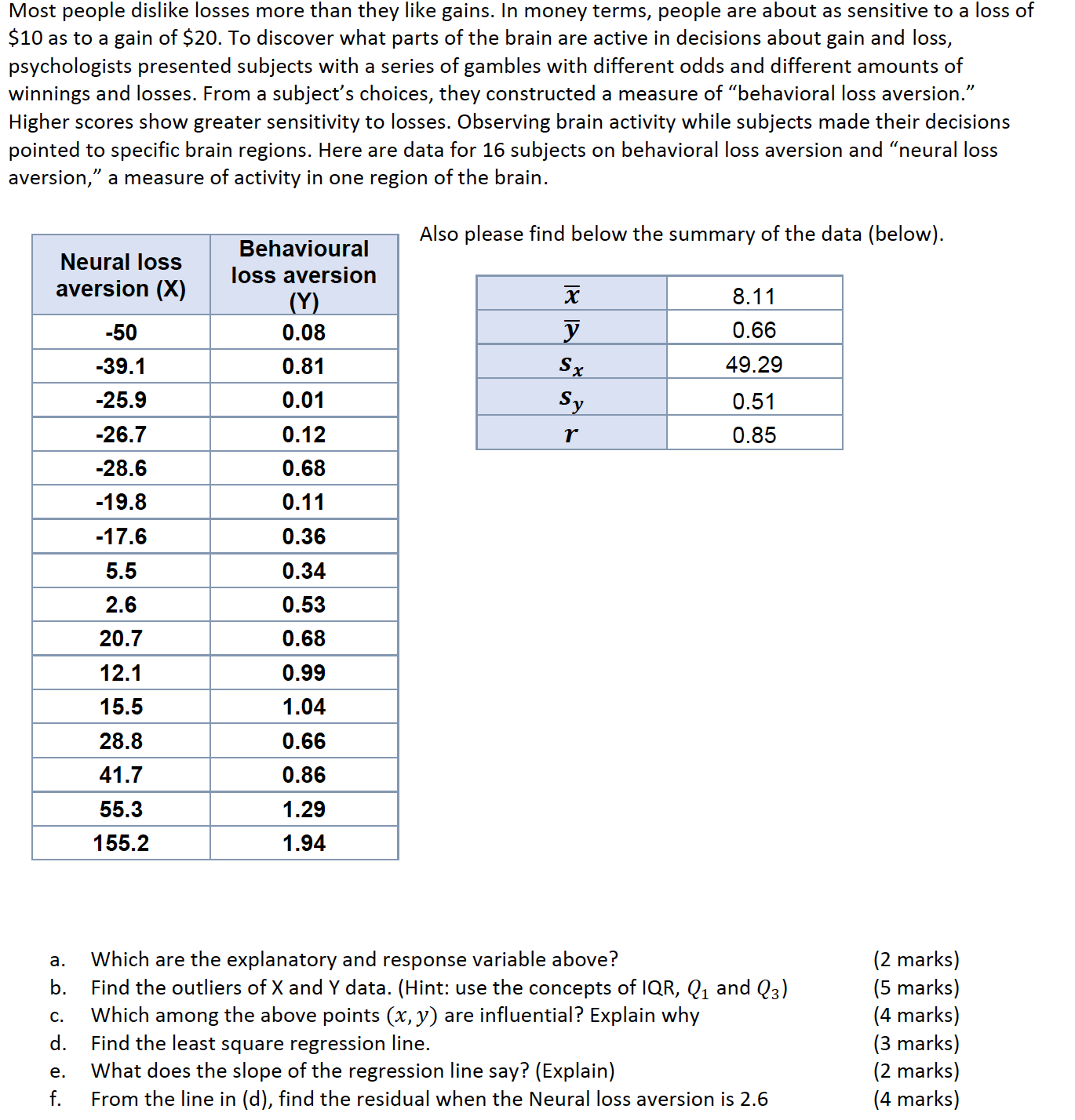
Most people dislike losses more than they like gains. In money terms, people are about as sensitive to a loss of $10 as to a gain of $20. To discover what parts of the brain are active in decisions about gain and loss, psychologists presented subjects with a series of gambles with different odds and different amounts of winnings and losses. From a subject's choices, they constructed a measure of "behavioral loss aversion." Higher scores show greater sensitivity to losses. Observing brain activity while subjects made their decisions pointed to specific brain regions. Here are data for 16 subjects on behavioral loss aversion and "neural loss aversion,\" a measure of activity in one region of the brain. . Also lease find below the summar of the data below . Behawoural p y l l loss aversion Neural loss aversion (X) a. Which are the explanatory and response variable above? (2 marks) b. Find the outliers of X and Y data. (Hint: use the concepts of IQR, Q1 and Q3) (5 marks) c. Which among the above points (x, y) are influential? Explain why (4 marks) d. Find the least square regression line. (3 marks) e. What does the slope of the regression line say? (Explain) (2 marks) f. From the line in (d), find the residual when the Neural loss aversion is 2.6 (4 marks)
Step by Step Solution
There are 3 Steps involved in it

Get step-by-step solutions from verified subject matter experts
 Study Help