







Question: Could you do C11 (iii) How come the standard error on the bs coefficient is smaller in part (ii) than in part (i)? (Hint: What
Could you do C11
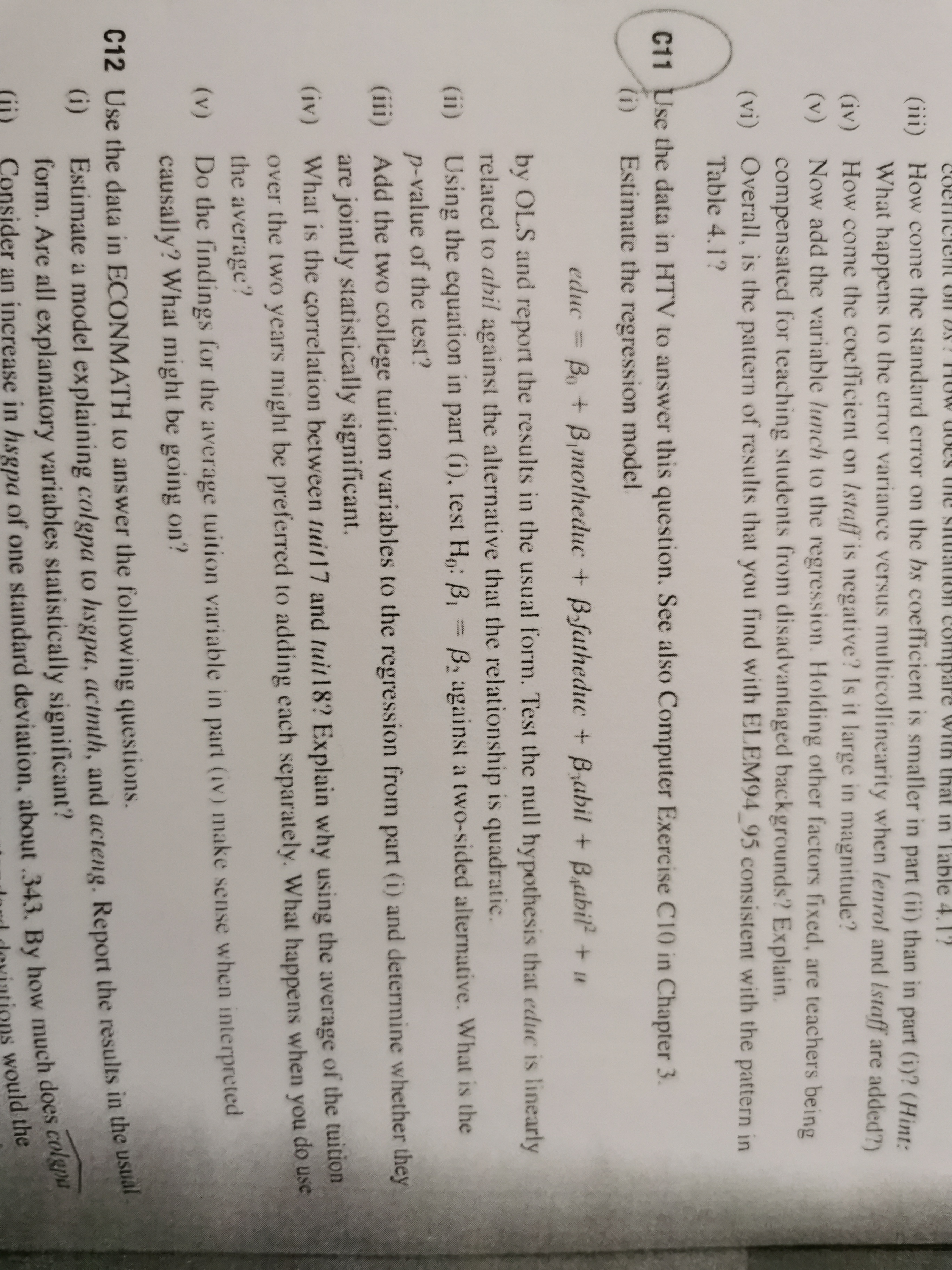
(iii) How come the standard error on the bs coefficient is smaller in part (ii) than in part (i)? (Hint: What happens to the error variance versus multicollinearity when lenrol and istaff are added?) (iv) How come the coefficient on Istaff is negative? Is it large in magnitude? ( v ) Now add the variable lunch to the regression. Holding other factors fixed, are teachers being compensated for teaching students from disadvantaged backgrounds? Explain. (vi) Overall, is the pattern of results that you find with ELEM94_95 consistent with the pattern in Table 4.1? C11 Use the data in HTV to answer this question. See also Computer Exercise C10 in Chapter 3. Estimate the regression model educ = Bo + B,mothedue + Bofatheduc + Byabil + Babil + a by OLS and report the results in the usual form. Test the null hypothesis that educ is linearly related to abil against the alternative that the relationship is quadratic. (ii) Using the equation in part (i). test Ho: 3, = B, against a two-sided alternative. What is the p-value of the test? (iii) Add the two college tuition variables to the regression from part (i) and determine whether they are jointly statistically significant. (iv) What is the correlation between mil17 and muir18? Explain why using the average of the tuition over the two years might be preferred to adding each separately. What happens when you do use the average? (v) Do the findings for the average tuition variable in part (iv ) make sense when interpreted causally? What might be going on? C12 Use the data in ECONMATH to answer the following questions. Estimate a model explaining colgpa to hagpa, actmth, and acteng. Report the results in the usual form. Are all explanatory variables statistically significant? Consider an increase in hagpa of one standard deviation, about .343. By how much does colapu ns would the
Step by Step Solution
There are 3 Steps involved in it

Get step-by-step solutions from verified subject matter experts
 Study Help