







Question: could you help giving me explanations on this problem ? Thank you Please use R/Rstudio. show your code Please conduct any hypothesis test if necessary.
could you help giving me explanations on this problem ? Thank you
Please use R/Rstudio. show your code
Please conduct any hypothesis test if necessary.
For part(c), generate three residuals plots which are "residuals vs fitted" , "residuals vs algorithms", "normal q-q plot"
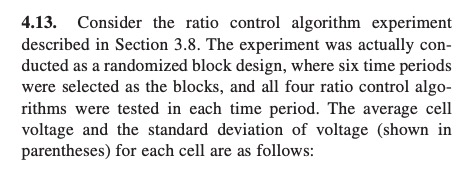
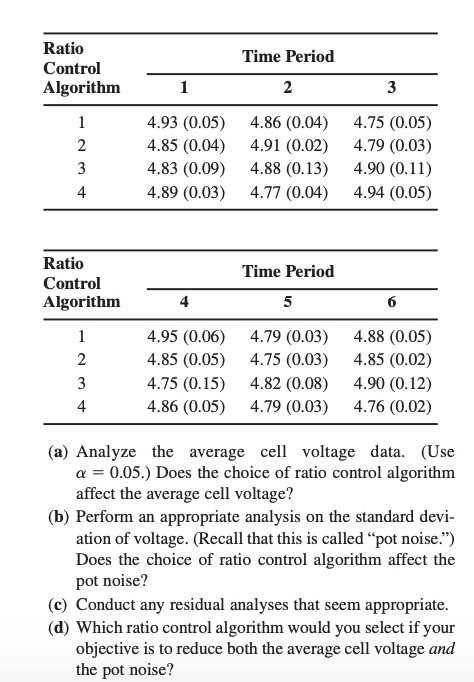
4.13. Consider the ratio control algorithm experiment described in Section 3.8. The experiment was actually con- ducted as a randomized block design, where six time periods were selected as the blocks, and all four ratio control algo- rithms were tested in each time period. The average cell voltage and the standard deviation of voltage (shown in parentheses) for each cell are as follows:Ratio Time Period Control Algorithm 2 4.93 (0.05) 4.86 (0.04) 4.75 (0.05) W N - 4.85 (0.04) 4.91 (0.02) 4.79 (0.03) 4.83 (0.09) 4.88 (0.13) 4.90 (0.11) 4 4.89 (0.03) 4.77 (0.04) 4.94 (0.05) Ratio Time Period Control Algorithm 4 5 6 4.95 (0.06) 4.79 (0.03) 4.88 (0.05) 4.85 (0.05) 4.75 (0.03) 4.85 (0.02) 4.75 (0.15) 4.82 (0.08) 4.90 (0.12) 4 4.86 (0.05) 4.79 (0.03) 4.76 (0.02) (a) Analyze the average cell voltage data. (Use a = 0.05.) Does the choice of ratio control algorithm affect the average cell voltage? (b) Perform an appropriate analysis on the standard devi- ation of voltage. (Recall that this is called "pot noise.") Does the choice of ratio control algorithm affect the pot noise? (c) Conduct any residual analyses that seem appropriate. (d) Which ratio control algorithm would you select if your objective is to reduce both the average cell voltage and the pot noise
Step by Step Solution
There are 3 Steps involved in it

Get step-by-step solutions from verified subject matter experts
 Study Help