







Question: Could you help me solve this question? This question explores the effects of an unemployment subsidy. Assume preferences are given by the following utility function,
Could you help me solve this question?
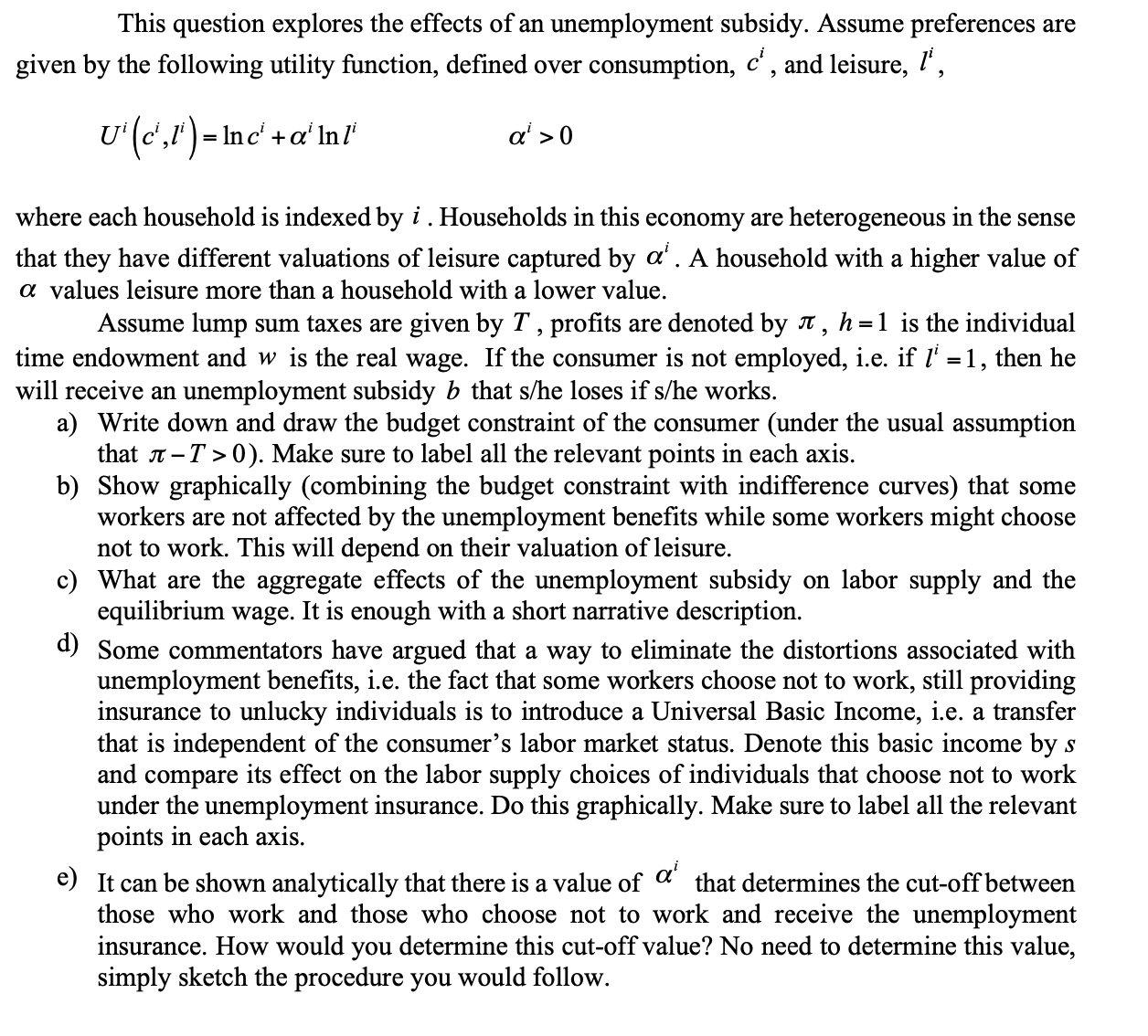
This question explores the effects of an unemployment subsidy. Assume preferences are given by the following utility function, dened over consumption, Ci , and leisure, 1" , Ui(c",li)=lnc"+a"lnl" (1'50 where each household is indexed by i . Households in this economy are heterogeneous in the sense that they have different valuations of leisure captured by Cl". A household with a higher value of a values leisure more than a household with a lower value. Assume lump sum taxes are given by T , prots are denoted by it , h = 1 is the individual time endowment and w is the real wage. If the consumer is not employed, i.e. if li =1, then he will receive an unemployment subsidy b that sfhe loses if s/he works. a) Write down and draw the budget constraint of the consumer (under the usual assumption that a: T > 0). Make sure to label all the relevant points in each axis. b) Show graphically (combining the budget constraint with indifference curves) that some workers are not affected by the unemployment benets while some workers might choose not to work. This will depend on their valuation of leisure. c) What are the aggregate effects of the unemployment subsidy on labor supply and the equilibrium wage. It is enough with a short narrative description. '1) Some commentators have argued that a way to eliminate the distortions associated with unemployment benets, i.e. the fact that some workers choose not to work, still providing insurance to unlucky individuals is to introduce a Universal Basic Income, i.e. a transfer that is independent of the consumer's labor market status. Denote this basic income by s and compare its effect on the labor supply choices of individuals that choose not to work under the unemployment insurance. Do this graphically. Make sure to label all the relevant points in each axis. e) It can be shown analytically that there is a value of at that determines the cut-off between those who work and those who choose not to work and receive the unemployment insurance. How would you determine this cut-off value? No need to determine this value, simply sketch the procedure you would follow
Step by Step Solution
There are 3 Steps involved in it

Get step-by-step solutions from verified subject matter experts
 Study Help