







Question: Could you please answer only even numbers . Thank you Chapter 17 or 30 Market Failure: Pre- Class & Name/I.D. Number: Section: Date: Part 2.
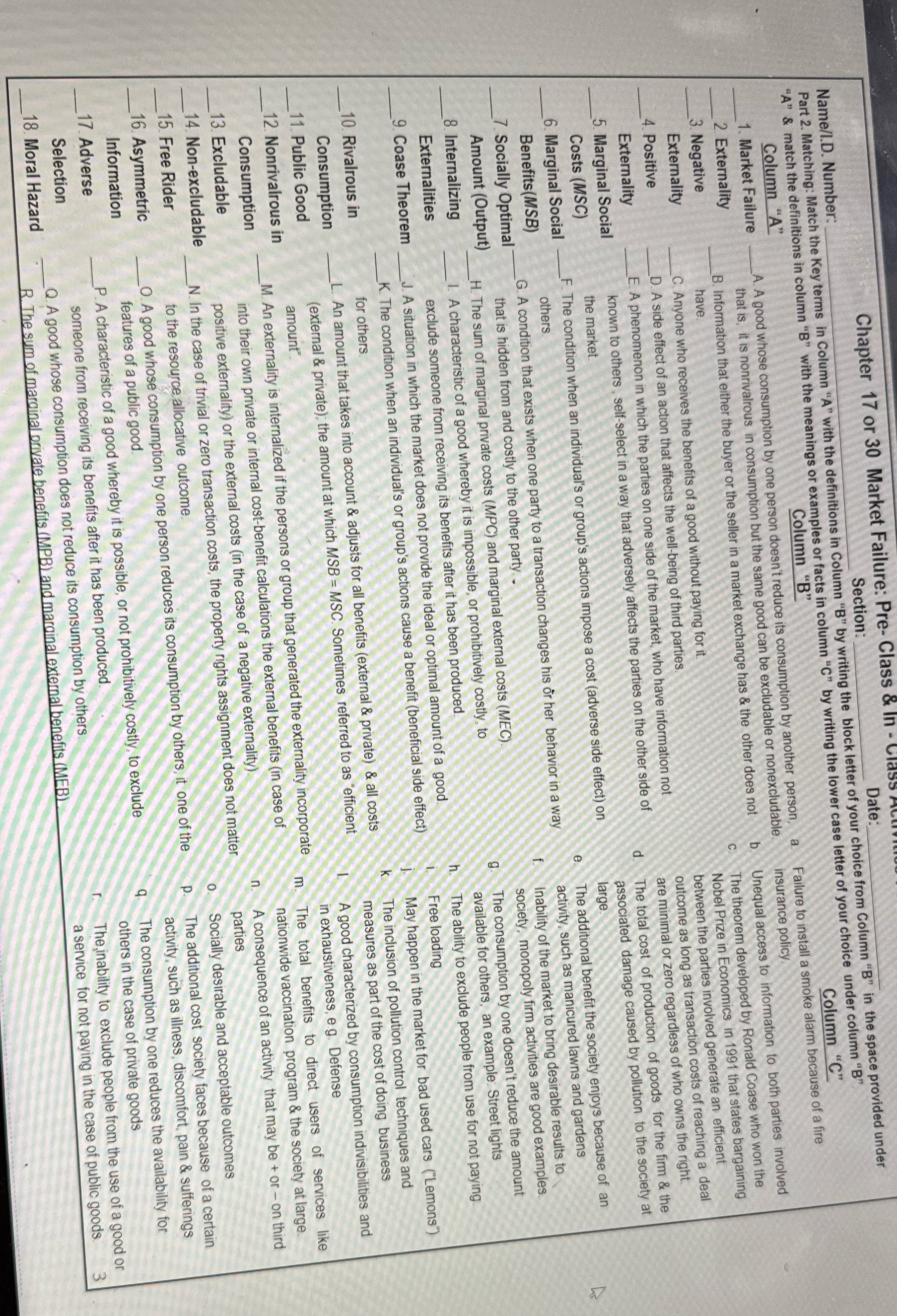
Could you please answer only even numbers . Thank you
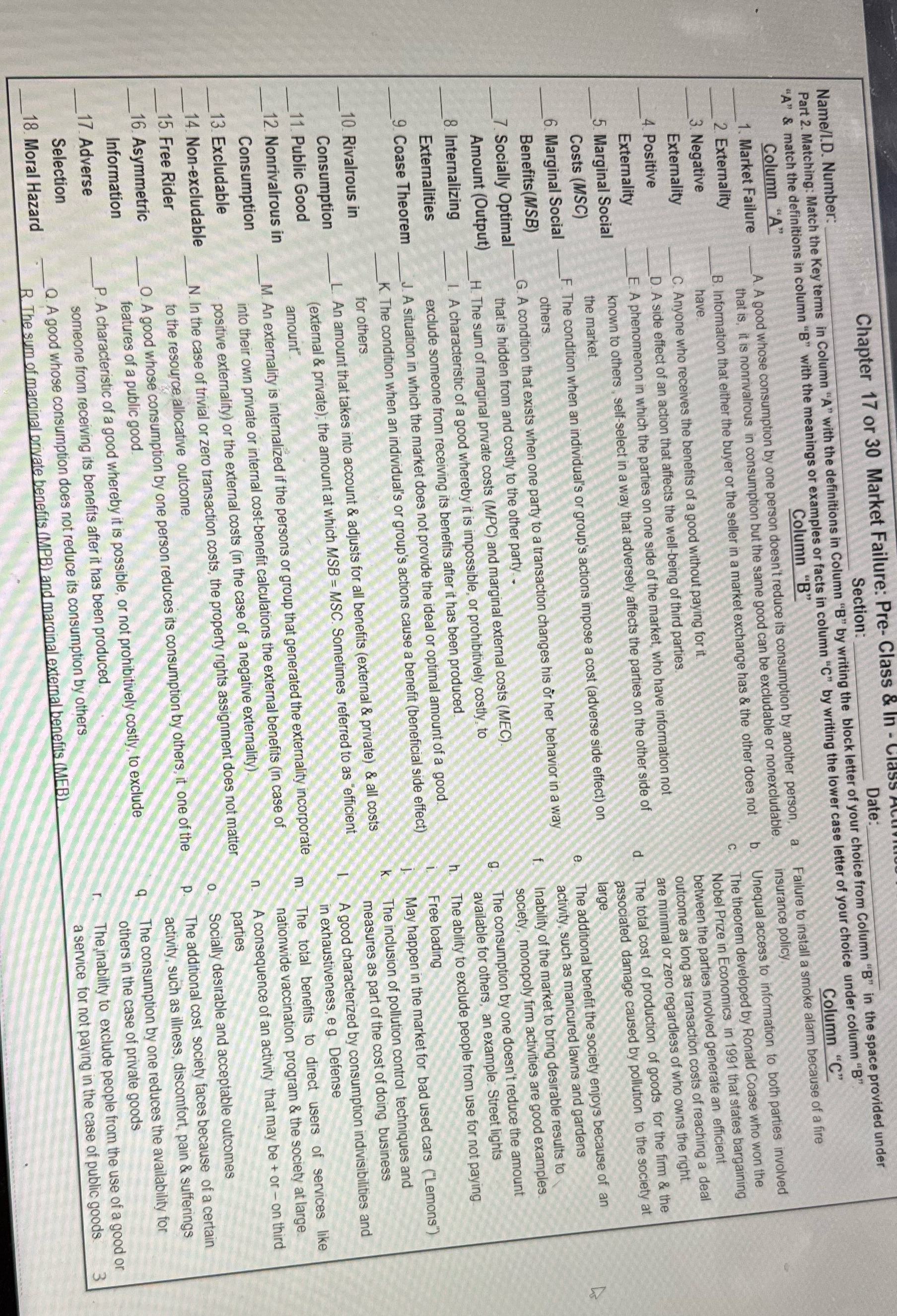
Chapter 17 or 30 Market Failure: Pre- Class & Name/I.D. Number: Section: Date: Part 2. Matching: Match the Key terms in Column "A" with the definitions in Column "B" by writing the block letter of your choice from Column "B" in the space provided under "A" & match the definitions in column "B" with the meanings or examples or facts in column "C" by writing the lower case letter of your choice under column "B" Column "A" Column "B" Column "C" 1. Market Failure A. A good whose consumption by one person doesn't reduce its consumption by another person, a. Failure to install a smoke alarm because of a fire 2. Externality that is, it is nonrivalrous in consumption but the same good can be excludable or nonexcludable. insurance policy. B. Information that either the buyer or the seller in a market exchange has & the other does not Unequal access to information to both parties involved 3. Negative have. The theorem developed by Ronald Coase who won the Externality C. Anyone who receives the benefits of a good without paying for it. Nobel Prize in Economics in 1991 that states bargaining 4 Positive D. A side effect of an action that affects the well-being of third parties. between the parties involved generate an efficient Externality E. A phenomenon in which the parties on one side of the market, who have information not outcome as long as transaction costs of reaching a deal are minimal or zero regardless of who owns the right 5. Marginal Social known to others , self-select in a way that adversely affects the parties on the other side of The total cost of production of goods for the firm & the Costs (MSC) the market. associated damage caused by pollution to the society at 6. Marginal Social F. The condition when an individual's or group's actions impose a cost (adverse side effect) on large Benefits (MSB) others. The additional benefit the society enjoys because of an 4 G. A condition that exists when one party to a transaction changes his or her behavior in a way activity, such as manicured lawns and gardens 7. Socially Optimal that is hidden from and costly to the other party. - Inability of the market to bring desirable results to Amount (Output) H. The sum of marginal private costs (MPC) and marginal external costs (MEC) society, monopoly firm activities are good examples. 8. Internalizing 1. A characteristic of a good whereby it is impossible, or prohibitively costly, to The consumption by one doesn't reduce the amount Externalities exclude someone from receiving its benefits after it has been produced. available for others, an example Street lights 9. Coase Theorem J. A situation in which the market does not provide the ideal or optimal amount of a good. The ability to exclude people from use for not paying K. The condition when an individual's or group's actions cause a benefit (beneficial side effect) Free loading May happen in the market for bad used cars ("Lemons") 10. Rivalrous in for others . The inclusion of pollution control techniques and Consumption L. An amount that takes into account & adjusts for all benefits (external & private) & all costs measures as part of the cost of doing business 11. Public Good (external & private), the amount at which MSB = MSC. Sometimes referred to as "efficient A good characterized by consumption indivisibilityes and 12. Nonrivalrous in amount". in exhaustiveness, e g. Defense _M. An externality is internalized if the persons or group that generated the externality incorporate Consumption m. The total benefits to direct users of services like into their own private or internal cost-benefit calculations the external benefits (in case of nationwide vaccination program & the society at large 13. Excludable positive externality) or the external costs (in the case of a negative externality). A consequence of an activity that may be + or - on third 14. Non-excludable N. In the case of trivial or zero transaction costs, the property rights assignment does not matter parties 15. Free Rider to the resource allocation outcome. Socially desirable and acceptable outcomes 16. Asymmetric O. A good whose consumption by one person reduces its consumption by others, it one of the The additional cost society faces because of a certain Information features of a public good. activity, such as illness, discomfort, pain & sufferings 17. Adverse P. A characteristic of a good whereby it is possible, or not prohibitively costly, to exclude The consumption by one reduces the availability for Selection someone from receiving its benefits after it has been produced. others in the case of private goods The inability to exclude people from the use of a good or 18. Moral Hazard Q. A good whose consumption does not reduce its consumption by others R. The sum of marginal private benefits (MPB) and marginal external benefits (MEB) a service for not paying in the case of public goods
Step by Step Solution
There are 3 Steps involved in it

Get step-by-step solutions from verified subject matter experts
 Study Help